
Our reading is from Matthew 18:21-35. This entire chapter is about life in the kingdom of God. One of the characteristics of kingdom life is forgiveness. Peter understood that point when he asked Jesus the question: how many times shall I forgive my brother when he sins against me? Jesus never had a chance to answer the question, because Peter answers it himself – up to seven times? Peter is obviously trying to impress Jesus, because Rabbinic teaching required a person to forgive up to three times. Peter had doubled that requirement and added one for good measure. He must have been waiting for Jesus’s approval, but it never comes. Jesus says seven times is not enough; we are supposed to forgive up to seventy-seven times. Jesus is not asking us to keep track of our forgiving acts, Jesus is asking us to make forgiving a constant characteristic in our lives. To underscore that point, Jesus tells them this parable.
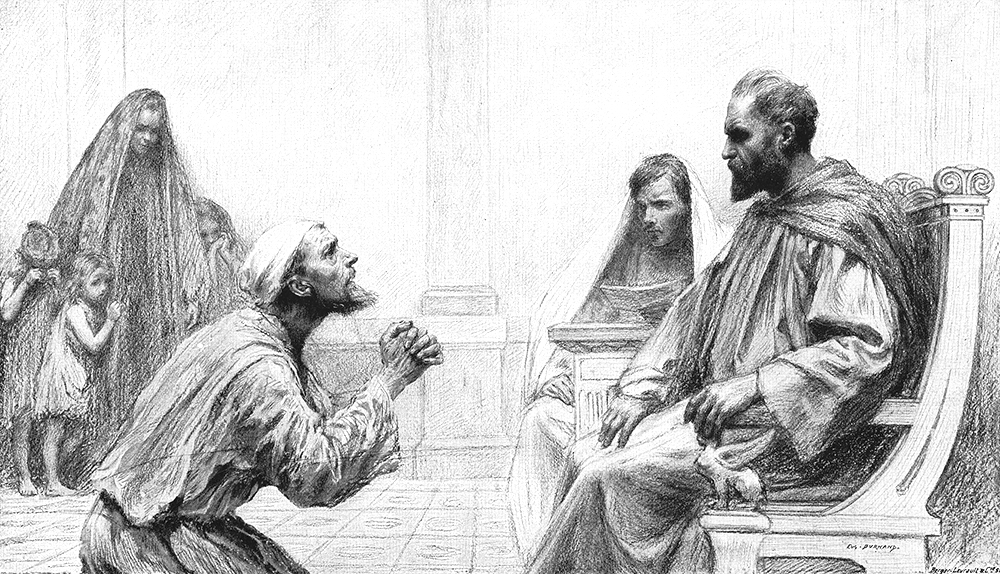
The story is really a one-act play with three scenes. In the first scene, a king wanted to settle his accounts with his servants. One of the servants is brought before the king. It is not a good day for him because he owes the king 10,000 talents. That is a significant sum. At that time, you could buy a servant for one talent. The entire tax base to this area was only 800 talents. This man owes the king 10,000 talents. To make it easy on us, let’s just say the man owed the king ten million dollars. Unable to pay the king back, the king considers selling the man’s wife and children. The servant begs the king not to sell his family and begs the king for more time. The king has mercy on the servant and cancels his entire debt. In the second scene, the shoe is on the other foot. The debt-free servant exits and goes after another servant who owes him money. The amount is very small, only a hundred denarii. If he owed the king ten million dollars, then this man owed him only $20. The second servant begs for more time, but no extension is given. He is beaten and thrown into prison. In the third scene, our story goes full circle. The king is told what happened and he summons the first servant. Because he did not show mercy, then he will not be shown mercy. He is turned over to the jailors to be tortured, until his debt is repaid. Jesus wanted to make sure they didn’t miss the point. He clears up any confusion in verse thirty-five: “This is how my heavenly father will treat each of you unless you forgive your brother from your heart.” Everyone knows the point that Jesus was trying to make. We know we are supposed to forgive. The problem is, we are not good at forgiving, especially within the life of the church. Historically, we are hard on ourselves. In my forty years in the ministry, every church I served struggled with forgiveness. How many examples do you need?
The first funeral I officiated at was for a man by the name of Randolph Scott. He lived in Lancaster, Kentucky. I was in his home several months before his sudden death. I sat in the living room with his wife, but he never came out to see me. He was watching a Cincinnati Reds baseball game. She apologized for her husband’s rudeness and explained he was mad at the whole church. To be more exact, he was mad at a single church member. He said, the man cheated him out of $50 in some business transaction. He said, if that man represented the kind of people in my church, then he didn’t want to have anything to do with my church. He said, he would never forgive the man or the church. Randolph was a man of his word. He never did forgive the man or the church. However, the church prepared a bereavement lunch after his funeral. Randolph Scott knew he was supposed to forgive. The problem was, he refused to forgive. That happened in my first church.
When I arrived at my last church, I found people who refused to forgive. One afternoon, I went to the hospital to visit a parishioner. She was a woman in her late eighties, who took great pride in her years of church service. As I sat next to her bed, she told me how she had saved the church several times with her church dinners. Others told me, she was a good cook, but she had no people skills. She offended many kitchen helpers during her reign. Foolishly, instead of talking to the woman about her behavior, the women’s organization decided to write her a letter to tell her she had been relieved of duty. She was no longer welcome in the kitchen. Obviously, her feelings got hurt, and she swore she would never forgive that group. She was a woman of her word. She never did forgive them. On the day I visited her, she quoted that twenty-year-old letter word for word, and she recited the names of all the people who had signed that letter. And in colorful, ugly language she told me, they could all go to hell. She had spent decades in the church but didn’t hear a single word. She knew she was supposed to forgive, she refused to forgive. Within the life of the church, we know we are supposed to forgive, but we refuse to forgive. No organization is better at self-inflicted wounds than the church. Satan loves our unforgiving spirits. Our unforgiving spirit damages the church we claim to love. This question haunts me:
Why do people refuse to forgive? Josh Emery is a counselor in Fort Collins, Colorado. He says his appointment calendar is filled with people who refuse to forgive. Every story is different, yet every story is the same. He says people don’t forgive for three basic reasons. This is his list:
- People don’t forgive because they don’t want to look like they condone the bad behavior.
- People don’t forgive because the person doesn’t deserve it.
- People don’t forgive because the person can’t be trusted.
I don’t have a problem with that list. I agree with each point. I am no different from you. I struggle with forgiveness too. I have good reasons not to forgive. The problem is, through the eyes of God, there is no good reason for not forgiving. God knows what we would like to ignore. When we refuse to forgive, we damage the relationship. The relationship between you and the unforgiven person stops evolving. That is true. For Randolph Scott, the relationship stopped evolving on the day he believed he was cheated out of $50. For the woman in the hospital bed, the relationship stopped evolving on the day she got the letter. What relationships in your life have stopped evolving? That is not a good thing. God expects us to forgive, because God expects our relationships to evolve. God expects our relationships to be strong. Within the life of the church, we know we are supposed to forgive, but we refuse to forgive. That is why stories of true forgiveness baffle us.
In the fall of 2006, Charles Carl Roberts IV (1974-2006) did the unthinkable when he held a one-room Amish school full of children hostage in Bart Township, Pennsylvania. After a few terrifying hours, Roberts bound, then shot 10 girls, killing 5 of them before turning the gun on himself. What do you think was the response of the parents of those children and the entire Amish community? Within hours, the Amish families immediately began extending their forgiveness to the gunman’s family. They visited his wife and parents to offer them comfort—they even attended the killer’s funeral. A grandfather of one of the murdered girls cautioned the family not to hate the killer and said, “we must not think evil of this man.” While another father said, “He had a mother and a wife and a soul. And now he’s standing before a just God. Christ calls us to forgive him.” If you were in that community and lost a loved one, could you forgive Charles Carl Roberts IV? In the kingdom of God we forgive, in the world we don’t. Obviously, true forgiveness is not easy.
Corrie ten Boom (1892-1983) was a Dutch watchmaker and Christian, who along with her father and other family members, helped many Jews escape the Nazi Holocaust during World War II. She, herself, suffered in a concentration camp. In her book, The Hiding Place, she recounts those dark days. After the war, she traveled extensively, speaking of God’s grace and forgiveness during those horrible years.
One night, in Munich after one of her speeches, a man came up to her. He looked familiar and it took a moment for her to recognize him. He had been a guard at her concentration camp, Ravensbruck. He had treated her and her sister cruelly. A mountain of emotional memories hit her. In her eyes, he was Satan incarnate. However, after the war, he became a Christian, but that didn’t change her feelings about him. It was hard for her to stand there, but then it got worse. He extended his hand to her and said, “I am grateful for your message. As you said yourself, ‘He washed my sins away.’” Corrie ten Boon would be the first one to admit it. It is one thing to speak about forgiveness, it is something quite different to forgive. She didn’t want to shake his hand because she didn’t want to forgive him, so she prayed God’s help. God did help her, and she did shake his hand. But what is more important, God helped her forgive him. Can I ask you a question?
If there anyone you need to forgive? I am assuming there is, because everyone has been hurt in some way. You know the truth – life is hard and sometimes life can be cruel. Who do you need to forgive? Within the Christian faith, forgiveness is not optional, it is a requirement. You are a disciple of Jesus Christ, and you are supposed to be practicing today what you will be doing for eternity. How can we expect to be forgiven, if we can’t forgive?
Indian activist, Mahatma Gandhi (1869-1948) was not a Christian, but he understood the power of forgiveness. He once said, “The weak can never forgive. Forgiveness is the attribute of the strong.” How strong are you?
 Russ Adams