John Quincy Adams (1767-1848) is one of the great names in American history. He served our country in many capacities. He was an ambassador to Russia, Prussia, and the Netherlands. He served as both a Congressman and Senator from Massachusetts. He was our nation’s Secretary of State under President James Monroe (1758-1831) and later served as our sixth President from 1825 to 1829. Adams lived an extraordinary life, yet his accomplishments did not spare him from personal hardships. In 1846, fifteen years after leaving the White House, he suffered a stroke. When he returned to Congress the following year, his health was clearly failing. Adams described his condition this way: “I inhabit a weak, frail, decayed tenement, battered by the winds and broken in upon by the storms; and from all I can learn, the landlord does not intend to repair.” He died a year later, in 1848.
I find that story especially sad because John Quincy Adams died without hope. As a self-proclaimed Unitarian, he rejected the divinity of Jesus and the belief in eternal life. Some Unitarians view Jesus as a great moral teacher or prophet, while others reject His authority altogether. Without Jesus, there is no hope; as Christians, we believe that Jesus is our only hope. In Paul’s opening words to I Timothy 1:1, he introduces himself by saying, “Paul, an apostle of Christ Jesus by the command of God our Savior and of Christ Jesus our hope.” That declaration reminds us that our hope is not found in our accomplishments. Our hope is found in Jesus Christ alone. With that truth in mind, let us turn to our reading from Matthew 14:22-33.
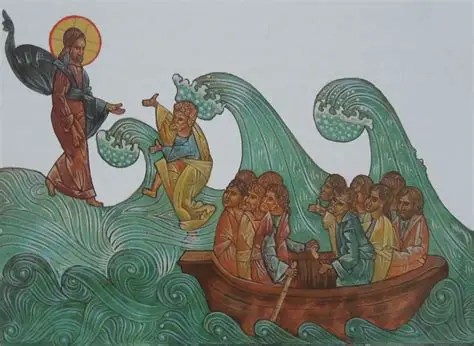
The scene is the Sea of Galilee. Only four and a half miles wide and seven miles long, it is more of a lake than a sea. However, it is notorious for its sudden and violent storms because of its shallow waters. In our story, that is exactly what the disciples experienced. They were crossing the Sea of Galilee when a storm arose between three and four o’clock in the morning. Fearful and distressed, the disciples cried out for help because they found themselves in a hopeless situation. Then, in a miraculous display of divine power, Jesus appeared, walking on the water. The mood of the story changed immediately when Jesus arrived. What had seemed hopeless was no longer hopeless.
It is a great story because it is the story of our lives. Like the disciples, we too are on a journey. We call that journey life. As we travel, we encounter many storms. Some storms come in the form of physical or mental illness. Others take the form of anxiety and depression. Still others involve broken relationships, grief, and addiction. In each of these situations, hope is essential. That is why Jesus must be a part of our lives. He gives us hope when the storms of life threaten to overwhelm us. No matter how dark the night may seem, Christ is present with us. Desmond Tutu (1931-2021), the South African Anglican bishop and theologian, once said, “Hope is being able to see that there is light despite all of the darkness.” For Christians, that light is Jesus Christ. He is our hope in every storm.
During my years in ministry, I made hospital visitation a priority. Every afternoon, I would drive to the various hospitals in my area to visit parishioners. Except for childbirth, most of those visits revolved around some kind of hardship. Some people were facing surgery, while others were recovering from it. Some were dealing with heart problems. Others were undergoing tests to determine the cause of an illness.
I never minded hospital visits because they gave me an opportunity to be with my people when they needed their pastor the most. At the close of each visit, I would pray with the patient. In those precious moments, I sought to lift their eyes away from the storm they were facing and direct them to the love and presence of Jesus Christ. Their illness did not have the final word. Four years into retirement, I confess that I miss making hospital visits and I do not understand pastors who choose not to visit their people in the hospital.
Psychologists tell us that hope benefits us in three ways. First, there are mental and emotional benefits. Hope reduces stress and anxiety, builds resilience, provides a sense of purpose, and improves focus. Second, there are physical benefits. Hope can strengthen the immune system and encourage healthier habits. Third, there are practical and social benefits. Hope drives problem-solving, strengthens relationships, and helps sustain a sense of meaning. Let me add a fourth benefit. The hope we have in Jesus Christ allows us to enjoy today because we do not fear death. As Christians, we know that someday we will leave behind the problems, pain, and disappointments of this world and enter the perfection of heaven. Let me close with this story.
The story comes from Parade magazine in 1981. Self-made millionaire Eugene Lang (1919-2017) arranged to visit a sixth-grade class in East Harlem. He wanted to inspire those students to make something positive of their lives. He did not want them to become another statistic or school dropout. As he stood before the class, Lang decided to set aside his prepared remarks and speak from the heart. “Stay in school,” he urged them, “and I’ll help pay your college tuition.” At that moment, the lives of those fifty-nine students changed. For the first time, they had hope. One student later recalled, “I had something to look forward to, something waiting for me. It was a golden feeling.” Six years later, 90 percent of those sixth graders graduated from high school. With a single promise, Lang gave those students something they desperately needed: hope. The millionaire changed their lives with one word: hope!
In a recent Gallup poll, it was reported that 59.2 percent of Americans are hopeful about their personal futures. How hopeful are you? In our reading, the disciples had no hope until Jesus entered their situation. As Christians, our hope is more than wishful thinking or positive thinking. Our hope is a person, Jesus Christ.