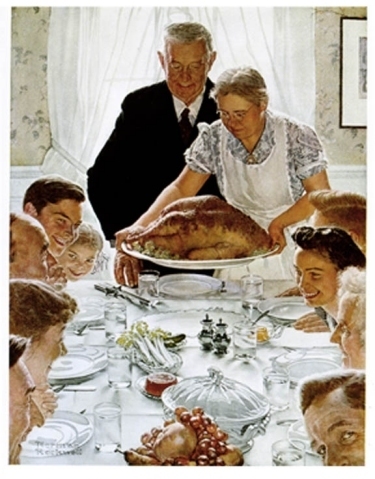

Americans have been celebrating Thanksgiving for a long time. The first recorded thanksgiving in America took place in Jamestown, Virginia in 1610. That winter had been harsh and many died. The population of the colony shrank from 409 to 60. The survivors prayed for help, not knowing when or how it would come. Miraculously, a ship from England arrived carrying food and supplies. A prayer meeting was organized to give thanks to God.
The Thanksgiving we remember happened in 1621. Seeking religious freedom, the Pilgrims left Southampton, England in 1620. There were problems from the very beginning. Originally there were two ships, but one of the ships, the Speedwell, was ruled not seaworthy. Some of the Speedway’s passengers boarded the second ship, the Mayflower. The extra weight made the estimated 66-day to North America longer. They had navigation problems as well. They wanted to go to Virginia, but they arrived in New England in November, so the weather was growing harsh. There was no time to build permanent shelters, so they survived that first winter in crude temporary housing. In time, the death toll began to rise. Only 51 of the original 102 survived. When spring came, they were forced to make a painful choice. Would they stay in America or return to England on the Mayflower, which was a rented ship? They decided to stay and their future began to brighten. With the help of the Wampanoag Indian Tribe, they planted 30 acres of wheat and built permanent shelters. By the fall of 1621 their homes were completed and their crops were harvested. They decided to observe a day of thanksgiving to thank God for his blessings. America’s journey with Thanksgiving does not end there.
President George Washington (1732-1799) declared a Thanksgiving Day on November 26, 1789, because the U. S. Constitution had been adopted and the new federal government had been established. President Abraham Lincoln (1809-1865) proclaimed November 26, 1863 “a day of thanksgiving and praise to our beneficent Father.” Each year afterward, for 75 years, the President formally proclaimed that Thanksgiving Day should be celebrated on the last Thursday of November. In 1939, President Franklin Roosevelt (1882-1945) set it one week earlier to help the struggling economy. In 1941, Congress declared the fourth Thursday of November a national holiday, Thanksgiving! How are you going to celebrate Thanksgiving this year?
During my lifetime, I have seen Thanksgiving became America’s shrinking holiday. In my youth, my family attended an ecumenical service on Thanksgiving morning. I have fond memories of those services, but that tradition faded away years ago. When I went into the ministry the annual Thanksgiving service was a staple. However, over the years attendance got smaller and in time it was discontinued. I found it hard to let it go. It is not just true of church; it is true in our society. Sandwiched between Halloween and Christmas, Thanksgiving is slowly disappearing. Consider these four reasons why.
First, Thanksgiving is overshadowed by the longer retail runway of Christmas. Retailers and advertisers understand that we live in an entitled and consumer driven culture, so they skip over Thanksgiving because it doesn’t center on gift-giving. Christmas advertising begins in early October. It has been said, on Thanksgiving we thank God for what we have and the next day we go out and buy more.
Second, our society is becoming more secular. Historically, Thanksgiving was a day of prayer and gratitude. Today, Thanksgiving is a day associated with food, parades and football. Public and personal expressions of gratitude have waned over the years. Thanksgiving Eve is one of the biggest drinking days of the year.
Third, Thanksgiving is becoming expensive. Rising costs of groceries, travel, and hosting the holiday feast have forced many families to scale back their celebration. According to the American Farm Bureau Federation, the cost of feeding ten for Thanksgiving this year is $137.93. In 1976, it cost $15.93.
Fourth, history is being reexamined. For many indigenous communities, Thanksgiving carries painful associations with colonization, historical erasure, and the whitewashing of Native American displacement. Parts of American history are painful to study, including the treatment of Native Americans. We are to learn from history, not worship it. Some Native Americans call Thanksgiving “The National Day of Mourning.”
I understand each one of those points, but Thanksgiving is still important. As Christians, it is important that we take an inventory of our blessings and express our gratitude to God. American pastor and writer Charles Stanley (1932-2023) once said, “Gratitude produces deep, abiding joy because we know that God is with us.” If the parade, the dog show, the football games, and the feast were all canceled, I would still celebrate Thanksgiving. Thanksgiving is not a meal; it is an attitude. What are you thankful for this year? That takes us to our reading, Luke 17:11-19, the traditional Gospel reading for Thanksgiving.
According to the story, Jesus is traveling on the border between Samaria and Galilee. As he travels, he encounters various people, including ten lepers. Leprosy is a highly contagious skin disease. In our time, it is treatable. In Jesus’s time, it was not. At that time, victims of leprosy were forced to live in isolation, away from family and friends, in leper colonies. They had no hope of being healed. Then, they hear Jesus is coming and suddenly they are hopeful. They run toward Jesus. Mandated by law to keep their distance, they yell at Jesus as he passes. Jesus hears their desperate cries and heals them. Jesus instructs them to go to a priest for inspection. The priests had the authority to grant them permission to re-enter society. On that day ten men were healed, but only one of the ten returned to thank Jesus. The other nine just resumed their lives.
The story of the ten lepers is a story about ingratitude, so it is also a story of our time. Many will not take an inventory of their blessings and not thank God. I will not be one of them. I am aware that God has been good to me, and I am humbled by his goodness. I hope that is your story too. Never underestimate the power of gratitude. How many truly grateful people do you know? First Chronicles 16:34 speaks for me, “Give thanks unto the Lord; for he is good; his love endures forever.”


Thank you Russ for another awakening as to how lucky are we to have what we do and not expecting more without giving!!
LikeLike