
Viktor Frankl (1905–1997) was an Austrian psychologist who spent four years in Nazi concentration camps. During that time, he observed something that reshaped his work: the people who survived were not always the physically strongest, but those who held on to a reason to live. That insight led him to ask, “What is the greatest motivating force in life?”
Frankl reflected on the leading theories of his day. Sigmund Freud (1856–1939) believed pleasure was life’s greatest motivator, but there was no pleasure in the camp. Alfred Adler (1870–1937) believed power was life’s greatest motivator, but the Jews had no power there. Frankl developed a different theory: the greatest motivating force in a person’s life is hope. Those who survived never lost hope. Despite the hardships around them, they believed their suffering would one day end and that they would again live meaningful, purposeful lives. Never underestimate the power of hope. That takes us to our scripture reading, Matthew 14:22-33.
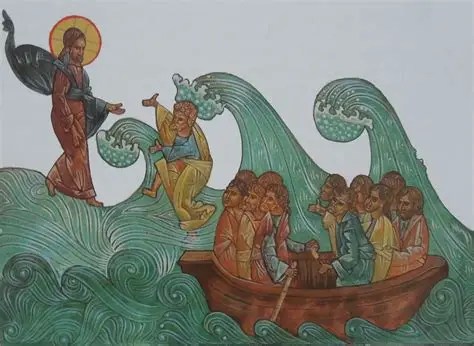
Jesus has just fed 5,000 men, plus women and children, with five loaves and two fish. Physically and spiritually spent, he longs to be alone. Before going up the mountainside to pray, he sends the crowd away and tells the disciples to sail to the other side of the Sea of Galilee. According to Mark’s version of the story, the disciples head to Bethsaida. While Jesus and the disciples are separated, a storm strikes. Things look bad when the disciples cannot row against the storm, but Jesus saves them. Breaking natural law, he walks on the water and calms the storm. That quick overview leads us to the first of three questions.
Where are the storms in your life? There are all kinds of storms. Maybe your storm is financial. Life is expensive. Maybe your storm is employment-related. There is more to life than paying bills. Maybe your storm is medical. You spend your time visiting various healthcare professionals. Maybe your storm is relational. You are concerned about your aging parents living alone in an old neighborhood that is no longer safe. Or maybe you are concerned about the youngest generation in your life because the world they are inheriting is complex. Maybe your storm is spiritual. You are afraid to die. Maybe you are facing more than one storm. Everyone faces storms. Where are the storms in your life? That leads us to question number two.
Are you ready to experience God in unexpected ways? In our story, the disciples are in a boat in the middle of a storm. They see what they believe is a ghost coming toward them and are afraid. In their culture, seeing a ghost meant someone was going to die. They think they are going to die. But then they experience Jesus in an unexpected way: he is walking on the water. They had just seen Jesus feed 5,000 men with only five loaves and two fish, but they are still amazed. They never expected him to come to them that way.
Sometimes Jesus comes to us in surprising ways. During the Korean War, a soldier became separated from his unit and was trapped behind enemy lines. With little chance of escape, he hid in a cave and prayed for God to help him. When he lifted his head, he saw a spider busily building a web over the cave’s opening. Moments later, he heard Korean soldiers approaching. Since he did not speak Korean, he understood only two words: spider web. As the enemy soldiers walked away, he realized why they had passed him by. Because the mouth of the cave was covered with a spider web, they assumed no one was inside. Sometimes God comes to us in surprising ways.
Sometimes God comes to us in the routine of daily life. I have been retired for four years, and people often ask what I miss about ministry. I do not miss preaching regularly. I do not miss the stress of Advent or Lent. I do not miss the weekly administrative meetings. I do not miss the complaints from well-meaning people. I do not miss attending every church function. I do not miss being accountable to all my parishioners. What I miss is praying with people during the most sacred moments of their lives: before surgery, at the birth of a child, and at the death of a loved one. I went into ministry to help people, but as a pastor, I was pulled in many directions. The larger my church grew, the less time I had with individuals. I took those moments for granted and forgot that God comes to us in the routine of daily life. That leads us to question three.
Are you ready to be a sign of hope for the hopeless? In our story, the disciples believe they are going to die. They have no hope, and then Jesus suddenly appears. Verse 27 says that once they recognize Jesus, they are no longer afraid. Peter, one of the twelve, is so inspired by Jesus’ presence that he attempts to walk on the water. Are you ready to be like Jesus? Are you ready to be a sign of hope to those who are hopeless?
American clergyman James P. Wind (1941–2011) once visited the Museum of Contemporary Art in Chicago, where he came across a piece titled “America’s Joyous Future.” As contemporary artists often do, Erika Rothenberg (born 1950) had taken something from everyday life, a small church bulletin board, and turned it into a provocative work of art. In a style familiar to clergy across the country, she spelled out life at one local congregation in simple white letters against a stark black background. This is what it said. EVENINGS AT 7 IN THE PARISH HALL. Mon. Alcoholics Anonymous. Tues. Abused Spouses. Wed. Eating Disorders. Thurs. Say No To Drugs. Fri. Teen Suicide Watch. Sat. Soup Kitchen. Sunday Sermon 9 a.m. “America’s Joyous Future.” Wind admitted later that the piece haunted him. Did visitors to that art museum see it as an indictment of churches and synagogues that preach pie in the sky in their worship services while remaining oblivious to real human hurt and need? Or did they see it as a sign that our congregations are deeply immersed in human suffering?
American poet Emily Dickinson (1830–1886) famously described hope as a “thing with feathers.” We tend to imagine hope as something winged, flying serenely above the storms and untouched by ordinary life. But the value of hope lies in its presence in our everyday lives. Hope walks beside us. Are you ready to walk alongside people who are hopeless? Are you willing to be a sign of hope? Or are you another example of indifference?
 Russ Adams