
American entertainer Kathie Lee Gifford (born 1953) was raised in a family where God was honored generally, but He was not known personally. Her father was Jewish, and her mother was a Christian. When she was twelve years-old, her mother and her sister were led to Christ by a televised Billy Graham evangelistic crusade. Several months later, they encouraged her to go see a movie produced by the Billy Graham organization, The Restless Ones. Kathy Lee decided to go.
In many ways, it was her story – a young girl trying to decide what path to take: the ways of this world, or the ways of God. She related to the girl in the movie, and she began to evaluate her own life. When the movie ended, an altar call was given, and young Kathie Lee went forward to accept Christ as her Lord and Savior. Her life would never be the same again. Ask Kathy Lee Gifford and she will tell you; we are saved by grace and by grace alone!
Charles Spurgeon (1834-1892) was an English Baptist preacher. He has been called the Prince of Preachers. He once said, “Saving faith is an immediate relation to Christ, accepting, receiving, resting upon Him alone, for justification, sanctification and eternal life by virtue of God’s grace.” That is an old quote. Charles Spurgeon died in 1892. That quote may be old, but it still rings true today. Someday, we will stand before God justified because of the redemptive work of Jesus Christ. Never forget it – we are saved by grace and by grace alone! That takes us to our scripture reading.
We are in the eighteenth chapter of Luke, verses nine through fourteen. It is the parable of the publican and the Pharisee. The story is dominated by two men. They are not identified by name, only by vocation. The first was a Pharisee. We are critical of the Pharisees because they confronted Jesus. The Master’s own generation was not critical of Pharisees. They were viewed as the religious elite, who were the bridge between mankind and God. The second man was a Publican. That was the term used in ancient Roman times for a tax collector. In our time, we dislike tax collectors; they hated tax collectors. They were viewed as traitors, who sold out to the Romans. They profited at the expense of their own people, the Jews. This parable plays on our stereotypes or prejudices.
According to the story, both men went to the Temple to pray. There is nothing surprising about that. The people of Jesus’s day valued prayer. They prayed regularly. Daily, morning and evening prayer was scheduled at the temple in connection with the sacrifices. In addition to those times, the temple was always open for private prayer. Prayer was not isolated to the Sabbath. It was a big part of their daily lives.
In Jesus’s story, the Pharisee was the picture of complete pride. He stood upright and reported to God all his good deeds. He fasted twice a week and gave generously to the poor. The other man, the Publican, was the picture of complete brokenness. He stands at a distance beating his breast. He is not proud of the way he is living. He admits he is a sinner, and he asks God for mercy. The two gentlemen in Jesus’s story are from opposite ends of the universe. There is nothing surprising in the story until the last verse. Verse fourteen reads, “I tell you that this man (the tax collector) rather than the other (the Pharisee) went home justified before God. For all those who exalt themselves will be humbled, and those who humble themselves will be exalted.” It is impossible to read this story and ignore the importance of humility. After all, we are all sinners saved by grace. Yet, there are many in our society who can relate to the Pharisee. You must know someone.
According to the Pew Research Group, 80% of American Christians believe Jesus is not their only hope of salvation. In other words, four out of five American Christians believe their entrance into heaven is merit-based. That is why we hear so much about good works when a loved one dies. They volunteered to help children read. They mowed their aging neighbor’s lawn. They gave generously to the church of their time, talent, and money. They cared for stray cats and loved dogs. They would do anything for anyone. Do you know why people say such things? They are trying to convince us, or themselves, that their loved one is in heaven because they were a good person. This is the problem: A merit-based entrance into heaven is not what the Bible teaches.
The Bible teaches us we are saved by grace and by grace alone. Ephesians 2:8-9 says it clearly: “For it is by grace you have been saved, through faith – and this not from yourself, it is the gift of God – not by works, so that no one can boast.” Grace is God’s unmerited favor, demonstrated most fully in the sacrifice of Christ. In short, the only way to heaven is through Jesus – the way, the truth and the life. The faithful understand what Jesus has done for them.
Hudson Taylor (1831-1905) was a missionary who spent fifty-one years in China. At some point in his life, he was scheduled to speak at a large Presbyterian church in Melbourne, Australia. The moderator of the service introduced the missionary in eloquent and glowing terms. He told the large congregation all that Taylor had accomplished in China, and then presented him as “our illustrious guest.” Taylor stood quietly for a moment, and then opened his message by saying, “Dear friends, I am the little servant of an illustrious Master.” Hudson Taylor never forgot the truth. He was a sinner, who was dependent on God’s grace. Never forget it – you are a sinner who is dependent on God’s grace. We are saved by grace and by grace alone!
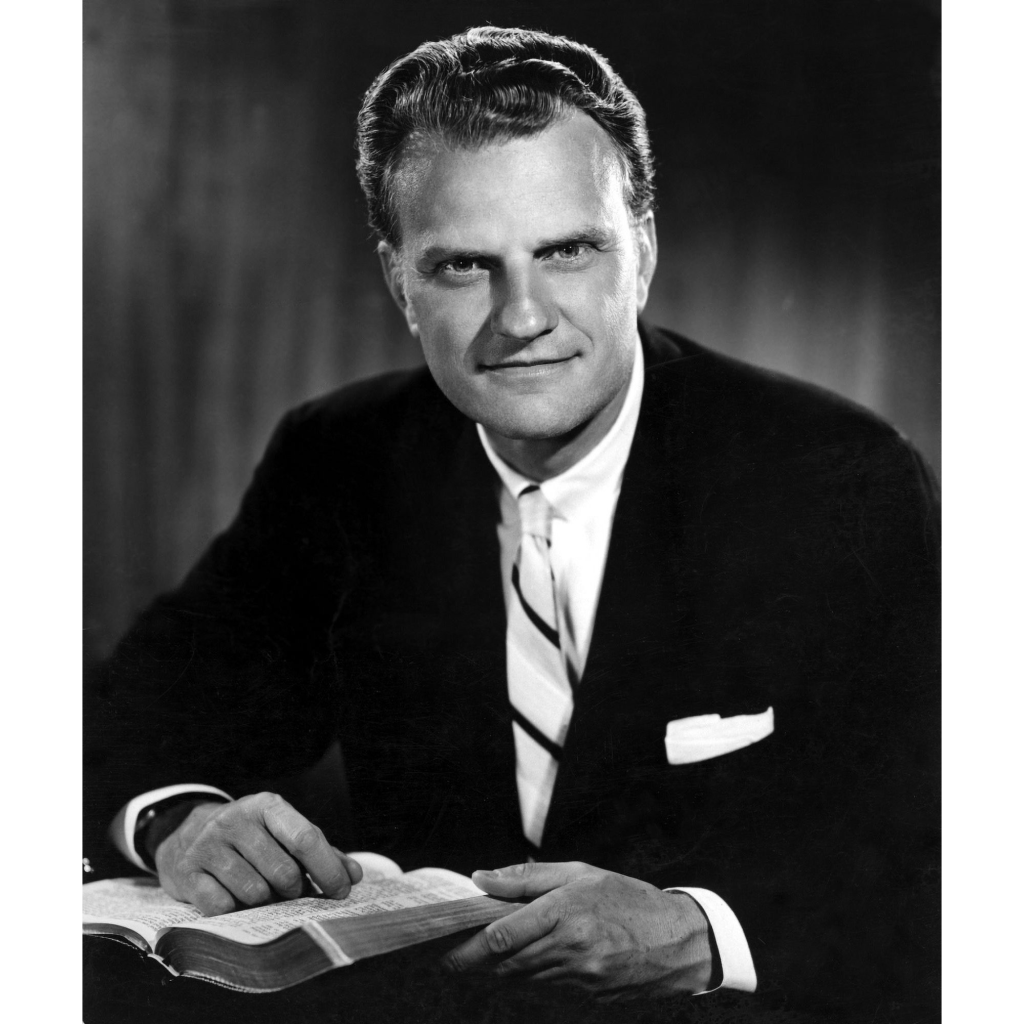
Billy Graham (1918-2018) was born on November 7, 1918 in a downstairs bedroom near Charlotte, North Carolina. His parents raised him and his three siblings in the Associate Reformed Presbyterian Church. He was converted at sixteen years old. He graduated from the Florida Bible Institute in 1940 and Wheaton College in 1943. In 1947 Billy Graham held his first crusade in 1947 in Grand Rapids, Michigan and held his last crusade in 2005 in New York City. I remember attending a Billy Graham crusade at Cleveland Municipal Stadium during college. Over those 58 years, he preached 417 crusades, including 226 in the United States and 195 abroad. It has been estimated he preached to more than 210 million people in his life. God only knows how many souls he won for Jesus Christ, including Kathie Lee Gifford. Graham is considered one of the most influential Christian leaders in the twentieth century.
Billy Graham died on February 21, 2018, in Montreat, North Carolina. He was a few months shy of his one hundredth birthday. If anyone deserved to go to heaven, it was Billy Graham. Yet, He never forgot the truth. He was a sinner, who was dependent on God’s grace. At his death, it was reported Billy Graham helped plan his own funeral. He had a simple request: less Billy, more Jesus. Billy Graham knew he was saved by grace and by grace alone! Do you? We are not saved by our good works. We are saved by grace. Do you remember the quote from Charles Spurgeon? He once said, “Saving faith is an immediate relation to Christ, accepting, receiving, resting upon Him alone, for justification, sanctification, and eternal life by virtue of God’s grace.”
 Russ Adams