Don’t Give Up Missions

There came a point in Jesus’s earthly ministry when he was no longer welcomed in the synagogues. With no other option, Jesus began to teach in the open air and began to tell parables. Parables are practical illustrations from daily living. Parables are not fables with a moral lesson. Parables are not analogies, where each character represents a contemporary character. Parables are different, because they illustrate a single divine truth.

Our reading, Matthew 25:31-46, the parable of the sheep and the goats, is a judgement parable. That generation saw the scene regularly. As a shepherd separates the sheep from the goats, so God will separate the righteous from the unrighteous. The righteous will enter heaven, because they responded to human need. They provided food, drinks, companionship, clothing, and medicine to those in need. The unrighteous were sent to hell because they failed to respond to human need. They were preoccupied with their owns needs and desires. The point of the story is clear – Jesus expects us to respond to human need. In the life of the church, we call responding to human need missions. Christian missions is an excellent way of expressing your appreciation to God for saving your soul. My goal in this blog is to help you appreciate the mission work of the church. I will do that by making three statements about mission work. I hope these statements make you think.

This is statement number one. Missions involve interpersonal relationships. Once you learn the name of the person you are helping, everything changes. Once you get involved in their story, missions come to life. Missions is not charity, missions is deeper. There is nothing wrong with collecting food, paper products or warm clothing. There are many people who need them. The problem is, you never get to know the person who will eat that food, use those paper products or wear that scarf. Charity is fine, but the needy always remain at a distance. Missions involve interpersonal relationships. In my life, I cherish the relationships I have made while helping someone in need. They changed my life while I was helping them. I think and pray for them regularly. If you want to thank Jesus, get involved in someone else’s story. Missions involve interpersonal relationships.

This is statement number two. Missions expose a person’s spiritual maturity. Spiritual babies only think about themselves. The spiritually mature grow to understand that life is about others. No activity in the life of the church exposes spiritual maturity more than missions. If it is true of people, and it is true of churches. If you show me a church that is not involved in missions, then I will show you a church that is on the way to extinction.

On the day missions take a backseat to everything else, your church will begin to die. If you want your church to close, then frustrate every mission opportunity. It is easy to do. You can justify your opposition based on sound business principles. Others will support you because there are other spiritually immature people. The church was never meant to be a business. The church was meant to be an extension of Christ in the world. When the winds of Pentecost blew, the only thing that mattered to those charter members was Jesus. The only thing that should matter to you is Jesus. The spiritually mature understand when we care for the needy of this world we are really caring for Jesus. When we ignore the needy of this world, we are ignoring Jesus. That is what the Master said in the parable. Missions expose a person’s spiritual maturity.

This is statement number three. Missions involve a certain amount of risk. Can I state the obvious? There are many frightened people within the life of the church. Whenever I have gotten involved in a mission project, well-meaning people try to stop me. When I went to the Philippines, people told me, don’t go! Their government is unstable. When I went to Mexico people told me, don’t go! You could get a disease. When I went to Haiti people told me, don’t go! You could be held hostage. Every time I traveled to the former Soviet Union, some well-meaning person warned me that I could be arrested and interrogated. When I tried to help the poor in my nearby city, people asked me, “Aren’t you afraid to be in the city? Someone seems to be killed every day.”

Yes, missions involve a certain amount of risk. Yes, the government may be unstable. Yes, the food may be bad. Yes, the residents may not like Americans. Yes, you may fall in love with someone in need and get your heart broken. However, this is what experience has taught me: The reward of helping those in need is greater than the risk. There is a world of needy people out there whom God loves. How can you turn your back on them? If you don’t believe God is calling you to go, then don’t go. Stay home. But, if God has called someone else to do something, then don’t discourage them. Encourage and pray for them. Never forget, God is with the person he has called into missions. Missions involve risk.

Ernest Henry Shackelton (1874-1922) was born in Ireland on February 15, 1874. His father wanted him to be a doctor, but he wanted to be a sailor. At the age of sixteen, he joined the merchant marines and saw the world. His greatest desire was to travel to the South Pole. In December of 1914, he got that opportunity. He was the captain of a ship called Endurance, which had a crew of twenty-seven men. For years, I read about an advertisement he ran to recruit his crew. This is the fictitious ad:

Men wanted for hazardous journey. Small wages. Bitter cold. Long months of complete darkness. Constant danger. Safe return doubtful. Honor and recognition in case of success.

The story ends by saying Shackleton could not take all the men that responded to that ad.  I was saddened to learn several years ago that story is not true. I wanted that story to be true, because I longed for an adventure. I didn’t just want to live and die. I wanted to make a difference. I am not alone. Many long for an adventure and to make a difference.

I believe you long for an adventure and want to make a difference in this world too. I believe you are desperate to find a way to thank God for saving your soul. The world is filled with people who are in need. How are you going to respond? Pastor of the Saddleback Church in California Rick Warren (born 1954) once said, “The only way to serve God is to serve other people.”  Never give up on missions!

Don’t Give Up Fasting

Scottish evangelist Oswald Chambers (1874-1917) once said, “The Sermon on the Mount is a statement of the life we will live when the Holy Spirit is getting his way with us.”  Jesus is setting the standard high. The Sermon on the Mount is found in the sixth, seventh and eighth chapters of Matthew. There are rich teachings found in these chapters. The Semon on the Mount includes the Beatitudes, and Jesus’s teachings on murder, adultery, divorce, along with his teachings on love, prayer and judging. In these chapters, Jesus teaches us to care for the needy. Standing with these memorable teachings is our reading, Matthew 6:16-18, about fasting. Many have chosen to ignore these words. I am one.

I was an active member of the clergy for 40 years. I served as a youth director in Frankford, Indiana for a year. I was the pastor of a small membership church outside of Danville, Kentucky for three years. Then, I served three United Methodist congregations in the old St. Clairsville District of the East Ohio Annual Conference for two years. I served a church outside of Medina, Ohio for a single year. Then, I served a church in Garfield Heights, Ohio for five years. During my last 28 years I served a church in Canfield, Ohio. That all adds up to 40 years. Conservatively, I have written approximately 2,000 sermons. Do you know how many sermons I have written on fasting? Including today’s blog, one! There is just something wrong with that imbalance. Jesus taught us about fasting, but we have ignored the whole topic. It is not just me. It is true of other preachers too.

My favorite website for “canned” sermon illustrations is called sermonillustrations.com. All the illustrations are arranged alphabetically in order of topic. If you want an illustration about grace, then you look up grace. If you want a sermon illustration about love, then you look up love. If you want an illustration on pickles, then you look up pickles. I thought they had an illustration on every topic, but I was wrong! I looked up an illustration on fasting and I got this response, “No illustrations yet”. I went to the internet highway and “GOOGLED” the question, what percentage of Americans fast? I was given information on the number of Americans who eat fast food.

Do you know of any Christians who fast for spiritual reasons? Through the years, I have met some amazing Christian people. I have known people who haven’t missed worship in decades. They even worship when they are on vacation. I know people who value prayer. I call them prayer warriors. I have known people who have studied the Bible and can quote it by chapter and verse. Just give them a Bible verse, they will quote it. Can you quote Ezekiel 31:9 right now? I have known people who take Holy Communion at home daily and people who won’t take an infant outside until after its baptism. I have known people who have served on all the church committees three times. I have known many people, but I have never known a single Christian who fasts for spiritual reasons. Do you know of anyone who fasts for spiritual reasons? That leads me to another question.

Jesus assumed in our reading people would fast, so why don’t we? Why have so many decided to ignore the spiritual discipline of fasting? I believe there are a couple of reasons. Some don’t fast for medical reasons, and they shouldn’t. If you are pregnant, then you should not fast. If you are a diabetic, then you should not fast. If you have a physical condition that depends on a regular diet, then you should not fast. Some don’t fast because they don’t completely understand the concept of fasting. A fast is not a diet. The goal is not to lose weight so you can look good in your swimsuit this summer. A fast is not a hunger strike where you refuse to eat to get attention for your cause. Many don’t fast because they are preoccupied with food. This is it in a nutshell: Most of us are more infatuated with food than we are with God. I don’t want that to sound harsh or judgmental. I want it to sound observant. How many people do you know who talk easily about food, but they never talk about God? The whole situation is sad.

However, those Christians who do fast say there are spiritual benefits. This is the list:

Fasting will strengthen your prayer life

Fasting will help you find God’s guidance

Fasting will help you grieve

Fasting will help you find divine deliverance or protection

Fasting will help you truly repent

Fasting will humble you before God

Fasting will enhance your sincerity

Fasting will help you overcome temptation

Fasting is not for those who are just curious about God. Fasting is for those who are infatuated with God. Are you just curious about God, or are you infatuated with God? John Wesley (1703-1791) said, “Fasting and prayer make a powerful combination.” The topic of fasting always reminds me of an experience I had years ago.

I decided to try a new program at my church.  During that season of Lent, I formed a group called “Lunch with the Pastor”. The idea was simple. We would meet at noon in the fellowship hall and discuss that day’s sermon. I wrote a list of hard-hitting questions to discuss and ordered a sandwich ring. It was a simple straight forward idea. I thought, what can go wrong?

On the first Sunday of Lent, the little group gathered. On paper plates, we ate our sandwiches and chips. We drank out of paper cups. I couldn’t have cared less about the food. I wanted to dig into my hard-hitting questions. Before I could ask my first question, someone asked me a question. It torpedoed the whole group. This was their question: “Russ, what did you pay for the sandwich ring?” I didn’t remember. It was somewhere between a dollar and a million dollars. It didn’t matter, because I paid for it. She said, “I’ll cook lunch next week. I can serve this group for a fraction of the cost.” That grabbed everyone’s attention because everyone knows the purpose of the church is to save money and eat. She went on to tell us in detail everything she could cook and save money. I don’t think we covered a single question that day. We spent the whole time talking about food. The next week, I thought, this week will be better. I was wrong! When the time came, she provided lunch, and the food was cheaper and better. Someone else in the group announced they would cook the next week and then we had another fascinating discussion about cooking. On the third week, I gave up. My sermon discussion group with my outstanding hard-hitting questions turned into a recipe exchange club. We never met again, and no one ever missed it. I never tried such a group again. I just can’t compete with food. Can I state the obvious? Food is a good thing! However, there is something better: God! It’s a fair question: Are you more infatuated with food, or with God?

In the Bible, Moses, King David, Elijah, Queen Esther, Daniel, Anna the prophetess, the Apostle Paul and Jesus Christ all fasted for one reason. Each one was infatuated with God. Are you infatuated with God? Or are you more interested in food? Fasting is giving up something good to experience something better. There is nothing better than God. Never give up fasting!

Why the Transfiguration is Important

According to the Revised Common Lectionary, this Sunday is Transfiguration Sunday where Matthew, Mark and Luke tell of the transfiguration. We are looking at Matthew’s version, Matthew 17:1-8. The scene is set up in the previous chapter. For in that chapter, Jesus gives the disciples a little quiz. There are only two questions. This is the first question: who do people say that I am? They give a variety of impressive answers. Then, he asks the disciples the second question: Who do you say I am? Only Simon Peter’s answer is recorded, “You are the Messiah, the Son of the Living God.”  That answer in itself means the disciples are making spiritual progress.

To show his approval, Jesus takes three of the disciples, Peter, James and John, to the top of a mountain. The Mountain was probably Mount Hermon, which raises 9,000 feet above sea level. The inner circle must have believed they were going to receive some special instruction from the Master, but they received so much more. According to Matthew 17:2, Jesus was transfigured. We are not exactly sure what that means. It will have to suffice to say, Jesus was glorified. His face began to shine like the sun and his clothes began to glow. It was an amazing scene. Then the scene grew more complex. Suddenly, Moses and Elijah appeared. They are endorsing Jesus’s ministry. The disciples are rattled, but then the truly miraculous happens. God, himself, suddenly appears. He identifies Jesus, so his identity is clear to everyone. Verse five quotes God. He says, “This is my Son, whom I love; with him I am well pleased. Listen to him!”  The scene ends as quickly as it began. It is one of the great scenes in the Bible, but what does it mean?

Warren Wiersbe (1929-2019) was an American pastor, Bible teacher, theologian and author. He said there are four things about the transfiguration of Jesus that should never be forgotten.  Each one is Biblical. Consider them with me, they have merit. 

The glory of His person – The transfiguration of Jesus came from his inside. It was not something that happened to Jesus, like a spotlight. It was something that came from within Jesus. His glory was permitted to shine. (Hebrews 1:3) 

The glory of His kingdom – Moses and Elijah represented the Old Testament law and the Old Testament prophets. They were the great characters in the Old Testament however they are inferior to Jesus. Everything in the Old Testament pointed to Jesus and his ministry. Jesus was the final piece of God’s plan of salvation for the world. (Hebrews 1:1) 

The glory of His cross – The transfiguration reminds us that suffering and glory go hand in hand. In time, the transfigured, glorified Jesus would be nailed to the cross and die. (1 Peter 1:6-8) 

The glory of His submission – In many ways, the transfiguration is the beginning of the end. Jesus did not go to the cross because he wanted to go. Jesus went to the cross because it was part of God’s plan of salvation. Jesus submitted to God’s will. 

The transfiguration of Jesus reminds us of the supremacy of Jesus. Within the life of the church, if we don’t have Jesus, then we have nothing at all. In my forty years in the ministry, I have reminded people of that divine truth countless times. It sounds simple, but it is easy to forget. Churches get so involved with building maintenance, fundraising for a good cause, and helping the needy that they forget about Jesus. Churches are not service clubs or community action groups. Churches are different because they are all about Jesus. Without Jesus, churches have nothing at all. That is why every congregation must keep Jesus the focal point of its ministry. That is why denominations must keep Jesus the focal point of their ministries. It is sad when churches forget about Jesus.

If you know me personally or read my blog regularly, you know I attended Asbury Theological Seminary in Wilmore, Kentucky. During those years, I served a small membership church between Danville and Lancaster, Kentucky. It was called the Pleasant Grove Christian Church. I am happy to report it is still active. I have nothing negative to say about that congregation. They were kind to me at a time when I needed kindness. In those three years, I got to know other churches in that community as well.

One of those churches was the Mount Olivet Baptist Church. In Kentucky, at that time, every church was Baptist, regardless of the sign. Their theology leaned to the right. It was named after the Mount of Olives. Since I left that area, the Mount Olivet Baptist Church closed. The reason is sad. The church simply shattered over a series of differences of opinions. It all began when the Board of Elders held an emergency meeting. They were upset their pastor, and his wife had filed for divorce. They believed in the Bible and the Bible’s teaching against divorce. They decided to let their preacher go. The problem was the church was divided over his dismissal. Everyone who had suffered through a divorce, or had a family member who had been divorced, was upset. There was an ugly church meeting and A large portion of the congregation left. They swore they would never return. That group was true to their word. They never returned.

A search committee was formed to find a new pastor to fix the mess. They collected a few names. One of the names was a woman. She was by far the most qualified. She had an excellent education, could preach up a storm and was effective in every church she served. There was only one problem – she was a woman, and you know what the Bible says about women speaking in church. For that reason, she didn’t get the call. They called an inferior man, who made a bigger mess. Everything was supposed to be done confidentially, but the word leaked out. Once again, the church was in an uproar. Everyone seemed to know of a gifted and effective female pastor. From that moment on, the Mount Olivet Baptist Church splintered. Both sides quoted Bible verses, and each side claimed they were right. Both sides memorized Bible verses, but both sides forgot about Jesus. Everyone used the Bible to support their opinion. They forget we are called to love people, not judge people. In the end, the once healthy church struggled paying basic bills. In time, the church building and property were sold to a local brewpub. It wasn’t all a loss. I hear both the food, and the beer are great. Can I ask you a question?  

Why do you think the Mount Olivet Baptist Church closed? Did it close because of a lack of Bible? Did it close because the people were not passionate about their church? Did it close because of a lack of money? I believe Mount Olivet Baptist Church closed because they forget about the supremacy of Jesus. Without Jesus, churches have nothing at all. Do you remember what God said? He said, “This is my Son, whom I love; with him I am well pleased. Listen to him!”

Lessons From the Magi

Our reading is Matthew 2:1-12. It is the traditional reading for Epiphany, a word that means manifestation. It is the liturgical season which celebrates how Christ was made manifest to the world, and especially how Christ came to save all people – both Jews and Gentiles. Epiphany is annually observed on January 6. This year, Epiphany Sunday is January 5.

The Bible says Jesus was born in Bethlehem, in Judea. So, Jesus was born five and a half miles south of Jerusalem. Matthew pinpoints the date. It was when King Herod sat on the throne. He sat on the throne for thirty-three years, from 37 – 4 B.C. He was appointed to his position by the Roman Senate. Over two thousand years later, he is still remembered for being ruthless and insecure. His insecurity led him to murder many in his family: his wife, three sons, mother-in-law, brother-in-law, and uncles. It has been said, it was better to be Herod’s dog than to be his family member. In our reading for today, we learn his murderous ways extended beyond the family. You know what the Bible says.

One day, Magi, Gentile astrologers from Persia or southern Arabia, (both east of Palestine), came to visit Herod. They had been studying the stars and had discovered that God was doing something new. A baby had been born, who was called King of the Jews. They assumed the King of the Jews would be born in the palace. They assumed wrong. The infamous insecure King Herod was thrown into a tirade. His insecurity fuels the loss of more human life. The story does not have a happy ending. It pains me to say it. Using the information received from the Magi about this divine birth, he orders the death of all baby boys under the age of two. However, in the end, the Magi find the toddler Jesus, no longer a baby. That means your nativity set is wrong. They did not visit the newborn Jesus on that holy evening. They visited Jesus two years later. Verse eleven says, they went to a house, not a stable. However, our misunderstanding about when the Magi actually arrived does not mean they do not have something to teach us.

They teach us seven important lessons. These thoughts are not original. I found them in an article called Seven Lessons from The Magi: Thriving in a Threatening World. It was on Tyndale.com. I believe these lessons have some merit; I hope you agree. This is their list:

  1. The Magi stayed open to new ideas. Isaiah 43:18-19 says,“Forget the former things; do not dwell on the past. See, I am doing a new thing. Now it springs up; do you not perceive it?” The Magi understood God was always doing something new. God has always shined light into our dark world guiding us and offering direction. Are you open to new ideas?
  • The Magi trusted God to guide them. They knew God as all-knowing. The greats of the faith trusted God. Jesus knew Peter would deny him three times and Job believed God was guiding his future. On the cross Jesus said, “Father into your hands I commit my spirit.” How far do you trust God?
  • The Magi cultivated an exceptional faith. Hebrews 11:6 says,“And without faith it is impossible to please God, because anyone who comes to him must believe that he exists and that he rewards those who earnestly seek him.” God must have been pleased with the Magi, they traveled a great distance into a foreign land. The greats of the faith have always cultivated exceptional faith. How great is your faith?
  • The Magi were spiritually discerning. Romans 12:2 says, Do not conform to the pattern of this world, but be transformed by the renewing of your mind. Then you will be able to test and approve what God’s will is–his good, pleasing and perfect will.” The star was seen by many, but only the Magi let it declare God’s Glory. It has been reported only 5% of Christians have the gift of discernment. Are you spiritually discerning?
  • The Magi were guided by God’s word. However, the Magi needed more than the star – they needed scripture. King Herod asked his religious scholars where the child would be born. They quoted Micah 5:2. He would be born in Bethlehem. They could have bypassed Herod if they knew scripture. How much time do you spend studying the Bible?
  • The Magi expected trouble. There is nothing easy about life, it is filled with troubles. We find it in our reading. Our story tells us Herod was troubled and all of Jerusalem with him. The Magi expected trouble because troubles are a part of life. Our troubles remind us to persevere and hold on to the faith. How firm is your hold on the Christian faith?
  • The Magi lived fearlessly. Our story ends with the Magi being warned in a dream to return home by another route. This reminds us that God was bigger than Herod. It still holds true today – God is all-powerful, God is bigger than any problem we will face, so live fearlessly. Are you living fearlessly or are you afraid?

As I stated earlier, Epiphany is January 6. Orthodox Christmas is January 7. There are more than 200 million Orthodox Christians in the world. They follow the Julian calendar, unlike most Christian branches which follow the Gregorian calendar. For several years, I had the good fortune of being in the Orthodox world during their Christmas. Annually, I would be part of a volunteer in mission team to Russia. Those trips were sponsored by To Russia with Love, later Project Orphan Outreach. We worked with Russian orphans who would never be adopted because of their physical disabilities. I cherish those memories.

One year, we were in Vladimir, Russia, which is 125 miles northeast of Moscow. On Orthodox Christmas Eve we wandered into the local Russia Orthodox Church. The scene was memorable. The congregation stood as the priest led worship in Russian. I didn’t understand a single word. The incense was thick. The locals studied us, because, as Americans, we stuck out like sore thumbs. The customs and traditions of Orthodoxy were unknown to me. We were strangers in a foreign land. Yet, the presence of the Holy Spirit was familiar to me. For some unknown reason God wanted me there. However, it is not just the story of a volunteer-in-missions team in the middle of Russia.

It is the story of the Magi. They too were visitors in a foreign land. They had traveled a long way, and everything must have been strange, but God wanted them there. There were many things they did not know, especially about Jesus. They did not know what the future held for Jesus. They did not know the impact Jesus would have on the world, but they knew there was something special about him. The Magi did not see it on that day, but we see it now.

When Jesus was born the future of the world changed. In the name of Jesus, many wonderful things have happened. In the name of Jesus, wonderful pieces of art would be created, and books would be written. In the name of Jesus, hospitals would be started to help the sick. In the name of Jesus, orphanages would be established to help the young without parents. In the name of Jesus, homes would be established to help the old. In the name of Jesus, the hungry would be fed and the homeless sheltered. In the name of Jesus, churches would be started to teach the Christian faith and offer salvation and hope. In the name of Jesus, injustice would be confronted. And there is a truth beyond that: for millions of people who have believed since, the birth of Jesus made possible not just a new way of understanding life, but a new way of living it. The Magi traveled a long way to see Jesus, and it was worth every mile! Perhaps Augustine of Hippo (354-430) said it best, Though many kings of the Jews had been born and died, none of them did the Magi seek to adore. And so they who came from a distant foreign land to a kingdom that was entirely strange to them…But they had learnt that such a King was born that by adoring Him they might be sure of obtaining from Him the salvation which is of God.” 

How Strong Are You?

Our reading is from Matthew 18:21-35. This entire chapter is about life in the kingdom of God. One of the characteristics of kingdom life is forgiveness. Peter understood that point when he asked Jesus the question: how many times shall I forgive my brother when he sins against me? Jesus never had a chance to answer the question, because Peter answers it himself – up to seven times? Peter is obviously trying to impress Jesus, because Rabbinic teaching required a person to forgive up to three times. Peter had doubled that requirement and added one for good measure. He must have been waiting for Jesus’s approval, but it never comes. Jesus says seven times is not enough; we are supposed to forgive up to seventy-seven times. Jesus is not asking us to keep track of our forgiving acts, Jesus is asking us to make forgiving a constant characteristic in our lives. To underscore that point, Jesus tells them this parable.

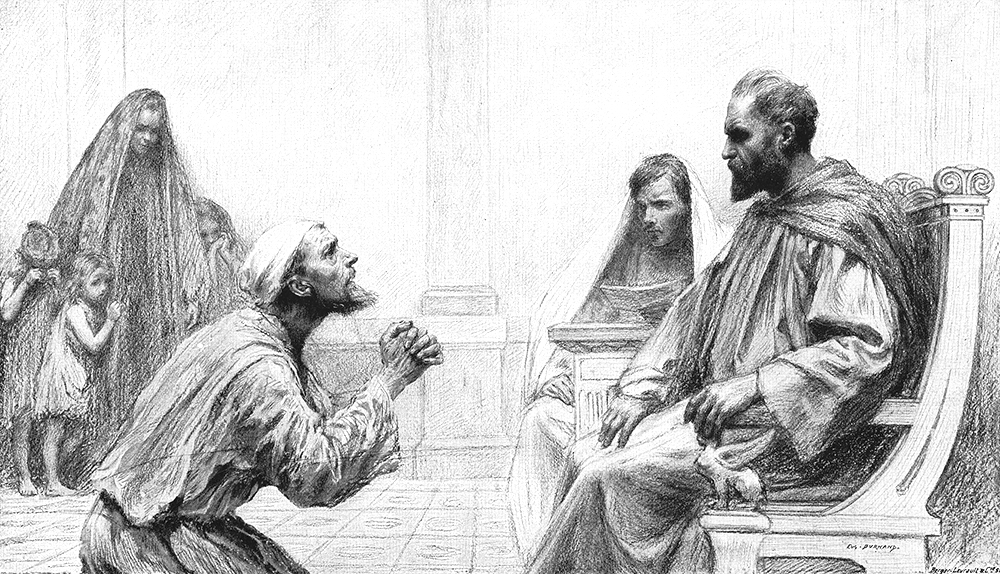
The story is really a one-act play with three scenes. In the first scene, a king wanted to settle his accounts with his servants. One of the servants is brought before the king. It is not a good day for him because he owes the king 10,000 talents. That is a significant sum. At that time, you could buy a servant for one talent. The entire tax base to this area was only 800 talents. This man owes the king 10,000 talents. To make it easy on us, let’s just say the man owed the king ten million dollars. Unable to pay the king back, the king considers selling the man’s wife and children. The servant begs the king not to sell his family and begs the king for more time. The king has mercy on the servant and cancels his entire debt. In the second scene, the shoe is on the other foot. The debt-free servant exits and goes after another servant who owes him money. The amount is very small, only a hundred denarii. If he owed the king ten million dollars, then this man owed him only $20. The second servant begs for more time, but no extension is given. He is beaten and thrown into prison. In the third scene, our story goes full circle. The king is told what happened and he summons the first servant. Because he did not show mercy, then he will not be shown mercy. He is turned over to the jailors to be tortured, until his debt is repaid. Jesus wanted to make sure they didn’t miss the point. He clears up any confusion in verse thirty-five: “This is how my heavenly father will treat each of you unless you forgive your brother from your heart.”  Everyone knows the point that Jesus was trying to make. We know we are supposed to forgive. The problem is, we are not good at forgiving, especially within the life of the church. Historically, we are hard on ourselves. In my forty years in the ministry, every church I served struggled with forgiveness. How many examples do you need?

The first funeral I officiated at was for a man by the name of Randolph Scott. He lived in Lancaster, Kentucky. I was in his home several months before his sudden death. I sat in the living room with his wife, but he never came out to see me. He was watching a Cincinnati Reds baseball game. She apologized for her husband’s rudeness and explained he was mad at the whole church. To be more exact, he was mad at a single church member. He said, the man cheated him out of $50 in some business transaction. He said, if that man represented the kind of people in my church, then he didn’t want to have anything to do with my church. He said, he would never forgive the man or the church. Randolph was a man of his word. He never did forgive the man or the church. However, the church prepared a bereavement lunch after his funeral. Randolph Scott knew he was supposed to forgive. The problem was, he refused to forgive. That happened in my first church.

When I arrived at my last church, I found people who refused to forgive. One afternoon, I went to the hospital to visit a parishioner. She was a woman in her late eighties, who took great pride in her years of church service. As I sat next to her bed, she told me how she had saved the church several times with her church dinners. Others told me, she was a good cook, but she had no people skills. She offended many kitchen helpers during her reign. Foolishly, instead of talking to the woman about her behavior, the women’s organization decided to write her a letter to tell her she had been relieved of duty. She was no longer welcome in the kitchen. Obviously, her feelings got hurt, and she swore she would never forgive that group. She was a woman of her word. She never did forgive them. On the day I visited her, she quoted that twenty-year-old letter word for word, and she recited the names of all the people who had signed that letter. And in colorful, ugly language she told me, they could all go to hell. She had spent decades in the church but didn’t hear a single word. She knew she was supposed to forgive, she refused to forgive. Within the life of the church, we know we are supposed to forgive, but we refuse to forgive. No organization is better at self-inflicted wounds than the church. Satan loves our unforgiving spirits. Our unforgiving spirit damages the church we claim to love. This question haunts me:

Why do people refuse to forgive? Josh Emery is a counselor in Fort Collins, Colorado. He says his appointment calendar is filled with people who refuse to forgive. Every story is different, yet every story is the same. He says people don’t forgive for three basic reasons. This is his list:

  1. People don’t forgive because they don’t want to look like they condone the bad behavior.
  • People don’t forgive because the person doesn’t deserve it.
  • People don’t forgive because the person can’t be trusted.

I don’t have a problem with that list. I agree with each point. I am no different from you. I struggle with forgiveness too. I have good reasons not to forgive. The problem is, through the eyes of God, there is no good reason for not forgiving. God knows what we would like to ignore. When we refuse to forgive, we damage the relationship. The relationship between you and the unforgiven person stops evolving. That is true. For Randolph Scott, the relationship stopped evolving on the day he believed he was cheated out of $50. For the woman in the hospital bed, the relationship stopped evolving on the day she got the letter. What relationships in your life have stopped evolving? That is not a good thing. God expects us to forgive, because God expects our relationships to evolve. God expects our relationships to be strong. Within the life of the church, we know we are supposed to forgive, but we refuse to forgive. That is why stories of true forgiveness baffle us.

In the fall of 2006, Charles Carl Roberts IV (1974-2006) did the unthinkable when he held a one-room Amish school full of children hostage in Bart Township, Pennsylvania. After a few terrifying hours, Roberts bound, then shot 10 girls, killing 5 of them before turning the gun on himself. What do you think was the response of the parents of those children and the entire Amish community? Within hours, the Amish families immediately began extending their forgiveness to the gunman’s family. They visited his wife and parents to offer them comfort—they even attended the killer’s funeral. A grandfather of one of the murdered girls cautioned the family not to hate the killer and said, “we must not think evil of this man.” While another father said, “He had a mother and a wife and a soul. And now he’s standing before a just God. Christ calls us to forgive him.” If you were in that community and lost a loved one, could you forgive Charles Carl Roberts IV? In the kingdom of God we forgive, in the world we don’t. Obviously, true forgiveness is not easy.

Corrie ten Boom (1892-1983) was a Dutch watchmaker and Christian, who along with her father and other family members, helped many Jews escape the Nazi Holocaust during World War II. She, herself, suffered in a concentration camp. In her book, The Hiding Place, she recounts those dark days. After the war, she traveled extensively, speaking of God’s grace and forgiveness during those horrible years.

One night, in Munich after one of her speeches, a man came up to her. He looked familiar and it took a moment for her to recognize him. He had been a guard at her concentration camp, Ravensbruck. He had treated her and her sister cruelly. A mountain of emotional memories hit her. In her eyes, he was Satan incarnate. However, after the war, he became a Christian, but that didn’t change her feelings about him. It was hard for her to stand there, but then it got worse. He extended his hand to her and said, “I am grateful for your message. As you said yourself, ‘He washed my sins away.’” Corrie ten Boon would be the first one to admit it. It is one thing to speak about forgiveness, it is something quite different to forgive. She didn’t want to shake his hand because she didn’t want to forgive him, so she prayed God’s help. God did help her, and she did shake his hand. But what is more important, God helped her forgive him. Can I ask you a question?

If there anyone you need to forgive? I am assuming there is, because everyone has been hurt in some way. You know the truth – life is hard and sometimes life can be cruel. Who do you need to forgive? Within the Christian faith, forgiveness is not optional, it is a requirement. You are a disciple of Jesus Christ, and you are supposed to be practicing today what you will be doing for eternity. How can we expect to be forgiven, if we can’t forgive?

Indian activist, Mahatma Gandhi (1869-1948) was not a Christian, but he understood the power of forgiveness. He once said, “The weak can never forgive. Forgiveness is the attribute of the strong.” How strong are you?