
Our reading is Luke 10:25-37. Jesus is in Judea and has just sent out the seventy-two followers. The Good News is being spread and lives are being transformed. Jesus understands it clearly. It is not enough just to believe. Those beliefs must change one’s behavior, values and opinions. That is what Jesus is saying at the beginning of our Gospel reading. When questioned about salvation, Jesus asked them to quote the greatest law. That was a softball question. Everyone in Jesus’s world knew the answer. They quoted it daily. It is called the Shema: Love the Lord your God with all your heart, mind and soul. Then, Jesus asks them about the second greatest law. They are to love their neighbor as themselves. Do you see what Jesus did? He connected the love of God with the love of neighbors. It is not enough to just love God. It is not enough to just love your neighbor. Jesus expects us to love both God and our neighbors. To underscore that point, he tells this parable:
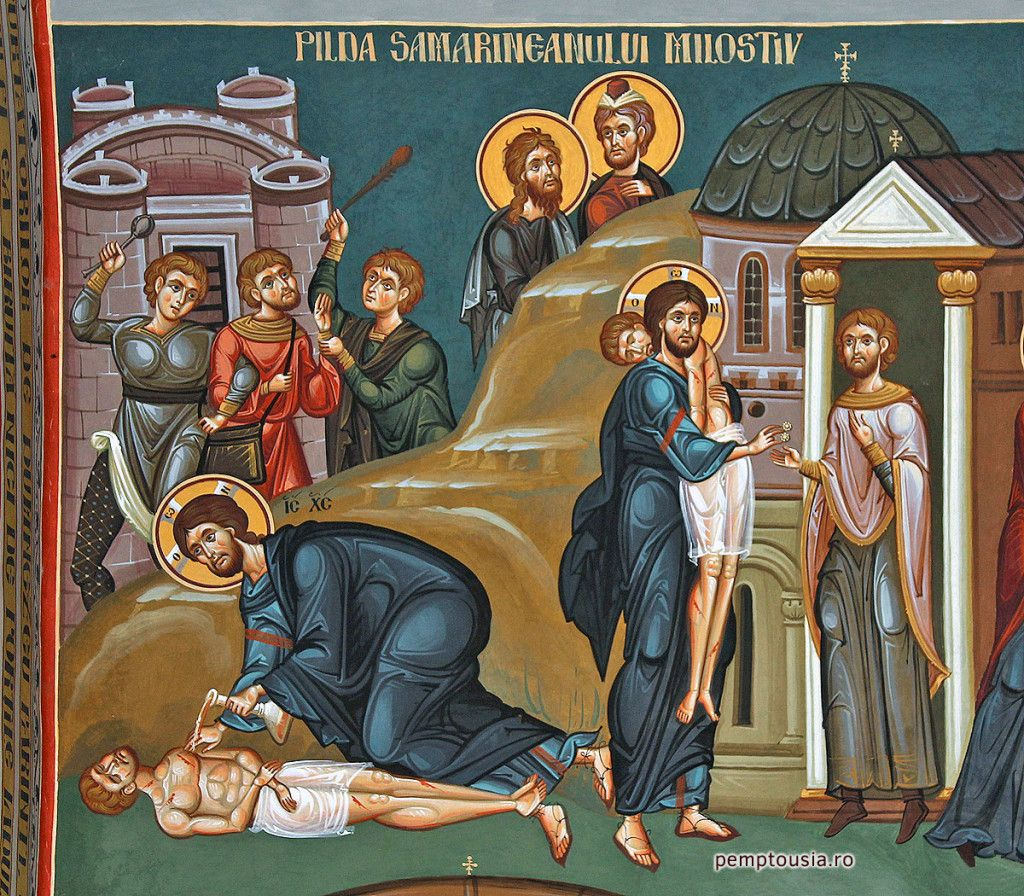
A man was traveling the road between Jericho and Jerusalem. It is a road that covers about seventeen miles. The direction you were traveling mattered because the road was steep. Jerusalem is 2,500 feet above sea level; Jericho is 800 feet below sea level. To make matters worse, it ran through rocky, desert country, which was perfect for robbers. Only a fool would travel this road alone, so we can say this man was a fool. As expected, he is attacked by robbers. The picture is not pretty. They stripped him of his clothes, beat him and left him for dead. Laying there in his half-dead state, various people walked by him. The first was a priest. A priest was from the line of Aaron and assisted in worship. The religious man should have known better, but he crosses to the other side of the road, ignoring the victim. The second was a Levite. He was a descendant of Levi, one of the brothers of Joseph. In addition to his religious duties, he had political and educational duties. He should have known better, but he crossed to the other side of the road, ignoring the victim. The third person is our unlikely hero, the Samaritan. You know the Samaritans. They were considered half breeds, half Jewish and half Gentile. The Jews believed they had compromised the faith. The Jews hated them, but the Samaritan was the one who had compassion on the victim in Jesus’s story. He treated the man’s wounds, and he put the man on his own donkey. Together, they traveled to an inn, where our victim heals. The Samaritan shows his true compassion. He takes out his money and gives it to the innkeeper. It equaled two days’ worth of wages. He instructs the innkeeper to care for him in his absence and tells him he will be compensated when he returns. Like all parables, Jesus’s simple parable of the good Samaritan is easy to imagine, yet it contains a profound message. It is easy to understand, yet it is hard to apply. It is not enough to say you love God; you must love others too. That is why compassion within the Christian faith is so important. It is one of the qualities you must nurture within yourself to experience the abundant life in Jesus Christ.
Webster defines compassion as sympathetic pity and concern for the suffering or the misfortunes of others. To me, that definition seems too shallow. True compassion is far more complex.
The great German Roman Catholic theologian, Henri Nouwen (1932-1996), seemed to understand the complexity of compassion. He once explained compassion this way:
Compassion is not pity. Pity lets us stay at a distance.
Compassion is not sympathy. Sympathy is for superiors over inferiors. Compassion is not charity. Charity is for the rich to continue in their status over the poor.
Compassion is born of God. It means entering the other person’s problems. It means taking on the burdens of the other. It means standing in the other person’s shoes. It is the opposite of professionalism. It is the humanizing way to deal with people.
The Good Samaritan illustrates true compassion. True compassion is based on need, not worth. True compassion is based on feelings, not fact. True compassion is based on doing, not understanding. Do the people in your life consider you compassionate? I hope so, because compassion is one of the great qualities of the Christian faith. I am not sure it is possible to be a true Christian without being truly compassionate. Compassion is a big deal, because our world is filled with so many problems.Did you know, according to UNICEF, 80% of our world’s population lives on ten dollars a day or less? How would your life change if you were forced to live on ten dollars a day? How much money do you live on in a single day?
When I think of compassion, Mother Teresa (1910-1997) pops into my mind. Born in Albania and raised in a devout Catholic family, she moved to Ireland at the age of eighteen to join the Sisters of Loreto. Later she moved to Calcutta, India and founded the Missionaries of Charity. They worked with the “poorest of the poor.” Over the decades that group grew to serve in 133 countries ministering to those dying of HIV/AIDS, leprosy, and tuberculosis, as well as running soup kitchens, dispensaries, mobile clinics, orphanages and schools. In 2016, she was canonized by the Catholic Church, because she refused to cross to the other side of the road. Mother Teresa was truly a woman of compassion.
When I research compassion, I find people like Pam Kidd. She writes devotions for Guideposts. One day she received a letter postmarked Harare, Zimbabwe. The letter read:
Dear Ms. Kidd, I have been reading your Daily Devotions for years. Recently, God spoke to me and asked me to tell you that you need to come to Zimbabwe to write about the orphans and the street children of Harare. Please contact me as soon as possible. Thank you.
It was signed by a woman working as a Presbyterian missionary in Harare.
That letter changed everything. A few weeks later, Pam and her husband were flying to Harare. When they arrived in Zimbabwe, they were shocked at what they saw. It was worse than they had imagined. Children living in mud huts, children jumping over sewage in gutters. She could not escape the smell of poverty. Children followed her everywhere. Pam decided to write a story about a woman who fed tea and bread to the orphans daily. They called her “Tea Lady.” As she researched this woman, Pam discovered this saintly woman had no help. She received no funding and needed help. Then, she had a revelation. God had brought her to Harare to help this woman. Over the next ten years, Pam Kidd returned to Africa ten times to help this woman help those orphans. Pam Kidd refused to walk to the other side of the road, because she was a woman of compassion. I hope I am a person of compassion. Are you a person of compassion? I hope so, because our world is crying out for help.
In 1964, Kitty Genovese (1965-1934) lived in Kew Gardens, in Queens, New York City. On March 13 of that year, Winston Moseley (1935-2016) raped and stabbed her to death. As shocking as that crime was the reaction of her neighbors was even worse. Many heard her cry out for help, but no one responded. Her neighbors were guilty of a sin of omission. They knew there was a problem, but they did nothing. In other words, they walked to the other side of the road. In the science of sociology, it has been called the “bystanders’ effect”, or diffusion of responsibility.
As Americans, we have been blessed in many ways. That is why so many long to live here. But, with those blessings comes great responsibility. To whom much is given, much is expected. Our world is calling out for help. What are you going to do? Are you going to walk to the other side of the road and ignore them, or are you going to be like the Good Samaritan, who responded to human need? It all distills down to a simple choice. Albert Schweitzer (1875-1965) once said, “The purpose of human life is to serve and to show compassion and the will to serve others.”
 Russ Adams