
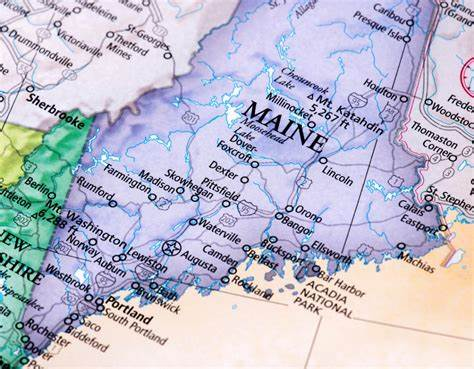
In Somerset County, Maine, is the community of Flagstaff. It was named after a flagstaff built by Benedict Arnold (1741-1801) in 1775. Today, Flagstaff is a ghost town. Her citizens left during the 1950’s when the Dead River was dammed, creating Flagstaff Lake. Historians tell us in the months prior to the flooding, all improvements, repairs and improvements in the whole town stopped. Why paint a house that was going to be flooded? Why repair something that was going to be wiped out? So, week by week, the whole town became more and more bedraggled, more gone to seed, more woebegone. Methodist preacher and teacher Halford Luccock (1885-1960) once said, “Where there is no faith in the future, there is no power in the present.” That quote describes Flagstaff, Maine. Many believe it describes the world in which we live.
Like the residents of Flagstaff, Maine, many believe our world has no future. Just think about it for a moment. Our world is facing some tremendous problems. Population growth, illiteracy, and food and water shortages are common in many places. The United States is facing some tremendous problems. The news media is filled with stories about illegal immigration, drugs and affordable healthcare. The American family is facing some tremendous problems. 50% of American marriages end in divorce and 25% of American children are being raised in a home without a father being present. The greatest shortage facing our world, country and homes is hope. That is why knowing Jesus is so important. With him there is always hope. That takes us to our scripture reading.
We are in the sixteenth chapter of Acts, verses nineteen through thirty-one. Do you remember the story? Paul healed the fortune-telling slave girl from an evil spirit. Everyone should have been happy, but that just didn’t happen. Everyone was upset. Those who wanted to see into the future were upset because their window into the future was gone. The owners of the slave girl were upset because they had lost an income stream. In the end, everyone turned against Paul and Silas. After being stripped and flogged, they are imprisoned. I can’t describe to you the misery of their surroundings. Whatever words I use to describe it falls short of their reality. They are completely dependent on God. However, with God all things are possible.
About midnight, Paul and Silas are singing and praying. God must have heard them, because a great earthquake rocked the entire prison. According to the text, the prison doors opened, and all the chains and fetters fell off the prisoners. The jailor was responsible for the incarcerated, and he assumed everyone ran away. He considered committing suicide. It was a good thing he reconsidered, because all the prisoners remained, including Paul and Silas. In the morning, he looked at them and asked, “Sirs, what must I do to be saved?” They answered, “Believe in Jesus.” It is a great story with two sides. There is an eternal spiritual side and a temporary practical side.
The spiritual eternal side cannot be ignored. There are fourteen earthquakes mentioned in the New Testament, including the earthquake mentioned at Jesus’s resurrection. Earthquakes in the Bible always illustrate God’s power. The jailor had just experienced God’s power and was humbled by the experience. All his earthly pride was wiped away and he felt insignificant. In this humbled state he asks the question, “What must I do to be saved?” I have never met a person who didn’t want to live for eternity. Despite all our shortcomings, we believe that heaven is waiting for us and our loved ones. It would be a horrible thing to lose a loved one and question their salvation.
Years ago, I officiated at a funeral of a nineteen-year-old. His life ended before it got started. The story was tragic. The only thing he had done in life was get into trouble. He made one poor decision after another. On the night he died, he made one last poor decision. It was 3:00 in the morning and he was drunk. He was walking down the middle of a busy road, when he was hit by a drunk driver. Everyone who came to his funeral was young. It was their first taste of death. One by one they passed by his closed casket. A young woman wanted to speak at his service. The family granted her request, and she ended her emotional words by saying, “I hope he found a way to get into heaven.” I have never forgotten her hopeless words.
Have you ever wondered about the salvation of one of your loved ones? There are no secret entrances to get into heaven. There is no side door. There is no back door. The only way to get into heaven is by believing in Jesus. He is our only hope of salvation. His blood washes us white as snow. That is the eternal, spiritual side to the story. Yet, there is another side to this story.
This is a temporary practical side to the story. God is always present and with God there is always hope. In the story, the incarcerated had no hope, until God intervened on their behalf. That theme isn’t just found in this story. It is found throughout the New Testament. It is the theme of our faith. People of faith understand it clearly. God can turn victims into victors. However, people who lack faith remain victims, like the residents of Flagstaff, Maine. Do the people in your life consider you a hopeful, optimistic person? Do the people in your life consider you a person of faith? Never forget, with God there is always hope. This is the story of the most hopeless time in my life.
When I was in seminary, there was one series of classes that I feared more than the rest – New Testament Greek. I was required to take three classes in New Testament Greek to graduate: Greek I, Greek II and a class in Greek grammar. I found Greek I to be challenging. I found Greek II to be impossible. Part of my problem was my life at that time; it was complex.
As the final exam approached, I knew it wasn’t going to be pretty. It would be the first class I ever failed. The standards were high for that class. There was only one test and you had to get an 80%. That simply wasn’t going to happen and my future hinged on that test. If I didn’t get an 80%, I wouldn’t get my degree, which meant I wouldn’t be ordained. It was one of the most stressful moments in my life. With no other options, I asked the professor for more time to study. He agreed and said I could take it at 8:00 on a Friday morning, because his grades were due at noon. I took that extra time to go back to the beginning of the class and retaught myself Greek. At first it was easy, but then it grew hard. The situation seemed hopeless. I remember the night before I took the test sitting in the library completely alone. Everyone else had gone home because the semester was over. Depressed, I sat there. In my heart, I knew it, I had no hope of passing. I remember at 8:00 in the evening I started to panic. I felt like my future was over before it began. Trying to control my emotions, I knelt by my study carrel and began to pray. My prayer was simple. “Please, God help me. I can’t do this alone. I need you. If you have called me into the ministry, then help me.” For another ninety minutes nothing changed. There is no other way to say it. I was living in Flagstaff, Maine, hopeless. I waited for the announcement that the library was closing. It was at that moment that God acted on my behalf. Like God rolled back the great stone on Easter morning, God rolled back the great stone to my brain. Suddenly, everything clicked. Greek is one of those things you either get or you don’t. For the first time, I got it! Overcome with emotions, I prayed a word of thanksgiving.
The next morning, I was there early to take the test so I wouldn’t have time to forget what I had studied. Once completed, I waited for the professor to grade it. I needed an 80% to pass the class. I would like to report I got a 100%, but I won’t lie to you. I got an 81% and it was the most magnificent 81% in the history of the church! I knew the truth. I didn’t get the 81% because I worked hard, I got an 81% because God was with me. Without God, I would have failed. Without God, there is no hope. However, with God, there is always hope. Can I ask you a question?
How much time do you spend in Flagstaff, Maine? How much time do you spend in a sea of hopelessness, wallowing in self-pity? I cannot tell you all your prayers will be answered with a yes, but I can tell you in the end God wins. With God, all things are possible. God knows what is best. Martin Luther King Jr. (1929-1968) once said, “We must accept finite disappointment, but never lose infinite hope.”
 Russ Adams