
Hudson Taylor (1832-1905) is remembered for his many years of mission work in China. One night, he was scheduled to speak at a church in Birmingham, England. After months of planning, the day finally came, but the weather was horrible. Some tried to discourage Taylor from speaking. Even the organizers of the event discouraged him. But Taylor, himself, insisted. Less than a dozen people showed up, but the meeting was marked with unusual spiritual power. Half of those present either became missionaries or their children entered the mission field, and the rest were faithful supporters of the China Inland Mission for years to come. Can I ask you a question? Was that meeting a success or was it a failure? Through the eyes of this world, it was a disaster; less than twelve people came. Yet, through the eyes of God it was a great success – lives were changed in the name of Jesus. Let me state the obvious, bigger isn’t always better.
We find ourselves today in the fourth chapter of Mark, verses twenty-six and thirty-four. Jesus is in Galilee. He was extremely popular there, so a great crowd was following him. They heard a series of parables about the Kingdom of God. The chapter begins with the parable of the sower. Next comes the parable of the light and the bushel basket, the growing seed, and our parable, the mustard seed. Jesus says the Kingdom of God is like a mustard seed. It is known by all, because it is so short and easy to understand.
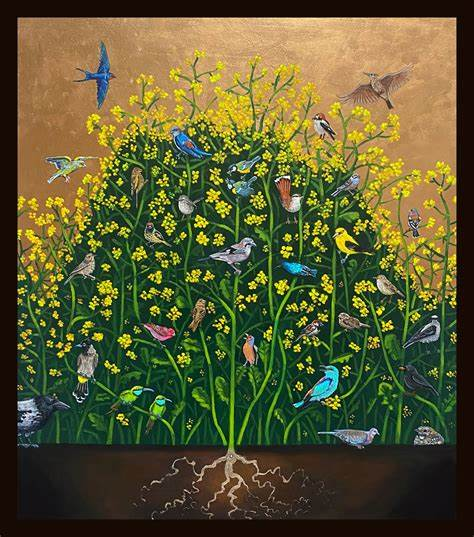
Proverbially speaking the mustard seed was the smallest of all the seeds. (The truth be told, other seeds in that corner of the world are smaller. For example, the seed of a cypress tree is smaller.) However, don’t be fooled by the size of the seed. It is deceiving. It starts out being small and insignificant, but it ends up being quite impressive. A full-grown mustard plant is more of a bush than a tree. It stands twelve feet tall. It is large enough for birds to take shelter. The point Jesus is trying to make is not hard to discover. The Kingdom of God may begin very small, but it will grow. In time, the Kingdom of God will become quite impressive.
Jesus wasn’t setting up the crowd for disappointment. The Kingdom of God did grow. Today, Christianity is the largest religion in the world. Our world has a population of approximately eight billion people. Approximately one-third of our world’s population is Christian. On the global scene Christianity is still growing. Did you know the Christian faith grows by 80,000 people per day? That didn’t just happen in an instant. It took time. Consider this with me:
- In 100 AD the world population was 181 million. For every 360 people, there was one Christian.
- In 1000 AD, the world population was 270 million. For every 269 people, there was one Christian.
- In 1500 AD, the world population was 425 million people. For every 84 people, there was one Christian.
- In 1900 AD, the world population was 1.6 billion people. For every 40 people, there was one Christian.
- In 1950 AD, the world population was 2.5 billion people. For every 30 people, there was one Christian.
Jesus didn’t lie to the crowd, he told them the truth. He told them the Kingdom of God would start out very small, but in time it would be very big. We like those big numbers, because in America we believe bigger is better. That line of thought has even filtered into the life of the church.
Lakewood Church in Houston, Texas is the largest church in America. They have 45,000 in worship every weekend. They have six services on an average weekend, four in English and two in Spanish. Joel Osteen (born 1963) is the lead pastor. I don’t know how you feel about Joel Osteen. I do not know how I feel about Joel Osteen. However, you must admit, in a bigger is better society, Joel Osteen is a great success.
Can I make a confession? I am a product of this society. I, too, believed bigger is better. For most of my working career, I chased the crowd. For decades, I studied church growth principles. I could have held my own church growth workshop. Weekly on Sunday afternoons, I added up my church’s attendance. If it was a good attendance day, then I was in a good mood the rest of the week. If it was a low attendance day, then I would be in a bad mood the rest of the week. When my colleagues ask me about my church, I give them a number. I researched other churches’ numbers. I believed bigger is better. There is nothing wrong with numbers, until they became a preoccupation. At some time, I had a revelation – the numbers were robbing me of any feeling of satisfaction. The numbers only promoted my failures. I began to evaluate my worth as a person based on the numbers. Joel Osteen averages 45,000. I averaged about 250. There really is no comparison. I am not criticizing Joel Osteen or any other mega church. Every community seems to have one. I am saying numbers aren’t everything. It all changed for me in an instant and I discovered it in one of my own sermons. I discovered it was more important to be faithful then it was successful. It was a humbling moment.
It was the Sunday before the resurrection of Jesus. You know the story. A great crowd had gathered in Jerusalem for the annual Passover observance. On the lips of everyone in the crowd was the name Jesus. His miracles had made him famous. Some believed he was the long-awaited Messiah. When Jesus arrived, everyone wanted to see him. Some were in the crowd cheering for Jesus because he was trending. Some were in the crowd cheering for Jesus because they wanted him to perform a miracle. Perhaps they needed a healing, or a loved one needed a healing. Some were in the crowd for political reasons. They were tired of foreign domination and hoped Jesus would use his power for political liberation. A minority in the crowd loved Jesus and just wanted to be near him. Through the eyes of the world, it couldn’t get any better. Jesus was a success because he had drawn a great crowd. But you know what happened. One by one the people walked away. On Thursday evening, the great crowd had been whittled down to twelve. By Friday, the crowd had been reduced to a select few. It didn’t seem to matter to Jesus, he wasn’t interested in the crowd anyway, he was more interested in the committed. Jesus was more interested in eternal faithfulness than he was in worldly success. Some things don’t change. To Jesus, bigger isn’t necessarily better. The only thing that really mattered to Jesus is faithfulness. This is the question you must answer: How faithful are you?
One of the great preachers of the twentieth century was Fred Craddock (1928-2015). He taught homiletics at the Candler School of Theology at Emery University. No one influenced my preaching more than Fred Craddock. Years ago, I read a story about a time Fred Craddock addressed a group of ministers at a conference. These are his own words:
To give my life for Christ appears glorious. To pour myself out for others. . . to pay the ultimate price of martyrdom — I’ll do it. I’m ready, Lord, to go out in a blaze of glory. We think giving our all to the Lord is like taking a $l,000 bill and laying it on the table—”Here’s my life, Lord, I’m giving it all.” But the reality for most of us is that he sends us to the bank and has us cash in the $l,000 for quarters. We go through life putting out 25 cents here and 50 cents there. We listen to the neighbor kid’s troubles instead of saying, ‘Get lost.’ Go to a committee meeting and cover the same issues again. We give a cup of water to a shaky old man in a smelly nursing home. Usually, giving our life to Christ isn’t glorious. It’s done in all those little acts of love, 25 cents at a time. It would be easy to go out in a flash of glory; it’s harder to live the Christian life little by little over the long haul.
It isn’t just true of preachers; it is true for everyone. We long to do something great for God, but what we normally do are the little things and hope God uses them. We aren’t just doing little things – we are planting mustard seeds. How many mustard seeds have you planted in your life? Charles Spurgeon (1834-1892) is one of the great names in the history of the western church. He was the minister of the New Park Street Chapel of London for 38 years, where he saved countless souls and influenced a generation. His accomplishments in life are impressive, but his own conversion was quite simple. He accepted Christ as a teenage boy at a little Methodist chapel in the middle of a snowstorm. Very few were there that night. Even the preacher was absent. A layman led the service for the tiny crowd. He spoke on just one verse Isaiah 45:22, “Look unto me and be saved, all ends of the earth.” Those words resonated in Spurgeon. He accepted Christ, and the world will never be the same again. When I read that story, I couldn’t help but to ask this question: I wonder if that sincere layman knew the impact he had on the world? I wonder what kind of impact we have had on the world. I wonder what kind of impact you have made on this world. How many mustard seeds have you planted?
 Russ Adams