

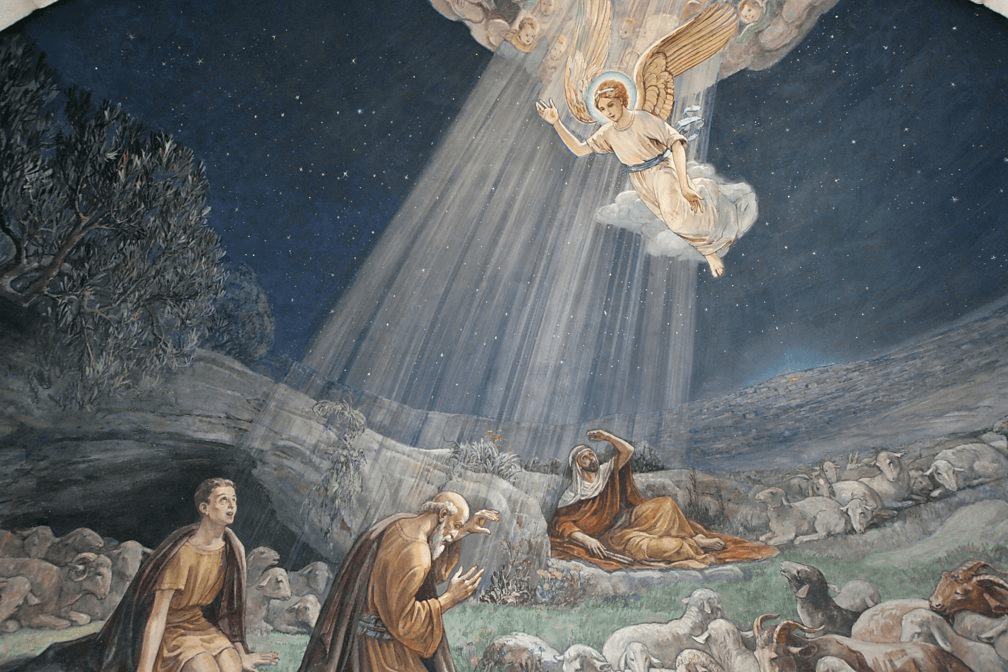
Our reading is from Luke 2:8-20. The role the shepherds played in the Christmas narrative is vital. They were common laborers who were responsible for the sheep who were to be sacrificed in the temple. The animals were valuable, and their job was dangerous. They guarded the sheep against thieves and predatory animals. To the religious leadership of the day, the lives of the sheep were more valuable than the lives of the shepherds.
There was nothing special about that night. It was like any other night, until an angel appeared to them to make the great announcement, the long-awaited Messiah had been born! That announcement is underscored by a great company of angels singing “Glory to God in the Highest, and on earth peace to men on whom his favor rests.” Their words remind us of the greatness of God and His desire to reconcile with mankind. We find the same message of reconciliation in Second Corinthians 5:19, “God was reconciling the world to himself in Christ, not counting men’s sins against them. And he has committed to us the message of reconciliation.” That is the Good News of Christmas. God came into the world to end the conflict with us. That divine truth changes everything. In this blog, I want to explore Jesus’ ministry of reconciliation. Consider three things with me.
First, because of Jesus we have peace with God. When you have peace with God, you have spiritual peace. Romans 5:1 says, “Therefore, since we have been justified through faith, we have peace with God through our Lord Jesus Christ.” On the day that I accepted Christ as my Lord and Savior, I experienced just one emotion – it wasn’t joy, it was relief. The battle was over. I was at peace with God. Augustine of Hippo (354-430) once said, “Because God has made us for Himself, our hearts are restless, until they rest in Him.”
The founder of the great Methodist movement was John Wesley (1703-1791). His brother Charles Wesley (1707-1788) was a great hymn writer for the movement. He wrote more than 1600 hymns. The words of those hymns taught those early Methodists about God. Did you know he wrote the first hymn in every Methodist hymnal ever published, O For Thousand Tongues to Sing? This is what he wrote:
I rest beneath the Almighty’s shade,
My grieves expire, my troubles cease;
Thou, Lord, on whom my soul is stayed,
Wilt keep me still in perfect peace.
Charles Wesley experienced the line he wrote, “keep me still in perfect peace.” Have you unwrapped the greatest gift you will ever receive? Do you know Jesus as your Lord and Savior? If your answer is anything but “yes”, don’t wait. You have been at war with God long enough. The gift of Jesus offers us spiritual peace. Jesus came to offer us peace with God.
Second, because of Jesus we have the peace of God. The peace of God is more than the absence of conflict. It is a deep-seated tranquility that comes from trusting in God’s sovereignty and grace. You can entrust this world to God. Philippians 4:6-7 says, “Do not be anxious about anything, but in everything, by prayer and petition, with thanksgiving, present your requests to God. And the peace of God, which transcends all understanding, will guard your hearts and your minds in Christ Jesus.” This is important because some things are out of our control. Never forget, God is omnipotent.
I have a five-month-old granddaughter, Violet. She has a two-and-a-half-year-old brother, Romeo. My wife, Kathryn and I watch them once a week. God was very wise when he entrusted babies to young people. Our day of babysitting is exhausting, but it is also rewarding. I want to know them, and I want to be part of their lives. At the end of the day, we limp out of their home, but we are always excited about returning the next week. I love my grandchildren with my entire heart, and I cannot help worrying about the world they are inheriting. Our world is facing some massive problems, and it does not appear to be improving. I am thankful for the peace of God, because I can entrust my grandchildren to God. I will love my grandchildren for the rest of my life, but God will love them for eternity. Canadian theologian J. I. Packer (1926-2020) said, “The peace of God is first and foremost peace with God.” Jesus came to offer us peace with God, so we can experience the peace of God. Yet, there is one more.
Third, Jesus expects us to have peace with others. When the Civil War ended in 1865 there was a great amount of hatred in the country. Some feared it would never end. However, time has a way of healing old wounds. In 1885, former General-in-Chief of the Union Army and former President of the United States Ulysses Grant (1822-1885) died. Four years later, former President of the Confederacy Jefferson Davis (1808-1889) died. However, their widows, Varina Davis (1826-1906) and Julia Grant (1826-1902), lived on and settled near each other. As fate would have it, they became close friends. They did something their husbands with all their armies failed to do. They modeled peace for a new generation. Are you a model of peace for your world?
Do you have any broken relationships in your life? How would those relationships improve if you applied Christian principles to them? Christmas is a great opportunity to fix your broken relationships. It may not be an easy thing to do but it is an important thing to do. It takes two people to reconcile. God only expects you to do your part.
Matthew 5:9 says, “Blessed are the peacemakers for they shall inherit the Kingdom of God.” Have you done everything in your power to fix all your relationships? Jesus offered the world reconciliation. There is peace with God. There is the peace of God. There is peace with others.
It really is quite a story. The shepherds were just common laborers working the night shift. Without warning their entire world changed in an instant. An angel appeared and told them the big news – the long-awaited Messiah had been born! That is the Good News of Christmas. God came into the world to end the conflict with us. The angel choir sang it then, but it is still true today, “Glory to God in the Highest, and on earth peace to men on whom his favor rests.”


 Russ Adams