Less Billy, More Jesus

American entertainer Kathie Lee Gifford (born 1953) was raised in a family where God was honored generally, but He was not known personally. Her father was Jewish, and her mother was a Christian. When she was twelve years-old, her mother and her sister were led to Christ by a televised Billy Graham evangelistic crusade. Several months later, they encouraged her to go see a movie produced by the Billy Graham organization, The Restless Ones. Kathy Lee decided to go.

In many ways, it was her story – a young girl trying to decide what path to take: the ways of this world, or the ways of God. She related to the girl in the movie, and she began to evaluate her own life. When the movie ended, an altar call was given, and young Kathie Lee went forward to accept Christ as her Lord and Savior. Her life would never be the same again. Ask Kathy Lee Gifford and she will tell you; we are saved by grace and by grace alone!

Charles Spurgeon (1834-1892) was an English Baptist preacher. He has been called the Prince of Preachers. He once said, “Saving faith is an immediate relation to Christ, accepting, receiving, resting upon Him alone, for justification, sanctification and eternal life by virtue of God’s grace.”  That is an old quote. Charles Spurgeon died in 1892. That quote may be old, but it still rings true today. Someday, we will stand before God justified because of the redemptive work of Jesus Christ. Never forget it – we are saved by grace and by grace alone! That takes us to our scripture reading.

We are in the eighteenth chapter of Luke, verses nine through fourteen. It is the parable of the publican and the Pharisee. The story is dominated by two men. They are not identified by name, only by vocation. The first was a Pharisee. We are critical of the Pharisees because they confronted Jesus. The Master’s own generation was not critical of Pharisees. They were viewed as the religious elite, who were the bridge between mankind and God. The second man was a Publican. That was the term used in ancient Roman times for a tax collector. In our time, we dislike tax collectors; they hated tax collectors. They were viewed as traitors, who sold out to the Romans. They profited at the expense of their own people, the Jews. This parable plays on our stereotypes or prejudices.

According to the story, both men went to the Temple to pray. There is nothing surprising about that. The people of Jesus’s day valued prayer. They prayed regularly. Daily, morning and evening prayer was scheduled at the temple in connection with the sacrifices. In addition to those times, the temple was always open for private prayer. Prayer was not isolated to the Sabbath. It was a big part of their daily lives.

In Jesus’s story, the Pharisee was the picture of complete pride. He stood upright and reported to God all his good deeds. He fasted twice a week and gave generously to the poor. The other man, the Publican, was the picture of complete brokenness. He stands at a distance beating his breast. He is not proud of the way he is living. He admits he is a sinner, and he asks God for mercy. The two gentlemen in Jesus’s story are from opposite ends of the universe. There is nothing surprising in the story until the last verse. Verse fourteen reads, “I tell you that this man (the tax collector) rather than the other (the Pharisee) went home justified before God. For all those who exalt themselves will be humbled, and those who humble themselves will be exalted.” It is impossible to read this story and ignore the importance of humility. After all, we are all sinners saved by grace. Yet, there are many in our society who can relate to the Pharisee. You must know someone.

According to the Pew Research Group, 80% of American Christians believe Jesus is not their only hope of salvation. In other words, four out of five American Christians believe their entrance into heaven is merit-based. That is why we hear so much about good works when a loved one dies. They volunteered to help children read. They mowed their aging neighbor’s lawn. They gave generously to the church of their time, talent, and money. They cared for stray cats and loved dogs. They would do anything for anyone. Do you know why people say such things? They are trying to convince us, or themselves, that their loved one is in heaven because they were a good person. This is the problem: A merit-based entrance into heaven is not what the Bible teaches.

The Bible teaches us we are saved by grace and by grace alone. Ephesians 2:8-9 says it clearly: “For it is by grace you have been saved, through faith – and this not from yourself, it is the gift of God – not by works, so that no one can boast.”  Grace is God’s unmerited favor, demonstrated most fully in the sacrifice of Christ. In short, the only way to heaven is through Jesus – the way, the truth and the life. The faithful understand what Jesus has done for them.

Hudson Taylor (1831-1905) was a missionary who spent fifty-one years in China. At some point in his life, he was scheduled to speak at a large Presbyterian church in Melbourne, Australia. The moderator of the service introduced the missionary in eloquent and glowing terms. He told the large congregation all that Taylor had accomplished in China, and then presented him as “our illustrious guest.” Taylor stood quietly for a moment, and then opened his message by saying, “Dear friends, I am the little servant of an illustrious Master.” Hudson Taylor never forgot the truth. He was a sinner, who was dependent on God’s grace. Never forget it – you are a sinner who is dependent on God’s grace. We are saved by grace and by grace alone!

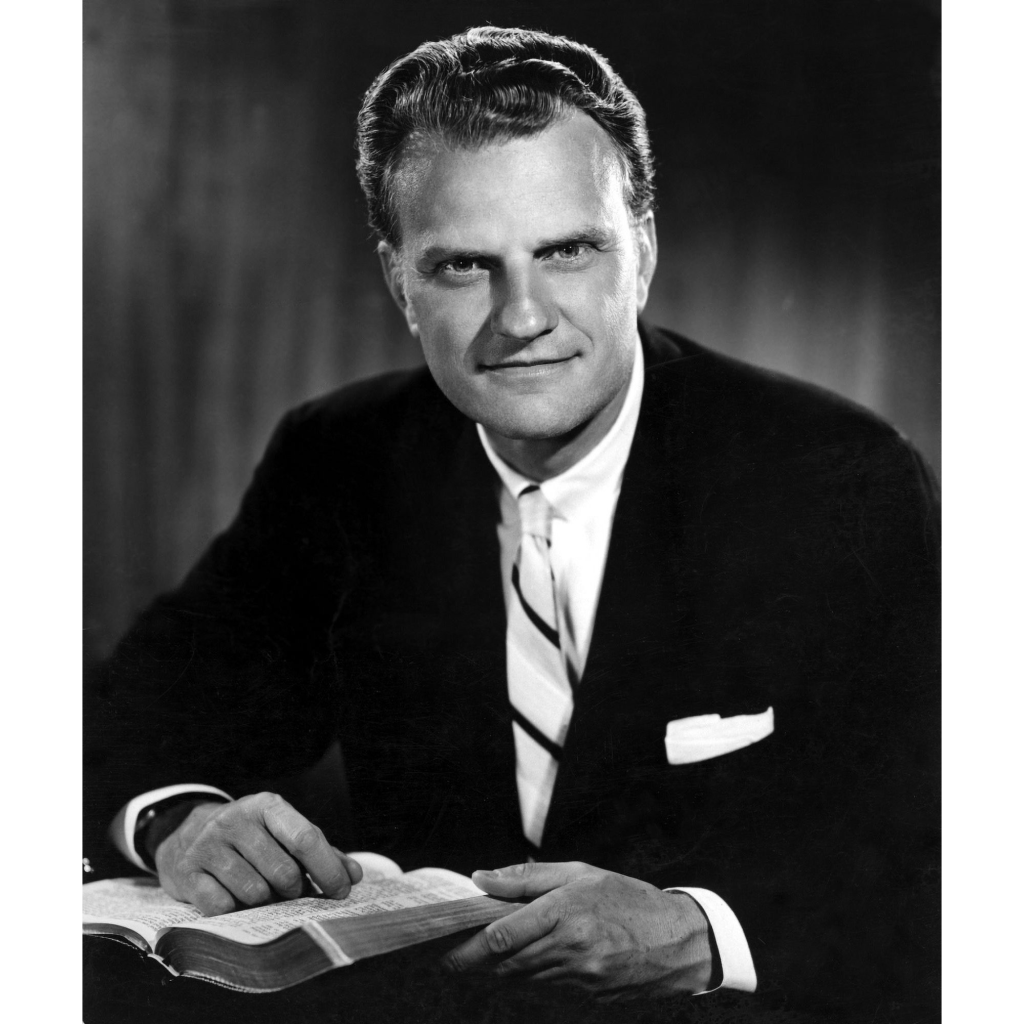
Billy Graham (1918-2018) was born on November 7, 1918 in a downstairs bedroom near Charlotte, North Carolina. His parents raised him and his three siblings in the Associate Reformed Presbyterian Church. He was converted at sixteen years old. He graduated from the Florida Bible Institute in 1940 and Wheaton College in 1943. In 1947 Billy Graham held his first crusade in 1947 in Grand Rapids, Michigan and held his last crusade in 2005 in New York City. I remember attending a Billy Graham crusade at Cleveland Municipal Stadium during college. Over those 58 years, he preached 417 crusades, including 226 in the United States and 195 abroad. It has been estimated he preached to more than 210 million people in his life. God only knows how many souls he won for Jesus Christ, including Kathie Lee Gifford. Graham is considered one of the most influential Christian leaders in the twentieth century.

Billy Graham died on February 21, 2018, in Montreat, North Carolina. He was a few months shy of his one hundredth birthday. If anyone deserved to go to heaven, it was Billy Graham. Yet, He never forgot the truth. He was a sinner, who was dependent on God’s grace. At his death, it was reported Billy Graham helped plan his own funeral. He had a simple request: less Billy, more Jesus. Billy Graham knew he was saved by grace and by grace alone! Do you? We are not saved by our good works. We are saved by grace. Do you remember the quote from Charles Spurgeon? He once said, “Saving faith is an immediate relation to Christ, accepting, receiving, resting upon Him alone, for justification, sanctification, and eternal life by virtue of God’s grace.”
Examining Your Priorities

Our reading comes from the twelfth chapter of Luke, verses thirteen through twenty-one. Jesus is in Judea and is surrounded by a great crowd. He is offering them both a word of encouragement and a word of warning. Jesus tells them to keep their eyes fixed on God. Without warning, Jesus is interrupted.

The interrupter did not hear a single word from Jesus, because he is preoccupied with personal problems. His problem is complex because it combines two of life’s most complicated topics: family and money. Some things don’t change; family issues and money issues are still complex. That is why verse thirteen resonates with us. The author quotes the man with these words, “Teacher, tell my brother to divide the inheritance with me.” As a member of the modern clergy, I have never been asked to help settle family estates. In Jesus’s day, it was common to take such problems to teachers or rabbis. As a rule, the older brother always received a double portion of the inheritance. Jesus saw the problem instantly – the Master knew the man’s request was rooted in materialism. In other words, Jesus knew the man’s problem was greed. The man’s priorities were confused. Then, Jesus told the man this story.

The ground of a certain rich man produced a bumper crop. That was a good thing and a bad thing. It was a good thing because his crop was valuable. It was a bad thing because he had no place to store his crop. To the business world, the problem is solved easily, he tears down his original barn and builds a bigger one. Once this bumper crop is harvested and stored, life will be easier. It is a great plan except for one major flaw –  the man suddenly dies and is separated from his earthly possessions. Sadly, the man was financially successful, but spiritually bankrupt. That makes me ask an interesting question. How many successful, spiritually bankrupt people do you know? Could it be you are a successful, spiritually bankrupt person?

I have said it a million times, Money is amoral. Money is neither good nor bad. It is how we handle and view our money that makes it good or bad. That is the case in this story. This parable is filled with personal pronouns. Listen to the story again with that filter.

“The ground of a certain rich man yielded an abundant harvest. He thought to himself, ‘What shall I do? I have no place to store my crops.’ “Then he said, ‘This is what I’ll do. I will tear down my barns and build bigger ones, and there I will store my surplus grain. And I’ll say to myself, “You have plenty of grain laid up for many years. Take life easy; eat, drink and be merry.”’

Jesus’s simple story is dominated by personal pronouns. In verses sixteen through nineteen, the word, “I” is uttered six times by the rich fool. Like the man with the problem, the man in the story is consumed with selfishness and materialism. The man with the problem and the man within the story were victims of greed. Yet, the story is not really about money. It is a story about priorities. The man with the problem and the man in the parable’s greatest priority was money. What is your greatest priority? Sometimes our greatest priorities are bad things. How many examples do you need?

Matthew Perry (1969-2023) was rich. At the time of his death, he was worth $120 million. Most of the money came from the TVshow Friends, where he played Chandler Bing. If he had used his fame and fortune for good, then he would have improved many lives. He would have been welcomed by any non-profit. Sadly, that was not his story. His greatest priority was himself. It has been estimated he spent $9 million on various alcohol and drug addictions treatments. He went into rehab fifteen times. Sometimes our greatest priorities are bad things. However, this is also true: Sometimes our greatest priorities are good things. The problem is, our good things aren’t always the best thing.

There is a website called Quora. On it, people respond to all kinds of questions. I punched in the question: what is your greatest priority? People responded in a variety of ways. One guy said the highest priority in his life was survival skills. One woman answered the greatest priority in her life was her clothes, make-up and hair. Someone else said the greatest priority in their life was finding a life partner. One gentleman said, his greatest priority in his life was sex. How do you answer the question, what is your greatest priority? I would bet your answer is close to my answers.

One of my priorities is financial stability. There are four things you need to know about my personal finances. First, I am a fiscal conservative. I am uncomfortable carrying any kind of debt. I have been known to pay the bill before the bill comes. I do not expect to die rich, but I hope I die debt-free. Second, I am terrified of the Internal Revenue Service. I think everyone should be afraid of the IRS. Third, I recognize everything I have in this world is only on loan from God. The last thing I am going to do financially is cheat God. Fourth, I value work. I was raised in a steel town in Northeast Ohio, where work was not just valued, it was expected. One of my priorities in my life is financial stability.

One of my priorities is good health. In January of 1950, my grandmother came home from church and was preparing lunch for her family. She never ate that meal, because she dropped dead from a fatal heart attack. She didn’t get to be my age. My family tree is filled with high blood pressure. Every morning, I get up and take my medicine, so I won’t have a heart attack. My greatest fear in life is not dying, it is lying in a bed in a nursing home unable to care for myself. One of my priorities in life is my health.

One of my priorities are my children and my grandchildren. I am proud of my children, Sarah and Anna. They are good people who are doing well. I believe they are good people for two reasons. First, they were raised in a single community and knew stability. I never longed for them to be Methodist gypsies wandering around the Annual Conference. They are good people because they are a product of a good community. Second, they know Kathryn and I love them and support them. They don’t need us, but we need them. They know we want what is best for them. It goes without saying – we want what is best for our grandchildren, Pippa and Romeo, and are willing to sacrifice for them. One of my priorities is my children and grandchildren.

One of my priorities is my spouse. Kathryn and I have been married thirty-six years. The time has gone fast; I wish I could slow life down. There are so many things we would like to do together. There are so many places we would like to go together. I have never hidden my feelings for her. My life began on the day we met. One of my greatest priorities is my wife. Nothing seems to matter without her. Let me ask you the question again. What are your priorities?

None of those things are bad things. The problem is none of those things are eternal. Someday, I am going to be separated from my material possessions. Someday, there is an excellent chance I am going to get a terminal disease or get in a fatal accident. The problem is, there is only so much I can do for my children or my grandchildren. Kathryn and I would like to leave this world together, but there is no guarantee. It is a cruel fact; the world is constantly changing. The only thing that is completely stable is God. Only God is eternal.

Years ago, I was called by one of the local funeral homes to officiate at a service. I did not know the deceased. I was called for one reason – neither the deceased nor anyone in the family had a church home. They didn’t even know a member of the clergy. However, they wanted to celebrate their loved one’s life. As is my custom, I went to the calling hours to meet with the family. It was a painful couple of minutes for the family. They apologized to me for not going to church. In their minds, they had good reasons. I told them I wasn’t there to judge them, but I was there to help them celebrate their loved one’s life.

As they told me about him, I discovered he was a good person. He would do anything for anyone. He had worked hard and was well respected by his peers. His hobbies always included family members. His absence would leave a great void in their lives. His brother said, “He lived every day to the fullest. He lived as if he was never going to die.” This is the problem: He did die. Sadly, like the man in Jesus’s story, he was economically successful, but spiritually bankrupt.

The funeral service went off without a hitch. His life was remembered. Some of the memories made people laugh. Some of the memories made people cry. The service ended with me giving the benediction. As is the custom, the last ones to view the body were the family members. After I perform a funeral, most family members stay for a few unpleasant minutes. This family stayed for what seemed like an eternity. Numb, they just stood there looking at the corpse. The veteran funeral director, who was a great churchman, motioned for me to come to him. He whispered in my ear, “Russ, I have seen it a million times. People with no faith linger, because once the service is over, it is over. They will never see their loved one again. People with faith are different. They move on because they know there is more. They know they will see their loved one again in heaven. How great of a priority is God to you? American Baptist minister Rick Warren (born 1954) once said, “Living in the light of eternity changes your priorities.”

Is Bigger Better?

Hudson Taylor (1832-1905) is remembered for his many years of mission work in China. One night, he was scheduled to speak at a church in Birmingham, England. After months of planning, the day finally came, but the weather was horrible. Some tried to discourage Taylor from speaking. Even the organizers of the event discouraged him. But Taylor, himself, insisted. Less than a dozen people showed up, but the meeting was marked with unusual spiritual power. Half of those present either became missionaries or their children entered the mission field, and the rest were faithful supporters of the China Inland Mission for years to come. Can I ask you a question? Was that meeting a success or was it a failure? Through the eyes of this world, it was a disaster; less than twelve people came. Yet, through the eyes of God it was a great success – lives were changed in the name of Jesus. Let me state the obvious, bigger isn’t always better.

We find ourselves today in the fourth chapter of Mark, verses twenty-six and thirty-four. Jesus is in Galilee. He was extremely popular there, so a great crowd was following him. They heard a series of parables about the Kingdom of God. The chapter begins with the parable of the sower. Next comes the parable of the light and the bushel basket, the growing seed, and our parable, the mustard seed. Jesus says the Kingdom of God is like a mustard seed. It is known by all, because it is so short and easy to understand.

Proverbially speaking the mustard seed was the smallest of all the seeds. (The truth be told, other seeds in that corner of the world are smaller. For example, the seed of a cypress tree is smaller.) However, don’t be fooled by the size of the seed. It is deceiving. It starts out being small and insignificant, but it ends up being quite impressive. A full-grown mustard plant is more of a bush than a tree. It stands twelve feet tall. It is large enough for birds to take shelter. The point Jesus is trying to make is not hard to discover. The Kingdom of God may begin very small, but it will grow. In time, the Kingdom of God will become quite impressive.

Jesus wasn’t setting up the crowd for disappointment. The Kingdom of God did grow. Today, Christianity is the largest religion in the world. Our world has a population of approximately eight billion people. Approximately one-third of our world’s population is Christian. On the global scene Christianity is still growing. Did you know the Christian faith grows by 80,000 people per day? That didn’t just happen in an instant. It took time. Consider this with me:

  • In 100 AD the world population was 181 million. For every 360 people, there was one Christian.
  • In 1000 AD, the world population was 270 million. For every 269 people, there was one Christian.
  • In 1500 AD, the world population was 425 million people. For every 84 people, there was one Christian.
  • In 1900 AD, the world population was 1.6 billion people. For every 40 people, there was one Christian.
  • In 1950 AD, the world population was 2.5 billion people. For every 30 people, there was one Christian.

Jesus didn’t lie to the crowd, he told them the truth. He told them the Kingdom of God would start out very small, but in time it would be very big. We like those big numbers, because in America we believe bigger is better. That line of thought has even filtered into the life of the church.

Lakewood Church in Houston, Texas is the largest church in America. They have 45,000 in worship every weekend. They have six services on an average weekend, four in English and two in Spanish. Joel Osteen (born 1963) is the lead pastor. I don’t know how you feel about Joel Osteen. I do not know how I feel about Joel Osteen. However, you must admit, in a bigger is better society, Joel Osteen is a great success.

Can I make a confession? I am a product of this society. I, too, believed bigger is better. For most of my working career, I chased the crowd. For decades, I studied church growth principles. I could have held my own church growth workshop. Weekly on Sunday afternoons, I added up my church’s attendance. If it was a good attendance day, then I was in a good mood the rest of the week. If it was a low attendance day, then I would be in a bad mood the rest of the week. When my colleagues ask me about my church, I give them a number. I researched other churches’ numbers. I believed bigger is better. There is nothing wrong with numbers, until they became a preoccupation. At some time, I had a revelation – the numbers were robbing me of any feeling of satisfaction. The numbers only promoted my failures. I began to evaluate my worth as a person based on the numbers. Joel Osteen averages 45,000. I averaged about 250. There really is no comparison. I am not criticizing Joel Osteen or any other mega church. Every community seems to have one. I am saying numbers aren’t everything. It all changed for me in an instant and I discovered it in one of my own sermons. I discovered it was more important to be faithful then it was successful. It was a humbling moment.

It was the Sunday before the resurrection of Jesus. You know the story. A great crowd had gathered in Jerusalem for the annual Passover observance. On the lips of everyone in the crowd was the name Jesus. His miracles had made him famous. Some believed he was the long-awaited Messiah. When Jesus arrived, everyone wanted to see him. Some were in the crowd cheering for Jesus because he was trending. Some were in the crowd cheering for Jesus because they wanted him to perform a miracle. Perhaps they needed a healing, or a loved one needed a healing. Some were in the crowd for political reasons. They were tired of foreign domination and hoped Jesus would use his power for political liberation. A minority in the crowd loved Jesus and just wanted to be near him. Through the eyes of the world, it couldn’t get any better. Jesus was a success because he had drawn a great crowd. But you know what happened. One by one the people walked away. On Thursday evening, the great crowd had been whittled down to twelve. By Friday, the crowd had been reduced to a select few. It didn’t seem to matter to Jesus, he wasn’t interested in the crowd anyway, he was more interested in the committed. Jesus was more interested in eternal faithfulness than he was in worldly success. Some things don’t change. To Jesus, bigger isn’t necessarily better. The only thing that really mattered to Jesus is faithfulness. This is the question you must answer: How faithful are you?

One of the great preachers of the twentieth century was Fred Craddock (1928-2015). He taught homiletics at the Candler School of Theology at Emery University. No one influenced my preaching more than Fred Craddock. Years ago, I read a story about a time Fred Craddock addressed a group of ministers at a conference. These are his own words:

To give my life for Christ appears glorious. To pour myself out for others. . . to pay the ultimate price of martyrdom — I’ll do it. I’m ready, Lord, to go out in a blaze of glory. We think giving our all to the Lord is like taking a $l,000 bill and laying it on the table—”Here’s my life, Lord, I’m giving it all.” But the reality for most of us is that he sends us to the bank and has us cash in the $l,000 for quarters. We go through life putting out 25 cents here and 50 cents there. We listen to the neighbor kid’s troubles instead of saying, ‘Get lost.’ Go to a committee meeting and cover the same issues again. We give a cup of water to a shaky old man in a smelly nursing home. Usually, giving our life to Christ isn’t glorious. It’s done in all those little acts of love, 25 cents at a time. It would be easy to go out in a flash of glory; it’s harder to live the Christian life little by little over the long haul.

It isn’t just true of preachers; it is true for everyone. We long to do something great for God, but what we normally do are the little things and hope God uses them. We aren’t just doing little things – we are planting mustard seeds. How many mustard seeds have you planted in your life? Charles Spurgeon (1834-1892) is one of the great names in the history of the western church. He was the minister of the New Park Street Chapel of London for 38 years, where he saved countless souls and influenced a generation. His accomplishments in life are impressive, but his own conversion was quite simple. He accepted Christ as a teenage boy at a little Methodist chapel in the middle of a snowstorm. Very few were there that night. Even the preacher was absent. A layman led the service for the tiny crowd. He spoke on just one verse Isaiah 45:22, “Look unto me and be saved, all ends of the earth.” Those words resonated in Spurgeon. He accepted Christ, and the world will never be the same again. When I read that story, I couldn’t help but to ask this question: I wonder if that sincere layman knew the impact he had on the world? I wonder what kind of impact we have had on the world. I wonder what kind of impact you have made on this world. How many mustard seeds have you planted?