Move Forward!

The twenty-third President of the United States, Benjamin Harrison (1833-1901), was a Republican from Indiana. He held the office for four years, 1889-1893. It was during this time that the White House was wired for electricity. History tells us Harrison was intimidated by electricity. He and his wife, Caroline (1832-1892), refused to touch a single light switch. They were so paralyzed by fear that the Harrisons slept with the lights on if no servants were present to turn them off. Fear has a way of paralyzing people. Faith has a way of mobilizing people. Have you ever been paralyzed by fear? Are you a person of faith or fear? That takes us to our reading Exodus 14:10-15.

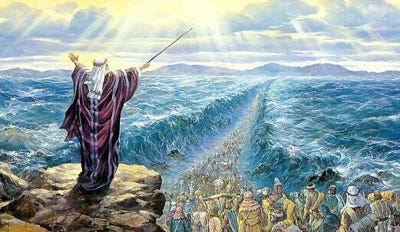
The main character in the story is Moses, the one God selected to liberate the Hebrews. His story is well known – enslaved in Egypt, they prayed for help and that help came in the person Moses. As the story goes, after a series of plagues, the Egyptian Pharaoh freed the Hebrews. That must have been an exciting day. For the first time in their lives, they were free. Their journey went well until they reached the coast of the Red Sea. It was at that moment someone noticed their greatest nightmare – the Egyptian army was following them because the Pharaoh had changed his mind; they were trapped. If you use your sanctified imagination, you can imagine the scene. The Red Sea was in front of them and the Egyptian army was behind them. Moses stands in front of the crowd and implores them to move forward trusting God. Instead, the people were paralyzed by fear and did three things the faithless have always done. Their reactions are still witnessed today in the lives of the faithless, who refuse to move forward and claim God’s calling for their lives. Let’s look at how they reacted to this difficult situation.

Some of the Hebrews refused to move forward because they looked back. Do you know of anyone who keeps looking back? That is what the Hebrews did. The Egyptians were behind them, and the Red Sea was in front of them. Things looked bad. What did they do? They glamorized the past. In verses 11 and 12 Egypt is mentioned five times. Slavery looked good next to death. They looked back to Egypt and remembered the good old days. When was the last time you recalled the good old days? Or perhaps you have never recovered from some negative experience in your past? Years later, those individuals still have a hold on you. How often do you look back? Is it possible the past is preventing you from fully living today?

Some of the Hebrews refused to move forward because they were consumed with self-pity. Do you know of anyone who loves a good pity party? In verses 11 and 12 they are speaking to Moses, “Was it because there were no graves in Egypt that you brought us to the desert to die? What have you done to us by bringing us out of Egypt? Didn’t we say to you in Egypt, ‘Leave us alone; let us serve the Egyptians’? It would have been better for us to serve the Egyptians than to die in the desert!”  American author and activist Helen Keller (1880-1968), who could have easily wallowed in self-pity, once said, “Self-pity is our worst enemy and if we yield to it, we can never do anything wise in this world.”  How many pity parties have you thrown for yourself lately?

Some of the Hebrews refused to move forward because they blamed others. Do you know someone who is always blaming others for their shortcomings? Verses 11 and 12 again tell us, “They said to Moses, ‘Was it because there were no graves in Egypt that you brought us to the desert to die? What have you done to us by bringing us out of Egypt? Didn’t we say to you in Egypt, ‘Leave us alone; let us serve the Egyptians’? It would have been better for us to serve the Egyptians than to die in the desert!’”  What are the Hebrews doing in those two verses? They are blaming Moses for their situation. If Moses hadn’t taken them out of Egypt, then they would not be in this difficult situation. Do you know of anyone is having a difficult time taking responsibility for their own lives? Is it possible you have blamed others for your shortcomings?

Moses is the only one in the story who trusted God. While the rest of the Hebrews are paralyzed by fear, Moses trusts God and commands the people to move forward. Verse 13 says, “Moses answered the people, ‘Do not be afraid. Stand firm and you will see the deliverance the LORD will bring you today. The Egyptians you see today you will never see again’”, verse 15 says, “Then the LORD said to Moses, ‘Why are you crying out to me? Tell the Israelites to move on.’”  The choice is really yours. You can be paralyzed by fear, or you can move forward trusting God. What is God calling you to do, but you are simply too afraid to act. I have two words for you: move forward!

Years ago, I read a story about a man by the name of Janez Rus. A member of the Nazi party, he fought in the German army during World War II. In 1945, the war ended and Rus began hiding in the basement of his sister’s farmhouse, because he was afraid he would be arrested. He wasn’t discovered until 1977. He hid for 32 years! He lost 32 years of his life. He missed everything because he was paralyzed by fear. How much of your life are you wasting because you are paralyzed by fear? What is God calling you to do but you refuse because you are afraid? Don’t be like the fearful Hebrews. Be like Moses who trusted God and moved forward. American evangelist Bruce Wilkinson (born 1940) once said, “Dependence upon God makes heroes of ordinary people like you and me!”
Stop Complaining!

We find ourselves today in the sixteenth chapter of Exodus. (Exodus 16:1-8) The Hebrews should have been happy. They got everything they wanted. They prayed to God because their lives were hard and God sent them a liberator, Moses. It was Moses who confronted the Pharaoh. It was Moses who directed the plagues. It was Moses who led the people out of Egypt and into the wilderness. It was Moses who raised his hands as God parted the Red Sea. It was Moses who gave the people hope for a bright future. The people should have been happy, but they were unhappy. Verse two says the community stood united. They were not united in their appreciation of Moses and all he had done. They were united against Moses, and Aaron, in their dissatisfaction. In a short time, the people had forgotten about their hard lives in Egypt, and they longed for the good old days in that foreign land. It is one of those things that links one generation to the next. Every generation has their complement of complainers. We have our share of complainers. If it were not so sad, it would be funny. I love this story.

A monk joined a monastery and took a vow of silence. After the first 10 years his superior called him in and asked, “Do you have anything to say?” The monk replied, “Food bad.” After another 10 years the monk again had opportunity to voice his thoughts. He said, “Bed hard.” Another 10 years went by and again he was called in before his superior. When asked if he had anything to say, he responded, “I quit.” His superior responded, “It doesn’t surprise me a bit. You’ve done nothing but complain ever since you got here.”

Complaining is what makes church work so exhausting. The hardest part of my job is not preaching or leading worship. I love to preach, and I love to worship in any form. The hardest part of my job is not pastoral care. It is a privilege to work with people during the most sacred times in their lives. I am qualified to make this next statement because I have worked within the life of the church for forty years. The most challenging part of church work is dealing with all the complainers. People complain about everything: the temperature in the sanctuary, the content on the Facebook page, the style of worship we offer weekly, the state of the parking lot, the font size in the bulletin, and performance of the church staff. I could go on, but I will not because you get the point.

Sometimes, our complaints reveal arrogance. Not caring about anyone’s feelings opinions, they proclaim, “I just do not like it! I will leave if you do not make me happy. I will not give if you do not make me happy.” (We will try to get by without you!) Sometimes we try to hide our complaints by hiding behind an unknown person.

 “I will not tell you who, but others do not like it. Certainly not me. I just thought you needed to know.” (We know it is you!”) Sometimes our complaints take the form of concerns. “I am concerned you are doing it all wrong.” (I hear. Why don’t you do it my way?) When I was young, I thought the key word in the life of the church was Jesus. Now, I understand the key words in the life of the church are power and control. I do not what to shock you, but church work takes some skill, not just opinion. That is why we are required to have so much education and attend so many continuing education events. Listen to the next line clearly. The church is not a business, you can not apply business principles. What worked at your place of employment will not work here. If we ran this church like a business, it would be gone in five years.

Complainers are exhausting because church work is so personal. One of the great preachers of the twentieth century was Fred Craddock (1928-2015). He said we go into church work because we are willing to give our lives to God. We are willing to die for God in a blaze of glory. However, that never happens. We give our lives away one nickel at a time. Complainers make church work exhausting. This is equally true. Complainers frustrate the mission of the church and put a smile of Satan’s face. I must ask you these questions. Do the people in your life consider you a complainer? Do the people in your life consider you a whiner? I could have called this message Stop Whining.

The question is not if people complain. They complain! The question is why do people complain? Will Bowden (born 1971) is a pastor and motivational speaker in the northwest. He also authored a book called Complaint Free World. He says there are five reasons why people complain. Those five reasons spell out the word G.R.I.P.E. Here are the five:

Get attention – everyone wants to be acknowledged. When you complain, you get noticed.

Remove responsibility – people complain about a situation or task to remove themselves from taking responsibility to improve it.

Inspire envy – this type of complaining can be called bragging. You say, “The minister is dumb,” is another way of saying, “I am smarter than the minister.” (Chances are you are smarter than me.)

Power – you are trying to recruit others to your side of the argument. In other words, people are looking for support.

Excuse poor performance – people explain why they failed. For example, I would have caught the ball, but the sun was in my eyes.

I do not like that list because I found myself in it several times. Will Bowen said,“Complaining is like bad breath, you notice it when it comes out of somebody else’s mouth, but not your own.” I do not know why the Hebrews complained, but they complained. God had given them everything they wanted, yet they still complained. Perhaps, they were victims of human nature. It is true throughout time. It is true of our generation. We glorify the past and we only saw what we want, blind to what they have.

On November 4, 2010, Eunice Sanborn (1896-2010) became the world’s oldest living person. She celebrated her 114th birthday on July 20, 2010, at her church, the First Baptist, in Jacksonville, Texas. Eunice says that she not only loves everything about her life, but she also has “no complaints.” If she had wanted to complain, she would have had many things accumulate throughout her 114 years to complain of. Yet, this lady has demonstrated that complaining is a choice. Did you hear what I said? We choose to complain! It is not a requirement, and I cannot speak for you. I can only speak for myself. I am going to do my best to stop complaining. Here’s why…

I have just finished the most challenging year of my life. It all began about a year ago. In October, I thought I had a sinus infection. I was wrong! I had the coronavirus. I did not lose my sense of taste, but I had all the other symptoms. I spent five days in the hospital, and I missed five weeks of work. I should have stayed home another work because I was so fatigued. One of the saints in this church placed a stool behind the pulpit, but I was too weak to climb on it. In January, my wife, Kathryn, had heart surgery. I am thankful to say they did it robotically. She did great and only has three small incisions. In April, my daughter, Anna, got married. It was the week after Easter, so it was a busy time. It was an exciting time. Her wedding day was perfect. The weather was perfect. (How many 80-degree April days do you remember in Ohio?) The ceremony was perfect. The church reception was perfect. The evening reception was perfect. The gathering of family and friends was great. I would not change a single thing about that day. Two days later, Kathryn and I flew to Chicago to escape the post wedding blues. We had set an agenda to see the Windy City, but we did not see a thing on the list. Shortly after I arrived in Chicago, I was having emergency surgery for an intestinal blockage. It was during that surgery they nicked my bowel. I spent a week in the hospital in Chicago. I struggled when I got home, so I spent a few days in a local hospital. They sent me to the Cleveland Clinic, where I spent about ten days. I was home by my birthday on May 9th. I was released by my infectious disease doctor on my anniversary May 27th. I was released by my surgeon, who never operated on me, in Cleveland on July 27th. I preached on Easter, April 4, and did not preach again until July 11th. Most of that time I laid on my couch, where my wife cared for me. Without her, I would have ended up in a nursing home. I will always be grateful. People ask me how I am doing? I respond, I am not dead yet. Part of that is funny, part of that is true. I am happy to report I have not felt this good in a year.

I am telling you this again because my horrible year changed me. I learned three things during that horrible year. I knew them in the past so you could call them reminders. First, I learned life is short. Every day is a gift and not a single day should be wasted. I will be the first one to admit it. I have a good life. I do not know why I have such a good life. Second, I learned to never take your health for granted. It is true. If you have your health, then you have it all. Third, I learned to be less critical of others and more optimistic about life. I am going to do my best to stop being so negative and stop complaining about things that do not matter. What is going to matter to you in one hundred years? The only thing that is going to matter to you in one hundred years is Jesus! Complaining is a choice, so stop complaining.

In 1842, the great English writer Charles Dickens (1812-1870) came to America for the first time. He was treated like a celebrity and was impressed by our country. However, he found Americans to be curious. He felt that Americans took for granted the greatness of their country. He thought Americans had it backwards. He thought we had Thanksgiving Day all wrong. He thought Americans should take 364 days a year and thank God for all he given us, and one day a year to complain.

Do you remember the quote from Will Bowen? He said, “Complaining is like bad breath, you notice it when it comes out of somebody else’s mouth, but not your own.” Moses must have said it to the Hebrews, and I am going to tell you, stop complaining. God has been good to us!