What Job Teaches

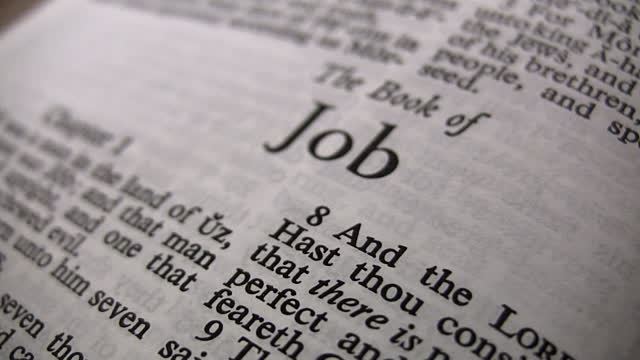
Our reading is Job 1:1-3, 6-12. Everyone knows Job’s story – his is a story filled with hardship and suffering. It wasn’t always that way. In the beginning, Job lived the perfect life. Verse three says, “He (Job) was the greatest man among all the people of the East.”  Fearing God and shunning evil, he was a good man who was blameless and flawless. Living with seven sons, he had a prosperous life. His perfect life would have continued except for one imperfect being – Satan. According to verses six through twelve, Job’s perfect life changes in an instant.

According to the text, the angels present themselves to God. In their company is Satan. God questioned his presence and began to dialogue with him. God, who was impressed with Job, asked Satan if he had encountered Job. Satan had, but he was not impressed. He believed Job’s faith was shallow, he only had faith in God because he had a perfect life. It is at this moment that Satan proposes a test. He believes Job will reject God when some hardship enters his life. God does not believe Job’s faith is shallow; God believes his faith his deep. In the face of great hardship and suffering, Job will remain faithful. The book is filled with Job’s hardship and suffering. He loses everything, but he never loses his faith in God. Everyone knows Job’s story because we can relate to him. Job teaches us three divine truths.

First, Job teaches us suffering is a part of life. In my time in the ministry, I took nearly every afternoon to visit. Visitation is important because it is the best way to get to know your people. People need their pastor when life is difficult. Regularly, I went to the hospital. Someone was always facing surgery or recovering from surgery. Sometimes, someone was recovering from an accident or having tests performed. Some were facing a disease, often with no hope of a cure. Often, I would go to nursing homes and I found those visits exhausting. Unable to live at home, men and women lingered in nursing homes where many prayed to die. For them every day was the same – the air was always stale, and the food was always tasteless. I guess the fortunate ones were shut-ins, where many lived alone in isolation. I have no clue how many visits I made in my four decades in the ministry, but each visit reminded me that life is hard. However, none of those individuals denounced the faith, each one longed for me to pray with them. They needed God. Job teaches us that suffering is a part of life.

Second, Job teaches us suffering changes our vision. Stephen Hawking (1942-2018) died on March 14, 2018, a victim of ALS Syndrome, also known as Lou Gehrig’s disease. He was an astrophysicist at Cambridge University. Many considered him the most intelligent man in the world. He advanced the general theory of relativity farther than any person since Albert Einstein (1879-1955). Mentally, he was brilliant, his personality could not be suppressed. Hawking once said that before he became ill, he had very little interest in life. He called life a “pointless existence.” He drank too much and wasted time. Then he learned he had ALS syndrome and was not expected to live more than two years. The ultimate effect of that diagnosis, beyond its initial shock, was extremely positive. He claimed to have been happier after he was afflicted by the disease. Hawking said, “When one has nearly everything taken away, one really appreciates everything that one does have.” Suddenly, each small pleasure becomes precious. By contrast, those who believe life owes them a free ride are often discontented with its finest gifts. How much of your life are you taking for granted? In suffering we learn to appreciate life’s simplest things. Job teaches us suffering changes our vision.

Third, Job teaches us suffering enhances our witness. The exact number of Christian martyrs is unknown. According to Gordon Conwell Theological Seminary, the number can range from tens of thousands to tens of million. It is estimated half of all Christians martyrs died in the 20th century under communism, fascist or totalitarian governments. No one can question the faith of anyone who made the ultimate sacrifice for Jesus. Each story is impressive. Let me tell you one.

John (1907-1934) and Betty Stam (1906-1934) met while studying at the Moody Bible Institute in Chicago. The China Inland Mission accepted them as missionaries in 1932. In 1934, the couple was arrested by the communist government for possessing Bibles and other Christian materials in their home. A short time later, the couple was executed. Their story was covered by many publications. As one account of their lives put it, the Stams’ powerful Christian testimony was carried to the ends of the earth by hundreds of secular newspapers which featured front page stories about the Stams’ faith, dedication and martyrdom. Many unbelievers turned to Christ; many believers were so moved by the Stams’ zeal that they became missionaries themselves. Job teaches us suffering enhances our witness.

In 1962, Victor (1914-1999) and Mildred Goertzel (1904-2000) published a study called Cradles of Eminence. The book was a revealing study of 413 “famous and exceptionally gifted people.” They spent years attempting to understand what produced greatness. Surprisingly, the most outstanding fact was that virtually all of them, 392 of the 413, had to overcome difficult obstacles to become who they were. Maybe we should look at our hardships and suffering as blessings in disguise. What major obstacles have you had to overcome in your life? Helen Keller (1880-1968), who lived her life completely blind and deaf said, “Character cannot be developed in ease and quiet. Only through suffering can the soul be strengthened, ambition inspired, and success achieved.”
Why the Innocent Suffer

Years ago, I officiated at a wedding in the St. James Meeting House in Boardman, Ohio. I have officiated at many weddings in Boardman Park through the years. They call me because they want a minister, but don’t have a church. On Friday night, I showed up for the rehearsal. Everyone was excited and in a good mood. At the conclusion of the rehearsal, the bride invited me to the rehearsal dinner. My wife Kathryn was out of town, so I decided to go. I planned on dining and dashing. I had other things I needed to do. This is the truth – when I walked into the restaurant, everyone ignored me. Some people are uncomfortable talking to a minister. (I think it is because I am too handsome.) I was relieved when the groom’s father walked up to me and asked me to sit with his family.

His name was Jeff, and he was simply a good guy. I just met him that evening, but I felt like we had known each other for years. Somewhere in our discussion, he confessed that the next day was not only his son’s wedding day, but his anniversary. I asked him the appropriate questions. “How long have you been married?” And “Where were you married?” He gave me an educated guess on the number of years, and he wasn’t sure of the location. I responded, “You don’t know where you were married?” He tried to explain his ignorance by telling me he was an atheist. I said, “You don’t believe there is a God? Jeff said, “No!” I asked, “Have you always been an atheist?” “No! I used to believe in the existence of God but stopped believing because of all the suffering in the world. Why would a loving God permit innocent people to suffer?” I found his honesty to be refreshing. Do you know of anyone, like Jeff, who doesn’t believe there is a God because of all the suffering? Do you know of anyone who is mad at God because of all the suffering in the world? I will be honest with you, all the suffering in our world upsets me.

Someone once asked British novelist and lay theologian C.S. Lewis (1898-1963), “Why do the righteous suffer?” “Why not?” he replied. “They’re the only ones who can take it.” Unless you are living in a coma, you know we have a surplus of suffering in our world. Suffering does not discriminate. It is universal; no one escapes. It is found in both the east and the west. It is found among the young and the not so young. Both men and women experience suffering. Both the wealthy and the poor suffer. It is found among the educated and the uneducated, the ambitious and the not so ambitious. Suffering is found among both believers and non-believers. No one escapes; everyone suffers at one time or another.

Suffering comes from a variety of ways. Sometimes suffering is caused by natural disasters. It takes the form of a tornado, tsunami, or wildfire. Sometimes suffering is caused by poor personal decisions. You decide to smoke and ignore all the research. You sign your name on the line too many times and find yourself hopelessly in debt. You decide to drink and drive. Sometimes suffering is caused by violence. My local news is filled with violent crimes daily. The international news is filled with violence. For example, there are thirty-two wars in our world at this moment, causing countless innocent people to suffer. Sometimes suffering is caused by disease. Our world seems to be filled with various diseases and conditions. How many people do you know are dealing with cancer? Sometimes suffering is caused by mental or emotional issues. How many people do you know take medication to find that perfect balance? How many people do you know see a professional counselor regularly? Sometimes suffering is spiritual. Did you know death is the most common fear in America. Over 20% of Americans are afraid to die. This list is not complete. Our world is filled with suffering. German philosopher Friedrich Nietzsche (1844-1900) once wrote, “To live is to suffer, to survive is to find the meaning in the suffering.”  This leads us to our scripture reading.

Our reading is Job 1:13-22. You know the story; everybody knows the story. Job was a man who was blameless and upright. He feared God and shunned evil (1:1). He had everything in this world a man could desire. He was wealthy and his family had no obvious problems. The best part was that God, Himself, was proud of him. One day Satan comes before God and admits he has been roaming the world. He must have experienced many people in the world, but none could measure up to Job.  God highlights Job for his excellence, but Satan is not impressed. Cynical to the core, he questions Job’s behavior. Why not worship God if you have everything? Satan believes Job will change his tune once some hardship enters his perfect life. God grants Satan permission to test Job’s faith. Over a period, Job loses everything—his wealth, family, and health. So, to speak, he goes from the penthouse to the outhouse. He loses everything this world has to offer, but his faith remains intact. In the end, Job passes the test. Job does not stand alone.

The Bible is filled with many people who experienced suffering firsthand. The Bible doesn’t tell us about people who God protected from hardship and suffering; the Bible tells us about people who clung to the faith despite their suffering. How many examples do you need? The son of Jacob, Joseph, the well-built handsome young man, was sold into slavery. The Israelites spent 400 years enslaved by the Egyptians. Moses led them to freedom, but they suffered along the way. The wilderness was hard. King Saul spent many years trying to kill the young David. The entire book of Lamentations was written after Jerusalem fell to the Babylonians and God’s Chosen People were exiled. In the New Testament, only one of the original disciples, John, died of natural causes. The rest were martyred. Even John suffered on the island of Patmos, where he had a series of visions, we call Revelation. The Apostle Paul didn’t fare much better. The scriptures tell us he was shipwrecked, beaten, flogged, exposed to the elements, and left for dead. Even Jesus knew suffering. He was beaten and bruised before being nailed to the cross. The Bible is filled with people who have experienced suffering firsthand. People who get mad at God about the suffering, like Jeff, simply don’t read the Bible.

Suffering is even found in church history. One of the most historic creeds within the church is the Nicene Creed. It was accepted in the year 325 in present-day Turkey, near present-day Istanbul. 318 delegates attended the Nicene Council. It was reported that fewer than 12 had not lost an eye or lost a hand or did not limp on a leg lamed by torture for their Christian faith. Their story is not unique. Throughout Christian history, across all traditions of Christianity, and in every part of the world, some 70 million Christians have been murdered for their faith and hence called martyrs. Suffering is part of the Christian faith. Why do you think you should be excused? Suffering is a part of discipleship.

When I was in seminary, I took a class on theodicy. What is theodicy? It is the combination of two Greek words, the word for God and the word for justice. The entire course was built on the question for today, why do the innocent suffer? The professor told us we needed a strong theology of suffering if we were going to survive in the ministry. He was right. In the ministry, I worked with many good people who suffered regularly. In that class, we were required to develop our own theology of suffering. This is my theology of suffering in a nutshell.

It is grounded in the book of Job. We may live in God’s creation, and it is a great place. Nature, all four seasons, testify to God’s greatness. The world is a great place to spend 100 years! However, while we may live in God’s creation, we also live in Satan’s playground. Our world is not always a pretty place; our world can be downright ugly. The source of all that ugliness is Satan, himself. He attacks us in many ways. There is suffering from natural disasters. He attacks us with the consequences from poor decision making, disease, violence, mental, emotional spiritual issues, and the rest. Every day, we play the part of the Old Testament character, Job. Satan places suffering into our lives because Satan wants us to denounce our faith. However, we won’t do it because we are disciples of Jesus Christ! We know this world is not the main event; it is only the warm-up act. Someday, we are going to heaven! There is no suffering in heaven, only perfection. American theologian and apologist Timothy Keller (1950-2023) once said, “Suffering can define us rather than destroy because God himself walks with us in the fire.”