Looking for God

Our reading is John 14:1-9. I have read these words countless times while officiating at funerals. The background is straight forward – Jesus is telling the disciples he will be leaving them soon, and they are uncomfortable with that news. Jesus tries to comfort them by saying this is not the end. This is just a momentary separation. Someday, they are going to be reunited in paradise. They heard what Jesus was saying, but they have some doubts. Two disciples respond differently. Thomas admits his ignorance, he doesn’t even know where Jesus is going. Phillip demands proof. In verse eight Phillips says, “Show us the father and that will be enough for us.”

His request is not so absurd. You can’t really blame him. Everything about his life is about to change. Jesus is leaving! He spent three years with Jesus. He walked with Jesus. He talked to Jesus. He ate with Jesus. He sacrificed for Jesus. His dreams revolved around Jesus and now he hears Jesus is leaving. He will be alone, and everything is about to change.

He is not different from us. Our world is constantly changing. Going back to the past is not an option, and the path to the future seems unclear. With his insecurities on display for the entire world to see, he says, “Show us the father and that will be enough for us.”  Have you ever wanted to see God? Perhaps, this is a better question: where do you look for God? It is my experience we look for God in various ways.

Some look for God in the spectacular. They want to see God in wide screen technicolor. That is how Philip wanted to experience God. Philip said, “Show us the father and then we will believe.” That verse relates back to the transfiguration. Do you remember the story? Peter has just identified Jesus as the Messiah. Jesus takes the inner circle, Peter, Andrew, James and John, to the top of a mountain. It is at that location that Jesus is transfigured. In other words, Jesus begins to glow. It is at that location that the two greatest characters of the Old Testament appear: Moses and Elijah. Moses was the great law giver. Elijah was considered the greatest of the prophets. The climax of the story is when God appears. Only four of the twelve disciples have that experience. The other eight get their information second hand. Philip got his information second hand and felt left out. Philip said, “Show us the father and we will believe.” In other words, he wants to have a spectacular experience with God too.

Some want to experience God in a spectacular way. That is why people study their toasted cheese sandwich for the face of Jesus. That is why people find the image of the Virgin Mary in their baked potato. That is why people see the image of the Last Supper in a rusting water tower. That is why people spot Jesus on a chariot in the clouds. They are hungry for God, and we are looking for him in spectacular ways. We want God to see God in the spectacular because we need proof that God is in control. Are you looking for God in the spectacular?

Some look for God at a specific location. Lakeside is an old Methodist retreat center on the Marblehead peninsula in Ohio. For decades, people have gone to Lakeside for family vacations and spiritual renewals. The Chapel in the Woods is not fancy, but it is sacred to many. I cannot tell you how many young people have accepted Christ there. I can tell you what one man said to me. He said, “Russ, I want to go back to The Chapel in the Woods to see if God is waiting there for me.” Do you have a place in your life where God is waiting for you?

In the Christian tradition, we go to the altar because it is at the altar we expect to experience God. For that reason, we reserve the most sacred experiences in our lives for the altar. We pray about our problems at the altar. We get married at the altar. We baptize our young at the altar. We bury our dead loved ones at the altar. When you go to the altar you just don’t hope to experience God. You expect to experience God! Are you looking for God in a specific location?

Some see God in nature.How can you question the existence of God when you see the leaves in full color during an Ohio autumn? How can you question the existence of God when the spring flowers bloom after a cold dark winter? How can you question the existence of God when you are walking on the beach? How can you question the existence of God when the snow is fresh, and everything is white? How can you question the existence of God when you stand on top of a mountain and soak in the view? How can you question the existence of God when the sky is filled with stars? Dante Alighieri (1265-1321) once said, Nature is the art of God.”  Are you looking for God in nature? In our scripture reading, Jesus says we see God in sacrificial lives.

John14:9 is the perfect scripture for anyone who is looking for God. It says, “Jesus answered: “Don’t you know me, Philip, even after I have been among you such a long time? Anyone who has seen me has seen the Father.”  There is nothing simple about that statement. It deals with our understanding of the Trinity. Jesus was divine, so his priorities were divine. Jesus’ priorities centered around His love for God and his love for mankind (Mark 12:30-31). He lived those priorities out in the way he treated others. He ministered to the marginalized, empowered the powerless, showed mercy to sinners and practiced compassion with humility. Jesus says if you want to see God, then look at those individuals who sacrifice for strangers. That reminds me of an old preaching story.

On January 23, 1943, the SS Dorchester left New York harbor bound for an Army Command Base in southern Greenland. World War Two was raging, and everyone knew the danger. On February 3, the Dorchester was torpedoed by German submarine U-223. The Dorchester sank in twenty minutes. There were 903 troops on board, and four chaplains. Everyone scrambled for their life jackets. A young soldier came up to one of the chaplains and confessed he had lost his life jacket. The chaplain handed his to the young man. Before the Dorchester sank each one of the chaplains surrendered their life jacket to save a soldier. The heroic chaplains then linked arms and lifted their voices in prayer as the ship went down. In time, the four chaplains were awarded posthumously the Distinguished Service Cross.

That story reminds us of the sacrifice Jesus made for us. Jesus and the chaplains made the ultimate sacrifice. If you really want to see God, then look at people who sacrifice for others. That leads us to an interesting question. Has anyone ever seen God in the way you live? It has been said, God loves you as if you were the only person in the world, and He loves everyone the way he loves you.

Help!

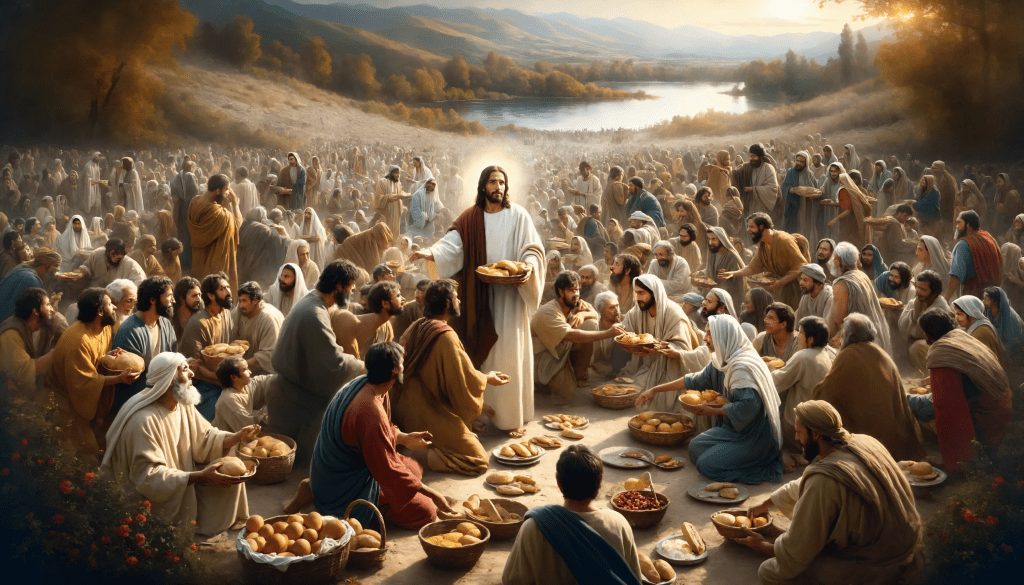
Our reading is John 6:1-13. It is one of the rare stories in the Bible because it is found in all four Gospels. This is John’s version. Different from the other accounts, John emphasizes Jesus’s divine identity and the spiritual significance of the event. According to our text a great crowd had gathered around Jesus. He had become as famous as a miracle worker. Jesus had brought wholeness and health to the limited and the sick. The crowd came to see a miracle, but Jesus wanted them to experience more. To be seen and heard by all, Jesus and his disciples sat on a mountainside. From that perched position Jesus saw the vastness of the crowd. Wanting to challenge the disciples, he looked at Phillip and said, “Where shall we buy bread for all these people to eat?” Phillip does the math and admits the funds are not available. It would take eight months to buy enough bread. He was right, yet he was wrong. Money was only one option. By the end of the day, everyone was satisfied, and the power of God was obvious. 

This story reminds us of two things. First, with God all things are possible. How else can you explain how Jesus took five barley loaves and two small fish and fed 5,000 people? It must be from God. Second, it reminds us that Jesus cared not just about the spiritual needs of people; Jesus cared for their physical needs as well. He could have sent them away hungry, and no one would have cared. However, that was not Jesus’s way. He cared about the basic physical needs of others. The question is: how concerned are you about the physical needs of others? Our world is crying out in pain; are you going to respond? To answer that question, I am going to ask you three uncomfortable questions. This is question number one.

Do you see others like Jesus? When Jesus looked out and saw the 5,000, he just didn’t see people, he saw their need. He saw they were hungry. Jesus knew they had to be fed because they didn’t have resources to feed themselves. Jesus cared about their temporary physical needs. Do you see the needs of others, or do you look the other way? Many would have said, “They are fools! They should have known better, they should have packed their own lunch!” Do you see things like Jesus? Do you see the needs of others? This is question number two.

Do you feel other people’s pain like Jesus? It is my experience we are more comfortable with the divine side of Jesus and less comfortable with his humanity. We struggle with the humanity of Jesus. Matthew 9:36 describes Jesus’s compassion. It says, Jesus had compassion on the crowds who were “harassed and helpless, like sheep without a shepherd.” Jesus had compassion on the 5,000 because they were hungry. Never underestimate the compassion of Jesus. Wikipedia, the online dictionary and encyclopedia, defines compassion as the response to the suffering of others that motivates some to help. Do you feel other people’s pain like Jesus? Perhaps this is a better question, how compassionate are you? Do you look at people, or do you look through people? This is question number three.

Do you do things like Jesus? The Master had the power to feed 5,000 people with five loaves of bread and two fish. Jesus used his power to respond to their need. We do not have the power to feed 5,000 people with five loaves and two fish. However, we do have the power to do something. What are you doing to help others? What is the Holy Spirit calling you to do? Do you do things like Jesus?

When I was in college, I remember studying the case of Kitty Genovese (1935-1964). She lived in Kew Gardens, Queens, New York City. She was a bar manager. On March 13, 1964, she was murdered by a man named Winston Moseley (1936-2016). He stabbed her with a knife, piercing her lung. She was buried at the Lakeview Cemetery in New Canaan, Connecticut. She was a victim of femicide. As shocking as that crime was, the reaction, or the lack of reaction, of her neighbors was even worse. Investigators discovered many heard her cry out, but no one responded. They simply didn’t respond to her cries for help, they didn’t want to be bothered. They were guilty of a sin of omission. In the science of sociology, it has been called the by-standers effect or diffusion of responsibility.  I would like to say it is an isolated case, but it happens all the time. Can I state the obvious?

Our world is crying out for help but very few are responding. It is not a matter of physical deafness. It is a matter of lack of caring. Do you care about the needy in our world, or are you too preoccupied with yourself? Are you more concerned about the happiness of your family pet, or are you more concerned about human beings who are in need? Jesus cared about people and responded. You must care and respond as well because you are a disciple of Jesus Christ. American essayist, lecturer, philosopher, minister and poet Ralph Waldo Emerson (1803-1882) once said, “The purpose of life is not to be happy. It is to be useful, to be honorable, to be compassionate, to have it make some difference that you have lived and lived well.”

Remembering William Borden

Sincerity is defined as the quality of being free from pretense, deceit, or hypocrisy. Sincere people are trusted. Along with patience and compassion, sincerity is one of those qualities we wish we had more of – and wish other people had more of, too. People who show sincerity are seen as being serious, kind and truthful. Sincerity is vital as you live out the Christian faith, and is vital in understanding our scripture lesson, John 10:22-30.

According to the text, Jesus is in Jerusalem during the Festival of Dedication, a time to remember the dedication of the temple by Judas Maccabeus in 165 BC. For those unfamiliar with the Hebrew calendar, John tells us it was during the winter months. Jesus was walking in Solomon’s Colonnade, a roof structure like a Greek stoa, when he was surrounded by a group of Jews. They asked him the question everyone has been asking: are you the Messiah? Jesus goes on to tell them the answer to their question is not found in his words, the answer to their question is found in his deeds. Those words resonate in our society today, because our world still believes actions speak louder than words. After all, we believe talk is cheap. That leads us to an interesting question: if you didn’t speak a single word about Jesus, would the people in your life know you are a disciple?

Everyone knew, and no one questioned the sincerity of William Borden (1887-1913), when he graduated from The Hill School in Pottstown, Pennsylvania in 1904. His father made a fortune in the Colorado silver mines, so William was a sixteen-year-old millionaire. However, his mother had the greatest influence on his life. She took him to the Chicago Avenue Church, later Moody Church, where he accepted Jesus. His graduation gift from his parents was a chaperoned trip around the world. Traveling through Asia, the Middle East, and Europe, gave Borden a burden for the world’s hurting people. Writing home, he said, “I’m going to give my life to prepare for the mission field.” When he made this decision, he wrote in the back of his Bible two words: NO RESERVES. In other words, he was totally committed to serving God. There would be no reserves for him. How committed are you to serving God?

David Livingstone (1813-1873) was totally committed. He was a Scottish physician, pioneer missionary with the London Missionary Society, and an African explorer. His passion for Africa made him famous. Once he received a letter while in Africa that contained this question: “Have you found a good road to where you are? If so, we want to send other men to join you.” Livingstone wrote back, “If you have men who will come only if they know there is a good road, I don’t want them. I want men who will come if there is no road at all.” David Livingstone and William Borden were totally committed. How committed are you? The first two words William Borden wrote in his Bible were NO RESERVES!

In 1905, Borden enrolled at Yale University. During his first semester, he began to pray and study the Bible with a friend. A short time later, a third student joined them. By the end of his first year, 150 freshmen had become interested in meeting for weekly prayer and Bible study. By the time he was a senior, 1,000 out of the 1,300 students at Yale were meeting in groups like these. It was his goal to win every soul at Yale University for Jesus. That wasn’t enough for Borden. Off Yale’s campus, he went to the darkest parts of New Haven, Connecticut helping those individuals’ society had forgotten.  Turning down high paying job offers, Borden entered two more words in his Bible: NO RETREATS. In other words, he was always finding new ways to serve God.

In my retirement, I supply preach. In other words, I go to churches when the pastor is away or unable to preach. I enjoy meeting new people and experiencing new churches. Most of the churches I preach at have the same story. They had a glorious past but are facing a questionable future. At some point, they stopped advancing; they are frozen in time. The crowd of the past has been replaced by a select few, who are committed to traditional worship. They haven’t gotten involved in missions in years because they are consumed by their own needs. The only energy present is the energy needed to maintain the basic church functions. The world is changing, yet they refuse to change. They all know the truth: the end is near and when the door is locked for the last time, no one will miss them. William was never satisfied doing the same old thing. He was always finding a new way to serve God. When was the last time your church tried a new ministry? When was the last time you tried something new to serve God? The second two-words William Borden wrote in his Bible were NO RETREATS!

After graduating from Yale in 1909, Borden prepared for the mission field at Princeton Seminary. At the age of twenty-two, Borden became the director of the National Bible Institute in New York City as well as the Moody Bible Institute in Chicago. His goal was to evangelize the Muslims in China. On his way to China, he stopped in Egypt to study Arabic. It was there that his bright future grew dark. He was diagnosed with spinal meningitis and died at the age of 24. To the world it really didn’t seem fair. However, William Borden trusted God. The only one he was trying to please was God. Who are you trying to please? I have said it a million times – the only things that really matters are those things that will matter in one hundred years. What is going to matter to you in one hundred years? The only thing that is going to matter to you in one hundred years is Jesus! Are you living for Jesus, or are you living for someone or something else? During his illness he wrote two more words in the back of his Bible, NO REGRETS.

How can you question the sincerity of William Borden? If he hadn’t spoken a word, his life spoke volumes. He was completed committed to serving God. He was always finding a new way to serve God. He completed trust God. No one could question his sincerity. Can the same thing be said about you? Jesus wasn’t wrong – actions do speak louder than words. Saint Francis of Assisi (1181-1226) once said, “Preach the Gospel, but only use words when absolutely necessary.”

Grow Up!

Our reading is John 4:4-24.  According to verse four, Jesus is in Samaria, near the town of Sychar at Jacob’s well (Ge. 48:21-22). It is noon and Jesus was looking for a cool drink of water. He was surprised to find a Samaritan woman there too. Normally, women drew water from the well early in the morning or at the end of the day, once the heat of the day had passed. She was no ordinary woman. She was a woman with a story. She was filled with regrets, because she had made so many mistakes.

She just couldn’t find a decent man; she was a repeat offender. She had been married five times and was currently living with another man. In our society, only fifty percent of first-time marriages last. Every time you marry, your chances of a successful marriage are cut in half. That means, on her fifth wedding day her chances of a happy marriage were down to 3.1%. If she would have married number six, it was down to 1.6%. She was at the well in the middle of the day to hide from the harsh tongues of the other women in that community. She was the punchline of every joke, and she knew it. Most of our reading is a dialogue between Jesus and the woman.

Jesus broke the social norms of that time and place. Men and women did not speak to each other in public; Jews and Samaritans did not speak at all. Jesus breaks both rules and talks to a Samaritan woman. Jesus and the woman at the well were a study in contrast. Jesus was a sinless, spiritually mature Jewish man; she was a sinful, spiritually immature Samaritan woman, yet Jesus speaks to her about spiritual maturity. In this blog, I want to address your spiritual maturity. How spiritually mature are you?

There is a website called Cripplegate.com.  It is a Christian website with the tag line, “for a new generation of non-conformists.” That line plays off Roman 12:1-2, “do not conform to this world but be transformed by the renewing of your mind.”  On November 7, 2011, they posted an article called: 5 Signs of Spiritual Maturity. In that article, they ask five questions. If you answer each honestly, then you will discover your level of Christian maturity. Each question has Biblical roots. If you answer each question honestly, you may find out that you are more mature than you thought, or you may discover you are less spiritually mature than you assumed. You can consider these five questions a little quiz. This is question number one:

Do you have an appetite for meat? Infants drink milk regularly, but in time they move on to solid food. When a twenty-one-year-old asks his mother to spoon feed him mashed potatoes, it is creepy and dysfunctional. When a nursing home resident can’t take a single bite, it is sad because the end is near. Spiritually mature people can’t get enough meat. They can’t get enough of the Bible. How much time do you spend with your Bible? Or do you ignore your Bible because it is just too hard to understand? Maybe that is the reason you are spiritually immature. Spiritually mature people have an appetite for meat. Hebrews 5:14 says, “Solid food is for the mature.”  This is question number two:

Are you easily offended? Experience has taught us that mature Christians seldom get offended, because they see the big picture. When Jesus turned the tables at the temple over because people were using the law for personal gain, people were upset. Jesus didn’t care, because he saw the big picture. The temple was a house of prayer, not a place of profit. Do you see the big picture, or do you only see yourself or your interests? The only thing that matters is Jesus! When was the last time you got offended at church? Philippians 1:18 says, “In every way Christ is proclaimed, and in that I rejoice. Yes. I will rejoice.”  This is question number three:

Is your conscience formed by scripture or opinion? One of the great attributes of a mature Christian is grace. We are saved by grace and by grace alone. It is a simple truth to understand, but it is a hard truth to live out. I have grown tired of negative, critical, and judgmental people who fell you need their permission, or must live up to your standards. Spiritually immature people are always critical of others. Spiritually mature people understand that we are saved by grace. Romans 14:1 says, “As for one who is weak in the faith, welcome him, but not to quarrel over opinions.”  This is question number four:

Do you serve humbly? God uses sinners in this world to do good things because there is no one else to choose. Have you ever known anyone who boasted about what they do for their church? Have you ever known someone who boasted of something they do for God in their community or the world? If so, then you have the perfect example of a spiritually immature person. Spiritually mature people get it. They know it is not about them; it is all about God. Do the people in your life consider you humble? 2 Corinthians 4:7 says, “We have this treasure in jars of clay, to show the surpassing power belongs to God and not to us.”  Do people in your life consider you arrogant? This is question number five:

Do you credit God for success? Contemporary American culture idolizes people. Personally, it may be a well-loved pastor or politician. It may be a popular entertainer, like Tom Cruise (born 1962) or Taylor Swift (born 1989). It may be a historical figure, like George Washington (1732-1799) or Abraham Lincoln (1809-1865). According to the people at Cripplegate, is idolizing others is a sign of spiritual immaturity. Spiritually mature understand all people, both contemporary and historical, are nothing more than tools in the hands of God. It is God who deserves all the credit. I Corinthians 3:7 says, “So neither he who plants nor he who waters is anything, but only God who gives the growth.”  

So how did you do with your little quiz? Did you find you are a spiritually mature person? Or did you find you have some work to do?

When I was young my grandmother came to visit us twice a year. She lived in Brooklyn, New York and we lived in Warren, Ohio. I can remember going to the Greyhound bus station to pick her up. Later, she flew into the Youngstown-Warren Regional Airport. Still later, she flew into the Cleveland Hopkins International Airport. It really didn’t matter where she arrived, every reunion was the same. I would run up to her and give her a big hug. She would always square my shoulders and say, “Let me look at you. You have gotten so big.” My dad, who hated those visits because he didn’t like her, always responded, “I would hope so. If he wasn’t growing there would be something wrong.” I think he missed the point, but he wasn’t wrong. We expect healthy children to grow.

God expects you to grow spiritually! When God looks at you does he say, “Look how big you have gotten!” Or does God say, “What is wrong?” Never forget, we are to be a little more like Jesus every day. The choice is yours. Are you growing spiritually, or are you going to remain a spiritual babe? Scottish evangelist Oswald Chambers (1874-1917) said, “Spiritual maturity is not reached by the passing of the years, but by the obedience to the will of God.”

Born Again

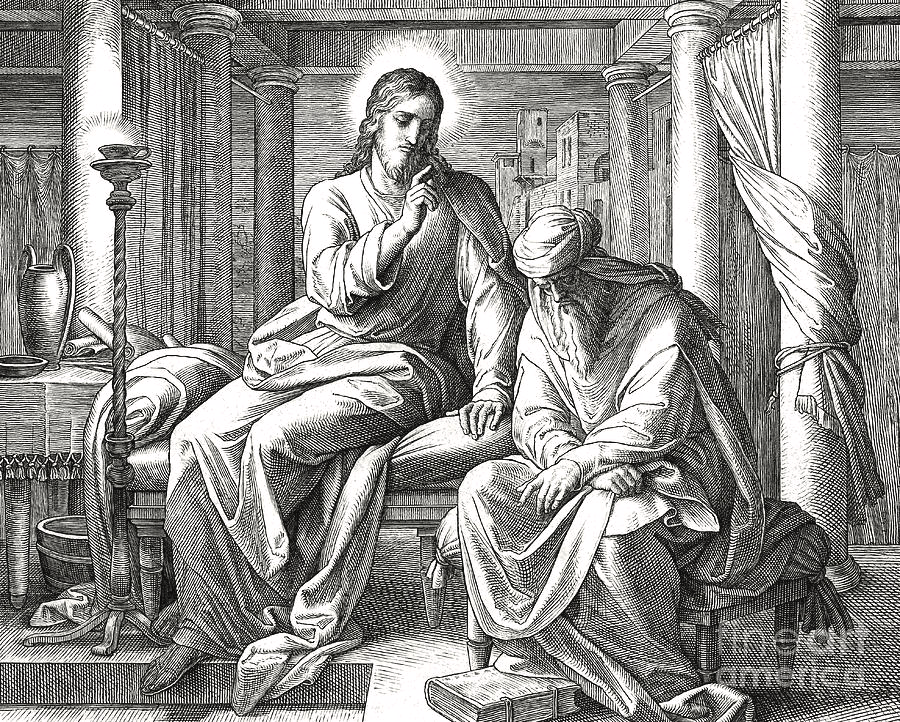
Our reading is John 3:1-15. The story is nothing more than a private discussion between Jesus and Nicodemus. Everyone knows Jesus, no additional information is needed. Some know Nicodemus. According to the second half of verse one, he was a member of the Jewish ruling council. That means he had climbed to the top of his profession. It is safe to say Nicodemus spent his days answering the questions of others. This story is unique because he is the one with the questions.

According to verse two, Nicodemus went to Jesus at night. Much has been made about that fact. Some say he went at night to hide his identity. How would it look for a trusted member of the clergy to go to Jesus, a man with no credentials? Others say Nicodemus went at night so the two would have time to talk. The business of the day was done. Regardless, Nicodemus went to Jesus because he was impressed by the Master. No ordinary man could have performed such miracles; he must come from God. Jesus hears through these kind words and knows the real topic – salvation! Jesus says in verse three, no one can enter the kingdom of God unless they are born again. Two thousand years later, the world is still wrestling with those words, so we should not be surprised that Nicodemus wrestled with them that night. He thinks Jesus is speaking of physical birth, reentering your mother’s womb. Jesus is speaking of spiritual birth. The two are as different as night and day. From the moment you were physically born, you struggled to survive. The goal of life is survival, so the most important person in your universe is you. Spiritual rebirth is different. From the moment you are reborn, the most important person is God. Spiritually immature people live for themselves; spiritually mature people live for God. Which is more important to you? Are you the center of your universe, or is God the center of your universe? To help you discover the center of your universe, let me ask you three questions. This is question number one.

First, how do you spend your time? One of the great stories in the Bible is the story of Mary and Martha, Luke 10:38-42. Mary and Martha were sisters of Lazarus, the one who Jesus had resurrected. Jesus stopped at their home in Bethany on his way to Jerusalem. Bethany was only two miles from Jerusalem. When Jesus arrived, Mary sat at Jesus’s feet, absorbing every word. Martha, on the other hand, was consumed by the traditional female duties. It is a story about priorities. In time, Martha resents doing all the work and goes to Jesus to enlist some help. Martha filled her time doing good things; Mary filled her time with the best thing in life, Jesus. How do you fill your time?

Are you spending your time in a way that is pleasing to God? Are you going to fill your life with good things: work, family, friends and entertainment? Are you going to fill your life with the best thing: Jesus? This is a more pointed question – how much time do you spend with God? Are you the center of your universe? Is God in the center of your universe? This is question number two.

Second, how do you spend your money? Studies tell us that one of the reasons people don’t attend church is money. To be more exact, people do not want to go to church and to be asked to give money. The problem is Jesus spoke more about money than any other topic. That is quite a statement. That means Jesus spoke more about money than he did love, forgiveness, grace, or salvation. In my time in the ministry, I was never afraid to talk about money, it is just so practical. If Jesus spoke about money, then I had the license to do the same. Monthly, in my sermons, money came up in one form or another. Annually, I covered the same points during the stewardship drive. First, money is important. If you don’t believe me, then try to live without it. Second, money is limited. It was reported recently that Amazon’s Jeff Bezos (born 1964) is worth approximately $250 billion. Even his fortune has limits. You have limits too. Third, because money is important and limited, how we spend our money is revealing. We only spend our money on things that are important to us. How great of a priority of God to you?

Are you spending your money in a way that is pleasing to God? The church was never meant to be destitute. It was meant to be fiscally responsible to meet the challenges our world is facing. This is a question to ponder: if everyone gave as much money as you do to your church, would the ministry of your church contract or expand? Are you living with yourself in the center of your universe? Are you living with God in the center of your universe? This is question number three.

Third, how do you use your talent? Some consider Leonardo da Vinci (1452-1519) the most talented person in the history of the world. His list of accomplishments is impressive. He excelled as an artist, scientist, and inventor. Some consider Isaac Newton (1647-1727) the most talented person in the history of the world. He made groundbreaking contributions to physics, calculus, and optics. He changed the way we look at the universe. Some consider Elon Musk (born 1971) the most talented person in the history of the world. He has made significant contributions to several industries, including electric vehicles, space exploration, and artificial intelligence. There have been many talented people in history.

Is God pleased with the way you are using your natural talents? You are not the most talented person in the history of the world, but that does not mean you lack talent. Everyone has some kind of talent. I have never met a talentless person. The question is, how are you going to use your talent? Are you just going to use your talents for personal gain? Are you using your talents to bring glory to God? Are you living making yourself the center of your universe? Are you living with God in the center of your universe?

When I was in high school, it seemed like the entire evangelical Christian world was asking the question, are you born again? I saw it as a death question. The real question was, are you prepared to die? Are you going to spend eternity in heaven or hell? Today, I consider that question, are you born again, a life question. Are you going to live in a way making your yourself the center of your universe, or are you going to live in a way to make God the center of your universe? Are you spending your time in a way that is pleasing to God? Are you spending your money in a way that is pleasing to God? Are you sharing your natural talents in a way that is pleasing to God? It has been said, “Being born again means embracing a life of purpose, love, and service.” Are you born again?

Following Jesus

According to Psychology Today, the average person makes more the 35,000 decisions in a single day. This includes conscious and subconscious choices, with many decisions based on prior knowledge and experience. Most decisions are rather simple – where to sit, what to eat for the next meal, what lane you should drive in. These decisions are easily made and have very little consequences. Other decisions are more serious with long-lasting effects. Your decision to follow Jesus is one of them. For once you decide to follow Jesus, everything in your life should change. If you don’t believe me, then look at the life of C. S. Lewis (1898-1963).

He was a novelist, poet, lecturer and Christian apologist. Absolutely brilliant, he held academic posts at both Oxford University and Cambridge University. His Christian faith can be seen in all his classic literary works: The Screwtape Letters, The Chronicles of Narnia, The Space Trilogy, Mere Christianity, Miracles, and The Problem with Pain. However, there was a period in his life when he believed nothing at all. In his memoir, Surprised by Joy, Lewis told how he was baptized into the Church of Ireland, but the sacrament had no influence on him. He walked away from the faith and didn’t return until he was 32. He thanked his friends, including J. R. Tolkien (1892-1973), for his spiritual wakening. His life would never be the same again. Your decision to follow Jesus changed you too. That takes us to our reading, John 1:35-42.

The story is a little complex. It is early in Jesus’s earthly ministry. It is so early Jesus doesn’t have a single disciple. However, John the Baptist does have disciples. When Jesus passes John the Baptist and his disciples, John identifies Jesus as the Lamb of God, referring to Jesus’s future sacrificial death. With that endorsement, two of John’s disciples began to follow Jesus. The Bible identifies one of the disciples as Andrew, tradition identifies the other disciple as John, the author of the fourth Gospel. Seconds later, Jesus noticed they were following him and asks them, “Why?” It is an excellent question because no one likes being stalked. They answered Jesus’s question with another question, “Where are you staying?” Jesus answers that question with an invitation, “Come and you will see.” They accept the invitation and stay with Jesus until about 4:00 in the afternoon. At that time, the two leave Jesus and tell others about him. Andrew told his brother Peter, who decide to follow Jesus too. In this story, three people decide to follow Jesus; their decision to follow Jesus changed them. The question is, are you following Jesus? To explore your answer, let me ask you three more questions.

First, do you follow Jesus exclusively? In the story, Andrew and John begin as disciples of John the Baptist. Don’t forget, John the Baptist was their rabbi or teacher, Andrew and John were his disciples or students. In other words, he gave them spiritual insight and direction. When John the Baptist identifies Jesus as the long-awaited Messiah, they listen to him because they trust him. This story is incredible because Andrew and John left John the Baptist to follow Jesus. They were going to follow Jesus exclusively. Are you following Jesus exclusively? In a politically correct world, this will make some people uncomfortable.

I was raised in a steel town in northeast Ohio. I have no childhood memories of knowing non-Christians. Everyone I knew followed some form of Christianity. I knew people who represented the various branches of the mainline Protestant church. I knew people who practiced the various forms of Orthodoxy. I knew people who were Roman Catholic or Byzantine Catholic. Everyone was a Christian. There was no spiritual tension because everyone believed in Jesus. Then, I became an adult and moved to more urban areas. Saying you follow Jesus exclusively suddenly took on a new meaning. It meant something. However, we are not called to judge others, we are called to love others. That divine truth disarmed many situations. Honestly, I am thankful I am not the judge. You can follow Jesus exclusively and love anyone. The question is, do you follow Jesus exclusively?

Second, do you follow Jesus unconditionally? One of the great stories in the Bible can be found in the Book of Job. Everyone knows the story because everyone has played the part of Job. In the beginning he has everything – wealth, health and family. Satan believes Job’s loves for God is conditional, so he begins to take things away from Job. His wealth is taken away. His health is taken away. His loved ones are taken away. His friends witness his ordeal and encourage him to curse God and die. Job refuses, because his love for God is unconditional. 

Many follow Jesus conditionally. It is easy to follow Jesus when life is good. It is easy to follow Jesus when you have a well-paying, enjoyable job. It is easy to follow Jesus when your health is good and your loved one’s health is good. It is easy to follow Jesus when all your relationships are sound. It is not so easy to follow Jesus when you are unemployed, sick and alone. It is not so easy to follow Jesus when a loved one is struggling. It is not so easy to follow Jesus when your friends tell you to stop following Jesus. After all, we believe in an all-powerful God who resurrected Jesus from the dead. Have you ever wondered why our all-powerful God doesn’t help you? Do you follow Jesus unconditionally?

Third, do you follow Jesus passionately? In other words, do you have a desire to be like Jesus? Are you more like Jesus now than the day you decided to follow him? Following Jesus should transform you in three ways. First, following Jesus will change your perspective. Are you looking at life through different lens, one that emphasizes God’s love, grace, and an eternal perspective. Second, following Jesus will change your priorities. You will be more concerned with others. Our world is filled with hurting people. Third, following Jesus will change your purpose. Personal gain or worldly success will be replaced by God’s plan for the world. If you are going to follow Jesus passionately, then you better be prepared to change. Too many use Jesus and the Bible to promote their personal causes and beliefs. Do you follow Jesus passionately?

In the scripture lesson for today, three people, Andrew, Peter, and John, decide to follow Jesus. They follow Jesus for the rest of their lives. In the end, only John dies of old age. Yet, he experienced the isolation of Patmos Island, where he had a series of visions. Those visions became the book of Revelation. Tradition tells us that Peter died in Rome, where he was crucified upside down for evangelizing. He was crucified upside down at his own request, because he didn’t feel worthy to die like Jesus. Tradition also tells us that Andrew was crucified on an x-shaped instead of a t-shaped cross in Achaea, Greece because he too didn’t feel worthy to die like Jesus. It is safe to say they followed Jesus exclusively, unconditionally, and passionately. The question is – do you follow Jesus, or is it how you follow Jesus? Billy Graham (1818-2018) once said, “When we come to Christ, we’re no longer the most important person in the world to us; Christ is. Instead of living only for ourselves, we have a higher goal: to live for Jesus.”

3 Simple Rules

Her name was Susanna Wesley (1669-1742), the mother of the founder of Methodism, John Wesley (1703-1791). She knew a thing or two about motherhood and she set the standard high. She was born in 1669, the youngest of twenty-five children. At the age of nineteen she married Samuel Wesley (1663-1735). They knew hardship. Constantly poor, they had nineteen children, nine of their children did not make it into adulthood. Their family home burned down twice. Yet, despite all of this, she is remembered as an outstanding mother. She prepared her children to survive in this world and to be prepared for eternity.

Each one of her children, both boys and girls, were home-schooled. Their education began on the day after their fifth birthday. Each one of them was required to know the complete alphabet after the first day. Once their education was complete, her children knew both Greek and Latin, along with the classics. All this was done within the framework of sixteen house rules. They still speak to our world today. These are her sixteen rules for parenting: 

  1. Eating between meals is not allowed. 
  2. Children are to be in bed by 8 p.m. 
  3. Children are required to take medicine without complaining. 
  4. Subdue self-will in a child to save the child’s soul. 
  5. Teach a child to pray as soon as he can speak. 
  6. Require all to be still during Family Worship. 
  7. Give them nothing that they cry for, and only that when asked for politely. 
  8. To prevent lying, punish no fault which is first confessed and repented of. 
  9. Never allow a sinful act to go unpunished. 
  10.  Never punish a child twice for a single offense. 
  11.  Reward good behavior. 

12. Any attempt to please, even if poorly performed, should be commended. 

  1.  Preserve property rights, even in smallest matters. 

14. Strictly observe all promises.  

15. Require no daughter to work before she can read well. 

16. Teach children to fear the rod.  

Those rules demonstrate that Susanna Wesley knew something about raising children. However, this is the Good News for today: This blog does not have sixteen points. This blog only has three. They are found in our reading, John 2:1-11. 

The scene is a wedding reception. Couples didn’t honeymoon in those days. No one traveled to Mexico or the Caribbean.  However, they did hold receptions that lasted approximately a week. Jesus was invited to one such reception because he was a respected rabbi. Over the generations, certain general rules of hospitality have remained intact. Running out of food or drink has always been a serious matter. In verse three we discover that the wine had run out. Everyone looked for the guilty party, but Mary looked to Jesus.

She knew Jesus had the power to save the day. She believed in Jesus when Jesus didn’t believe in himself. In verse four, we find Jesus making an excuse for his inactivity, “My time has not yet come.”  Mary does not listen. Instead, she instructs servants to bring him water. By the end of the scene, the party has resumed. Everyone had enough wine. Verse ten tells us it was the good wine. What does that mean? It means the wine that Jesus produced had a kick. What grabs our attention today is not the quality of the wine, it is the relationship between Mary and Jesus. 

Time is important in this story. The nativity was decades earlier. Jesus is no longer a newborn, and Mary is no longer a young mother. In this story, Jesus is thirty years old man, and Mary is a veteran mother. Mary illustrates how our relationships with our children must change. You can’t treat your thirty-year-old child like a newborn, that will destroy any relationship. Your relationship with your children must evolve, as your child evolves. Mary illustrates for us three simple rules parents must follow when dealing with their adult children. 

This is rule #1: Know your children! Mary knew Jesus. She was at the wedding reception with Jesus and this was not unusual. Mary spent most days with Jesus. Mary knew Jesus was different from the very beginning. She must have remembered many things. She must have recalled that visit from the angel years earlier, who told her that she had been chosen to be the mother of the Son of God. She must have remembered Jesus’ birth. She remembered the visitors, the shepherds and the Magi. She must have remembered how Jesus wandered off at the age of twelve and was found in the temple. Mary remembered it all because she was part of Jesus’ life for thirty years. She knew Jesus better than Jesus knew himself. How well do you know your children?  

How much real time do you spend with your children? Perhaps, this is a better question: How well do your children know you? Can you name three of your children’s friends? If not, maybe you don’t know your children. Spending time with your children is important. Rule #1 says, know your children. 

This is rule #2: encourage your children! History tells us that Abraham Lincoln (1809-1865) carried an old newspaper article with him regularly. Those who were closest to him say he read it daily. He couldn’t believe the words. The article said Lincoln was a great leader. The article was correct, he is remembered as being a great leader, perhaps our greatest president. However, Lincoln didn’t see himself that way. He was crippled with self-doubt. Lincoln illustrates for us a simple point. It doesn’t really matter what others think of you. The only thing that matters is how you feel about yourself. How do you feel about yourself? 

I love this Bible story because it shows the human side of Jesus. Jesus had an insecure side. Look at the story again. The Master is at a wedding reception when the wine ran out. Jesus had the power to solve the problem, but he didn’t try because he was too insecure. It is his mother who gives him the nudge to try. Verse 3 says, “When the wine was gone, Jesus’ mother said to him, ‘They have no more wine.’”  In other words, Mary is telling Jesus to do something. She is encouraging him to do something. Have you ever needed an encouraging word? The world reminds us regularly of what we can’t do. We need people in our lives to remind us of what we can do. It is not just true of the young. It is true of the not-so-young. We are often blind to our own abilities. It is impossible to receive too much encouragement. Rule #2 says, encourage your children. 

This is rule #3: Trust your children to God! Mary knew Jesus and she encouraged Jesus. However, the third rule must have been the hardest one for her to apply. She knew God had something special planned for him. She remembered how she and Joseph took Jesus to the temple when he was only eight days old. On that day, they met an old man by the name of Simeon. He knew Jesus was destined for greatness. Do you remember his words? Mary did. Simeon said, “This child is destined for the raising and the falling of many in Israel” (Luke 2:34). Mary didn’t know what that really meant, but she must have asked the question a million times: why does her son have to lead to the raising and the falling? Why not just the raising?  

When she encouraged Jesus to change the water into wine, she was encouraging Jesus to get on with his life. She was encouraging Jesus to fulfill his divine destiny. Jesus’ future was out of Mary’s control. She had done the best she could do. Now, she had to trust God with him. We only have our children at home for a short time. Most of their lives they are on their own. How far do you trust God with your children? This is rule #3, trust your children to God. 

Years ago, I watched Ken Burn’s (born 1953) documentary on World War II, The War. My father served during that war, so I felt some attachment. I found the interviews of the survivors interesting. That generation is dying quickly. In one episode, they interviewed a native-American soldier who was in the infantry. I will never forget it. I think about it every Mother’s Day. Years after the conflict, he cried about the day he took a German life with his own hands. Death did not come suddenly, the soldier died slowly. Before he died, he called out. According to the man interviewed, he didn’t call out for a medic. He didn’t call out for his friends. He called out for his mother, twice. The man was a solider, but the man was a son who needed his mother.  

Don’t tell me motherhood isn’t important. It is important to love your children when they are young, but it is equally important to love them today. Regardless of age, they will always be your children, and you will always be their mother. The English poet and playwright Robert Browning (1812-1889) once said, “Love begins and ends with mothers.” I believe he was right! 

3 Theories about Thomas

We find ourselves in the twentieth chapter of John, verses twenty-four through twenty-nine. Prior to our reading, the resurrected Jesus appeared to ten of the disciples. The two who were missing were Judas Iscariot, the one who had betrayed Jesus. By this time, he had committed suicide. The other absent disciple was Thomas. We do not know where Thomas was, but we know where he should have been. He should have been with the other disciples experiencing the resurrected Jesus. The other disciples told him about their experience, but their words were not enough. Thomas responds with these famous words, found in verse twenty-five, “Unless I see the nail marks in his hands and put my finger where the nails were, and put my hand into his side, I will not believe it.”  He must have regretted those words. For generations, people have judged Thomas for them.

Except for Judas Iscariot no other disciple has been judged more harshly by history than Thomas. It is unfair. His life was more than that a single sentence. Just think about it for a moment. Thomas was selected by Jesus, himself, to be one of the disciples. That means he traveled with Jesus for three years. He heard the lessons. He felt his authority. He saw his miracles. He was excited on Palm Sunday and devastated on Good Friday. Tradition tells us after Pentecost, he went to India to evangelize about Jesus. Even his death had meaning. Tradition tells us, he died in service to the Lord, martyred with a spear. He had an incredible life, but we remember him for one sentence, “Unless I see the nail marks in his hands and put my finger where the nails were, and put my hand into his side, I will not believe it.”  Why is it, we all remember those negative words? Could it be that we all point to that one moment of doubt because it was the one moment, we are the most like Thomas? You are not the first person to wrestle with doubt, and you will not be the last. However, this is the question of the day:

Why did Thomas doubt? Throughout the centuries, many have tried to answer that question. I have my theories. Maybe you have your theories? James W. Moore (1938-2019) was an author and the pastor of the St. Luke’s United Methodist Church in Houston, Texas for many years and he had his theories. In this blog, I want to look at his theories – I believe they have some merit. They speak to me; I hope they speak to you too.

This is theory number one: Thomas doubted because he had dropped out.  In other words, Thomas had some doubts because Thomas was not present, so he doubted. That is worth considering. We still see it today. How many people do you know question the resurrected Jesus, because they have dropped out of church? For that reason, many have a poor personal theology. They simple don’t understand God’s ways.

How many church dropouts do you know? I cannot blame them 100% of the time. The church is made up of imperfect people, so the church is not a perfect institution. Truth be told, there are times churches are downright ugly. We fight amongst ourselves. We gossip about one another. There are times when small groups like to run the whole show. There have been times when pastors do some horrible things. I know those things, but I also know this: there is no excuse for dropping out of church. Despite all our problems, church is still the best place to learn about God. If you do not go to church, then where do you learn about God? If you are not going to church, then you are self-taught.  For a short time, Thomas dropped out. Church dropouts are missing the whole Christian experience. No wonder they have doubts and questions. They simply do not know God’s ways.

This is theory number two: Thomas doubted because he gave in. In other words, Thomas had some doubts because he let science become the final answer. You cannot really blame him, the resurrection of Jesus is hard to believe because it is a miracle! It cannot be explained by science. If you do not believe in miracles, then you cannot believe in the resurrection. Do you know anyone who says people who believe in miracles are foolish, uninformed or uneducated? Do you know anyone who has given in?

Thomas Jefferson (1743-1826), the chief writer of the Declaration of Independence and Third President of the United States, gave into science. He was a deist. In other words, he believed in God, but God never broke natural law. For this reason, he had his Bible re-written. He wanted everything that could not be scientifically explained eliminated. Just think about it for a moment. Just think of the things Jefferson rejected. He dismissed the virgin birth, the healing stories, and the resurrection. In my opinion, that dismissed him from the Christian faith. Your belief in the resurrection of Jesus is not optional, it is mandatory. I have seen copies of Jefferson’s Bible. It is approximately one-third the size of our Bible.

I hope you do not misunderstand me, I am not saying that science is bad. I believe it is one of the paths to truth and knowledge. However, I do not believe it is the only path to truth and knowledge. Some of the most powerful forces in our world today cannot be explained by science. Can you give me the scientific formula for love, honesty, courage, faith, goodness, or humility. There is not a scientific explanation for patience, self-control, or kindness. You cannot put mercy or grace into a test tube. Those things cannot be scientifically explained, but we see examples of those things every day. Perhaps Thomas doubted because he gave in to science? Science is good, but it is not the final answer. The final answer is always God. Perhaps Thomas doubted because he dropped out or gave in.

This is theory number three: Thomas doubted because he gave up. In other words, Thomas had some doubts because he let death be the final answer. The scripture does not tell us where Thomas was when Jesus appeared to the others. However, I have a good guess. I believe he was doing what many do when they are upset. They walk to get some fresh air, clear their minds, and think. If you use your sanctified imagination, you can see him walking down every back street of Jerusalem. He is trying to answer the question, “How did it go so wrong, so fast?” As he walked, he couldn’t believe it was over. He was devastated. He thought it was over when Jesus died! However, he was wrong. It was not over. It was just the beginning. Why? Because Jesus was not dead. He had been resurrected; he was alive! Do you know anyone who lets death have the final word? Do you know anyone who has given up?

The other day, we observed the 30th anniversary of the Oklahoma City bombing. You remember the ugly story. On April 19, 1995, Timothy McVeigh (1968-2001) attacked the federal building in downtown Oklahoma City. I remember that day. The picture that caught my attention from that day was of a firefighter carrying a little girl away from the destruction. We found out later that the little girl was one year old. She celebrated her first and only birthday the day prior to the bombing. Reporters asked that little girl’s mother, “How can you go on?” She responded, “The only thing that keeps me going is the fact that my little girl is in heaven. Someday, I am going to see her again.” Can you relate to that mother? Your life would come to a grinding halt, if not for the belief that you will see your loved one again? Perhaps Thomas doubted because he was overcome with grief. Never forget! Death is not the final answer. The final answer is Jesus! I do not know why Thomas doubted, but he did. Do not be hard on him. We all have questions and doubts. Let me end with this story.

Years ago, I received a phone call from a young man by the name of Derrick. He was a student at Youngstown State University who was enrolled in a religion class. His assignment was to call a minister in the area and ask some questions. I was more than happy to answer his questions. However, before the first question was asked Derrick wanted to make a confession. He said, “Rev. Adams, I don’t want to scare you, but I have some questions and doubts about Christianity.” I said, “Derrick, the fact that you have questions and doubts doesn’t scare me. The only ones who frighten me are the people that say they have all the answers.” Voltaire (1694-1778) said, “Doubt is not a pleasant condition, but certainty is absurd.”  So, accept your doubts and ask your questions. They are a sign of a growing faith.

Are You Born Again?

We find ourselves in the third chapter of John, verses one through eight. The storyline of John is different than the synoptic gospels, Matthew, Mark, and Luke. They have Jesus cleansing the temple at the end of his ministry; it is part of the climax. John is different. He has Jesus cleansing the temple at the beginning of his ministry (John 2). That fact is important to us for only one reason; Jesus had the attention of some very powerful influential people from the very beginning. If you want to get someone’s attention, then touch their money. It is still true today.

One of those powerful influential people was Nicodemus. According to the second half of verse one, he was a member of the Jewish ruling council. That means he had climbed to the very top of his profession. It is safe to say Nicodemus spent his days answering the questions of others. This story is unique because he is the one with the question. With everything that has been written about this passage through the ages, one thing is important to remember. This story is nothing more than a private discussion between Jesus and Nicodemus. It is John, the author and editor, who promotes this private discussion to the public’s attention.

According to verse two, Nicodemus came to Jesus at night. There is some debate about that fact. Some say Nicodemus went at night so the darkness could help hide his identity. How would it look for a trusted member of society to go to Jesus, a man with no credentials? Others say he went to Jesus at night so the two could talk privately. There was time to talk. The business of the day was done. Maybe it is a combination of the two? However, this point is crystal clear. Nicodemus went to Jesus because he was impressed by the Master. No ordinary man could have performed such miracles; he must have come from God. Jesus hears through these kind words and knows the real topic, salvation! That takes us to the key verse in the reading.

Jesus says in verse three, no one can enter the kingdom of God unless they are born again. Two thousand years later, the world is still wrestling with those words, so we should not be surprised that Nicodemus wrestled with them that night. Nicodemus thinks Jesus is speaking of physical birth, reentering your mother’s womb. That sounds painful for everyone involved. However, Jesus is speaking of spiritual birth. The two are as different as night and day. This is the plain truth. From the moment you were physically born, you struggled to survive. Babies cry to fill their lungs with oxygen. The goal of life is survival, so the most important person in your universe is you. Spiritual rebirth is different. From the moment you are reborn, the most important person is God. Spiritually immature people live for themselves; spiritually mature people live for God. Which is more important to you? Are you the center of your universe, or is God the center of your universe?

Let me take you a little deeper. One of our primary understandings of God is that God practices free will. In other words, God may be directing history, but you are directing your own life. The choices you make are yours, so the burden of responsibility rests on you. So many things in life distill down to a choice. It has been reported the average person makes 35,000 choices in a single day. That figure seems high to me. (I know that figure is true because it came from the internet.) Some of our choices are simple choices. What are you going to have for lunch? Some of choices are harder? They will affect the rest of your life. Some choices have eternal consequences. That is what we find in the discussion between Jesus and Nicodemus. Jesus is telling Nicodemus he must be born again. So, this is the question of the day.

Are you born again? Do not answer too quickly. Your answer has eternal consequences. If you are born again then Jesus should be affecting every corner of your life. Remember, those who have experienced a physical birth live for themselves. Those who have experienced a second spiritual birth live for God. To answer the question of the day correctly, let me ask you three secondary questions. This is question number one.

Is God pleased with the way you are spending your time?  

One of the great stories in the Bible is the story of Mary and Martha. It is found in Luke 10:38-42. You know the story. Mary and Martha were sisters of Lazarus, the one who Jesus resurrected from the dead. The Master stops there on his way home to Jerusalem. For you see, their town, Bethany, was only two miles from the Golden City. When Jesus arrives, Mary sat at Jesus’s feet and hung on every word he spoke. Martha, on the other hand, slaved away doing the necessary duties, cooking and entertaining. That was the traditional role of women at that time. In time, Martha resents doing all the work and goes to Jesus to enlist some help. Instead of a helping hand, she receives some divine truth. Do you remember that divine truth? Jesus applauds Mary for her priorities. Martha filled her time doing good things, cooking, cleaning, entertaining. Mary filled her time with the best thing in life, Jesus. How do you fill your time?

Is God pleased with the way you are spending your time? I am not talking about spending your time in sinister ways, selling drugs or embezzling funds. However, I am talking about spending your time just doing good things, work, family, friends, church committees and fundraisers? How much time do you spend on the best thing, Jesus? That question challenges your priorities. Perhaps, this is a better question. How are you spending your time? Is God pleased with the way you are spending your time? If you are born again then God is the center of your universe. Are you born again? This is question number two.

Is God pleased with the way you are spending your money?

In 1965, Ferdinand Marcos (1917-1989) was elected President of the Philippines, which made his wife, Imelda (born 1929), first lady. They held those posts until 1986, when the entire family fled to Hawaii. The international news was fascinated with what was left behind. After having ruled a poor country for decades, the inventory was impressive: 15 mink coats, 508 gowns, 1,000 handbags and approximately 7,500 pairs of shoes. (However, Time magazine reported she only owned 1,060 pairs of shoes.) For your information, I only own four pairs of shoes; one is an old pair of sneakers for when I work on the lawn. Within a short time, Imelda Marcos was labeled the most selfish person in the world. One can only imagine how the world would have benefitted had she shared her wealth. Do the people in your world consider you selfish? In 2018, Imelda Marcos at age 89 was sentenced to forty-two years in prison for corruption.

Is God pleased with the way you are spending your money? Money is limited, so we only spend our money on things that are important to us. So, money is revealing. How much money do you spend on yourself? How much money do you spend on your family? How much money do you spend supporting the ministry of the church, the bride of Christ? How much money do you spend responding to human need? Imelda Marcos spent a fortune on shoes because shoes were important to her. What is important to you? Is God pleased with the way you are spending your money? If you are born again then God is the center of your universe. Are you born again? This is question number three.

Is God pleased with your personal witness?

We are only in this world for a short time. How will you be remembered? Will you be remembered as a kind person? Will you be remembered as a generous person? Will you be remembered as a loving person? Will you be remembered as a selfish person? Will you be remembered as a person who was passionate about your favorite team? Will you be remembered as a person who was passionate for God? Imelda Marcos owned 7,500 pairs of shoes. How do you think she will be remembered? How will you be remembered? Is God pleased with your personal witness? If you are born again then God is the center of your universe. Are you born again, or do you have some work to do?

It is like watching history. On February 24, Russian President Vladimir Putin (born 1952) announced in a prerecorded television broadcast he had ordered a special military action inside of Ukraine. It was not a complete surprise. I am not an expert on Eastern European history, but there has been tension between Moscow and Kiev for years. Some believe it can be traced back to the Bolshevik Revolution (1917-1923). The Ukrainians did not support Vladimir Lenin (1870-1924) and the Bolsheviks. The Ukrainians were punished for their lack of support. The Soviets starved the Ukrainians. When the Soviet Union fell in 1991, Ukraine became an independent nation. Russia has been trying to reclaim that land sense. In 2005, the Ukrainians expelled their Russian backed President because he failed to keep a campaign promise and join NATO. In 2014, the Russians took Crimea without a shot being fired. The latest military action is not as much a surprise as a continuation. Like Adolph Hitler (1889-1945) expected quick victories in the Second World War, Putin expected a quick victory, but it is not happening. The Ukrainians are fighting back. The west has responded with severe economic sanctions. The fragile Russian economy is crumbling, but the Ukrainians are suffering. The United Nations has reported more than 1,000,000 Ukrainians have left their country. That figure may jump to 5,000,000.

Nightly, I watch reports on those refugees. It is heartbreaking. Mothers/wives are taking their children to safety. Husbands/fathers are staying in Ukraine to support or serve in the Ukrainian army. Those men are willing to sacrifice everything, to change everything about their lives because they love their wives, children and country. There is no doubt about it. Love is the most powerful force in the world. We are not afraid to sacrifice and change for those that we love.

It is the story of the Christian faith; how much do you love God? How much are you willing to sacrifice for God? How much are you willing to change for God? The time has come to change the way you spend your time. The time has come to change the way you spend your money. The time has come to change your witness. Are you the center of your universe or is God the center of your universe? It is the question that will not go away. Are you born again?