John’s Question

Born in Eastern Europe, Isidor I. Rabi (1898-1988) moved to America as an infant. In time, he would study physics at MIT, Columbia and Cornell. In 1942, he won the Nobel Prize in Physics “for his resonance method for recording the magnetic properties of atomic nuclei.” (Whatever that is.) He credited his mother for his success. He said that every day after school his mother would talk to him about his school day. She wasn’t interested in his daily schedule. She was more interested in the questions he asked. Daily, she asked him, “Did you ask any good questions today?” “Asking good questions,” Rabi said, “made me become a better scientist.” In our reading, Matthew 11:1-6, John the Baptist had his disciples ask Jesus an excellent question, “Are you the one who was to come, or should we expect someone else?”

There is nothing innocent about this story. John the Baptist had been imprisoned because he had made an enemy of a powerful man, Herod Antipas (72 BC- 4 BCE). He was the son of Herod the Great (BC 72-BC 4) and the grandson of Antipater the Idumaean (BCE 114-BCE 43). He was appointed by the Romans as Herodian ruler of Galilee and Perea in 4 BCE. His political connections do not impress John. He called all to repent, including Herod Antipas. His story was well known and filled with immorality – it sounds like the storyline from a contemporary soap opera. Herod went to Rome to visit his brother, and became infatuated with his sister-in-law, Herodias (15 BC- 39 AD). He seduced her, took her home for himself and divorced his wife. While many stayed silent, John proclaimed it as morally wrong. John’s protests came to the attention of Herod Antipas, who imprisoned John near the Dead Sea.

Like Jesus, all teachers had students or disciples who believed in them, including John. John sent his disciples to Jesus with our question, are you the one who was to come, or should we expect someone else? This question is not unique to Matthew, it is also found in Luke 7:19-23. It is a great question. The issue that haunts the entire text is why John had his disciples ask the question. John knew Jesus’s identity. He knew it from within his mother’s womb (Luke 1:44) and he heard Jesus’s identity proclaimed by God at Jesus’ baptism (Matthew 3:15). There is no sign that John doubted or became frustrated with Jesus. So why did John have his disciples ask the question, “Are you the one who has come, or should we expect another?” 

The key to understanding John’s question is evangelism. We understand evangelism to be sharing the good news of Jesus Christ, calling individuals to repentance and faith in Him as their Lord and Savior. John knew Jesus was the Messiah and he wanted to make sure his disciples understood Jesus to be the Messiah. He knew the benefits of discipleship, and he wanted his disciples to experience those benefits too. Consider it the pastoral side of John. He sends them to Jesus to ask the question, are you the one who has come, or should we expect another,” because he wanted them to have the right answer too. He wanted the best for his disciples. The best we have to offer someone is Jesus. No one can accept Jesus for you, you must do it for yourself.  There is a world of difference between learning about Jesus and experiencing Jesus! That reminds me of a parishioner I met years ago.

Her name was Nancy and she lived in a Cleveland, Ohio suburb. She visited my church one Sunday, and I arranged to meet her several days later. We connected in the first few minutes and she told me her story. She had just been honorably discharged from the United States Navy and moved back home to attend college. She was studying nursing and confessed it was hard for her to be living at home with her mother.  She went as far as to tell me her mother was mad at her for visiting my church, because she had been raised Roman Catholic. She felt disconnected from the Roman Catholic Church during her military service. During those years, she tried various Christian traditions and had read the Bible cover to cover. Near the end of our discussion, she looked at me and said, “I know everything there is to know about Jesus, but I’m still not sure I am going to heaven when I die.” I looked at Nancy and said, “There is a world of difference between knowing about Jesus and knowing Jesus.” I asked her if she knew Jesus as her Lord and Savior. She did not, so I led her to salvation. She thanked me and walked out of my church a different person.

Can you relate to Nancy’s story? You know everything there is to know about Jesus. You go to church and read the Bible. You pray for the sick and read your devotional. However, you still aren’t sure about your own salvation. John the Baptist knew it from the very beginning. You can know everything about Jesus and still not know Jesus. He sent his disciples to Jesus with the question, “are you the one who has come, or should we expect another,” so they could experience Jesus for themselves. Do you know Jesus, or do you just know about Jesus? Until you know Jesus, you know nothing at all!

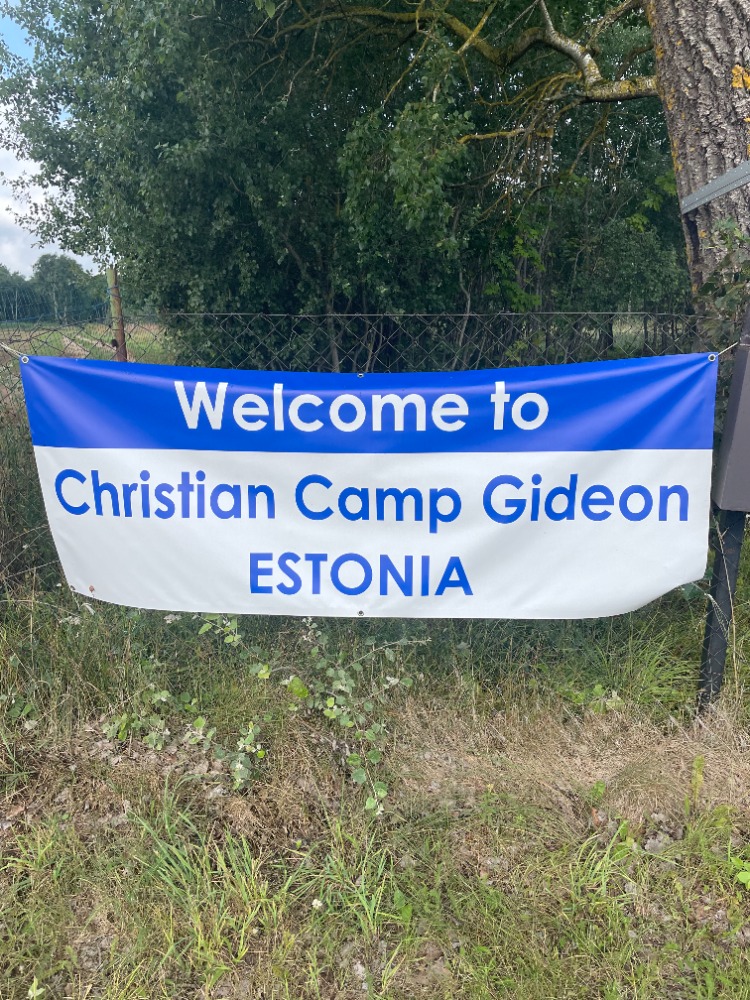
Christian Camp Gideon

Christian Camp Gideon is located in Aa, Estonia. The village is in northern Estonia, on the southern coast of the Gulf of Finland. The location is beautiful. The camp itself was built prior to World War II by the Soviet Union. At that time, it was a Pioneer Camp, where communism and atheism were taught to the young. The fall of communism in 1991 changed everything. In time, Estonia became an independent country and Camp Gideon found a new purpose.

During the summers of 1993 and 1994, Camp Gideon was used by the Estonian United Methodist Church. On March 15, 1995, Camp Gideon was purchased by the Asbury United Methodist Church of Tulsa, Oklahoma and given to the United Methodist Churches of Estonia. On that day Artur Põld was named the Director of Camp Gideon. He still holds that position today.

From the very beginning, American friends have supported Camp Gideon – both spiri­tually and financially. Every summer, several groups of volunteers from the United States arrive at Camp Gideon to organize children’s pro­grams and help repair the time-worn buildings. Over the years, Camp Gideon has become internationally known in Latvia, Russia, Finland, Sweden, Belarus, Germany and beyond. Thanks to the ministries of Camp Gideon, hundreds of children hear about Jesus each camp season. Together with the guests of Camp Gideon, several mission events have been organized, including family camps, Walks to Emmaus, and the Sum­mer Conference of the UMC in Estonia.

In 2019, my wife Kathryn and I visited Camp Gideon for the first time. We were moved by the work of these people. Since that visit she has been raising money to help with the reconstruction of the buildings. Currently there are fifteen buildings on the 75-acre camp. She is returning to Estonia between July 17 and August 5, and I am returning between July 24 and August 5. We will be helping with English Camp and are looking forward to seeing the progress that has been made at Camp Gideon. It is truly a resurrection story. A camp that once taught communism and atheism is now teaching the Good News of Jesus Christ.

You can help Camp Gideon in two ways. First, pray for Camp Gideon and us. Your prayers are more valuable than you will ever know. Second, prayerfully consider making a financial contribution to Camp Gideon. No amount is too small. It is amazing what God can do with a single dollar. Please make your check out to: PROJECT ORPHAN OUTREACH and mail it to 275 Bradford Drive, Canfield, Ohio, 44406. Some who read my weekly blog have already contributed. You will receive a thank-you note for your contribution as well as a report on what was accomplished after we return.

In advance, I would like to thank you for your generosity.

Camp Gideon

Camp Gideon is in Aa, Estonia. The village is in northern Estonia, on the southern coast of the Gulf of Finland. One cannot help but be moved by the natural beau­ty. The camp itself was built prior to World War II by the Soviet Union. At that time, it was a Pioneer Camp, where communism and atheism were taught to the young. The fall of communism in 1991 changed everything. In time, Estonia became an independent country and Camp Gideon found a new purpose.

During the summers of 1993 and 1994, Camp Gideon was used by the Estonian United Methodist Church. On March 15, 1995, Camp Gideon was purchased by the Asbury United Methodist Church of Tulsa, Oklahoma and given to the United Methodist Church of Estonia. On that day Artur Põld was named the Director of Camp Gideon. He still holds that position today.

From the very beginning, American friends have supported Camp Gideon- both spiri­tually and financially. Every summer, several groups of volunteers from the United States arrive at Camp Gideon to organize children’s pro­grams and help repair the time-worn buildings. Over the years, Camp Gideon has become internationally known in Latvia, Russia, Finland, Sweden, Belarus, Germany and beyond. Thanks to the ministries of Camp Gideon, hundreds of children hear about Jesus each camp season. Together with the guests of Camp Gideon, several mission events have been organized, including family camps, Walks to Emmaus, and Sum­mer Conference of the UMC in Estonia.

In 2019, my wife Kathryn and I visited Camp Gideon. We were moved by the work of these people. Since that visit she has raised thousands of dollars to help with the reconstruction of the buildings. Currently there are fifteen buildings on the 61-acre camp. With the pandemic ending, it is now possible to return to Estonia once again. We long to return to Camp Gideon to see the progress that has been made. It is truly a resurrection story. A camp that once taught communism and atheism is now teaching the Good News of Jesus Christ.

You can help Camp Gideon in two ways. First, pray for Camp Gideon. Our prayers are more valuable than we will ever know. Second, prayerfully consider making a financial contribution to Camp Gideon. No amount is too small. It is amazing what God can do with a single dollar. Please make your check out to PROJECT ORPHAN OUTREACH and mail it to 275 Bradford Drive, Canfield, Ohio, 44406. You will receive a thank-you note for your contribution and will receive a report on the progress.

In advance, I would like to thank you for your generosity.