John’s Question

Born in Eastern Europe, Isidor I. Rabi (1898-1988) moved to America as an infant. In time, he would study physics at MIT, Columbia and Cornell. In 1942, he won the Nobel Prize in Physics “for his resonance method for recording the magnetic properties of atomic nuclei.” (Whatever that is.) He credited his mother for his success. He said that every day after school his mother would talk to him about his school day. She wasn’t interested in his daily schedule. She was more interested in the questions he asked. Daily, she asked him, “Did you ask any good questions today?” “Asking good questions,” Rabi said, “made me become a better scientist.” In our reading, Matthew 11:1-6, John the Baptist had his disciples ask Jesus an excellent question, “Are you the one who was to come, or should we expect someone else?”

There is nothing innocent about this story. John the Baptist had been imprisoned because he had made an enemy of a powerful man, Herod Antipas (72 BC- 4 BCE). He was the son of Herod the Great (BC 72-BC 4) and the grandson of Antipater the Idumaean (BCE 114-BCE 43). He was appointed by the Romans as Herodian ruler of Galilee and Perea in 4 BCE. His political connections do not impress John. He called all to repent, including Herod Antipas. His story was well known and filled with immorality – it sounds like the storyline from a contemporary soap opera. Herod went to Rome to visit his brother, and became infatuated with his sister-in-law, Herodias (15 BC- 39 AD). He seduced her, took her home for himself and divorced his wife. While many stayed silent, John proclaimed it as morally wrong. John’s protests came to the attention of Herod Antipas, who imprisoned John near the Dead Sea.

Like Jesus, all teachers had students or disciples who believed in them, including John. John sent his disciples to Jesus with our question, are you the one who was to come, or should we expect someone else? This question is not unique to Matthew, it is also found in Luke 7:19-23. It is a great question. The issue that haunts the entire text is why John had his disciples ask the question. John knew Jesus’s identity. He knew it from within his mother’s womb (Luke 1:44) and he heard Jesus’s identity proclaimed by God at Jesus’ baptism (Matthew 3:15). There is no sign that John doubted or became frustrated with Jesus. So why did John have his disciples ask the question, “Are you the one who has come, or should we expect another?” 

The key to understanding John’s question is evangelism. We understand evangelism to be sharing the good news of Jesus Christ, calling individuals to repentance and faith in Him as their Lord and Savior. John knew Jesus was the Messiah and he wanted to make sure his disciples understood Jesus to be the Messiah. He knew the benefits of discipleship, and he wanted his disciples to experience those benefits too. Consider it the pastoral side of John. He sends them to Jesus to ask the question, are you the one who has come, or should we expect another,” because he wanted them to have the right answer too. He wanted the best for his disciples. The best we have to offer someone is Jesus. No one can accept Jesus for you, you must do it for yourself.  There is a world of difference between learning about Jesus and experiencing Jesus! That reminds me of a parishioner I met years ago.

Her name was Nancy and she lived in a Cleveland, Ohio suburb. She visited my church one Sunday, and I arranged to meet her several days later. We connected in the first few minutes and she told me her story. She had just been honorably discharged from the United States Navy and moved back home to attend college. She was studying nursing and confessed it was hard for her to be living at home with her mother.  She went as far as to tell me her mother was mad at her for visiting my church, because she had been raised Roman Catholic. She felt disconnected from the Roman Catholic Church during her military service. During those years, she tried various Christian traditions and had read the Bible cover to cover. Near the end of our discussion, she looked at me and said, “I know everything there is to know about Jesus, but I’m still not sure I am going to heaven when I die.” I looked at Nancy and said, “There is a world of difference between knowing about Jesus and knowing Jesus.” I asked her if she knew Jesus as her Lord and Savior. She did not, so I led her to salvation. She thanked me and walked out of my church a different person.

Can you relate to Nancy’s story? You know everything there is to know about Jesus. You go to church and read the Bible. You pray for the sick and read your devotional. However, you still aren’t sure about your own salvation. John the Baptist knew it from the very beginning. You can know everything about Jesus and still not know Jesus. He sent his disciples to Jesus with the question, “are you the one who has come, or should we expect another,” so they could experience Jesus for themselves. Do you know Jesus, or do you just know about Jesus? Until you know Jesus, you know nothing at all!

Modeling Discipleship

According to the liturgical calendar, Christmastide lasts twelve days – between December 25 and January 5. The liturgical season of Epiphany begins on January 6 and ends on Ash Wednesday. Epiphany means “manifestation.” It is the season we celebrate the fact that Christ came to save all people from their sins, both Jews and Gentiles. Our reading, Matthew 2:1-12, is the traditional reading on Epiphany Sunday. The story of the Magi is one of the most known and loved stories in the Bible; they complete the Christmas narrative. Yet, hiding in the tradition of their story is a fact we cannot ignore – the Magi give us the perfect model for discipleship. Consider these three things with me.

First, the Magi bowed down. The Magi were Babylonian astrologers or priests, who had seen a star that announced the birth of a newborn king. The Magi assumed the newborn king was born in the insecure palace of Herod the Great in Jerusalem. The chief priests and the teachers of the law corrected the Magi’s mistake. The newborn king would be born a few miles south of Jerusalem in Bethlehem. A short time later, the Magi found the infant Jesus in a house. When they arrived, they bowed down and worshipped Jesus. (Verse 11) What does it mean to bow down? It means the Magi, with all their worldly influence, knowledge and power, humbled themselves before Jesus. If you want to be a disciple of Jesus Christ, then you must humble yourself before him too. How humble are you? 

I love this story: Shortly after Booker T. Washington (1856-1915) took over the presidency of Tuskegee Institute in Alabama, he was walking in an exclusive section of town when he was stopped by a wealthy white woman. Not knowing the famous Mr. Washington by sight, she asked if he would like to earn a few dollars by chopping wood for her. Because he had no pressing business at that moment, Professor Washington smiled, rolled up his sleeves, and proceeded to do the humble chore she had requested. When he was finished, he carried the logs into the house and stacked them by the fireplace. A little girl recognized him, and she later revealed his identity to the lady. The next morning, the embarrassed woman went to see Mr. Washington in his office at the Institute and apologized profusely. “It’s perfectly all right, Madam,” he replied. “Occasionally I enjoy a little manual labor. Besides, it’s always a delight to do something for a friend.” She shook his hand warmly and assured him that his meek and gracious attitude had endeared him and his work to her heart. Not long afterward she showed her admiration by persuading some wealthy acquaintances to join her in donating large sums of money to the Tuskegee Institute. Isn’t it amazing how God can use a humble person? Do the people in your life consider you humble? The Magi bowed down.

Second, the Magi opened up. The Magi didn’t just bow down. They also offered him gifts. You know the gifts, they gave gold, frankincense and myrrh. Each one of the gifts reveals something about the life that Jesus is going to live. The gold was a gift for a king. The frankincense was a gift for a priest. The myrrh was a gift for one who was going to die. The Magi’s gifts reveal the generosity of the Magi. The Magi gave their best. If you want to be a disciple of Jesus Christ, then you must give him your best as well. One of the characteristics of the Christian faith is generosity. Hebrews 13:16 says, “And do not forget to do good and to share with others, for with such sacrifices God is pleased.” I have seen that verse played out within the life of the church many times.

Annually, my wife Kathryn and I travel to Estonia to help with Christian Camp Gideon. Normally, we travel alone, but last year we met a couple from Iowa at camp, who had heard about the camp but had never traveled to Estonia. Like us, they were moved by the people and the mission of the camp. Giving of their time was not enough, so they inquired about what the camp needed. It turned out the camp needed a riding lawn mower costing approximately $12,000. In the end, they bought that lawn mower and demonstrated their faith. One of the characteristics of the Christian faith is generosity. Do the people in your life consider you generous? The Magi opened up.

Third, the Magi changed. Once the Magi had worshipped Jesus and gave their gifts, they long to return home. They planned returning by the same route from which they came. There is no reason to believe they would have changed their itinerary, however they had a dream that warned them to go home a different way. Verse 12 says, “They returned home by another route.”  Jesus had changed their normal way, and they tried a new way. How much is Jesus changing your life? Are you willing to try something new for Jesus or do you like yourself as you are? That leads us to an interesting question.

How has the Christian Faith changed your life? The Christian Faith should completely transform you, because the Christian Faith offers us hope and a purpose. The Christian Faith should change your behavior, because you are to be more like Jesus, making you more empathetic and resilient. The Christian Faith should be changing your identity, because Jesus offers us spiritual renewal. The Magi changed. Have you?

According to recent polls, approximately 45% of Americans make New Year’s resolutions. Some resolutions revolve around personal health: exercise more, eat healthier, lose weight. Some resolutions revolve around finances: save money, pay off debt, follow a budget. Some resolutions revolve around personal well-being: being happier or learning something new. I hope you make a resolution to be more like the Magi, who took their discipleship seriously. They bowed down and humbled themselves. They opened up and gave generously. They changed and followed God’s direction. German Lutheran theologian Dietrich Bonhoffer (1906-1945) once said, “Christianity without discipleship is always Christianity without Christ.”

What Does God Look Like?

In Crystal McVea’s book, Waking Up in Heaven, she describes an experience she had in December of 2009. She was hospitalized with pancreatitis and accidentally overdosed on pain killers. She died for nine minutes. She said, “At the exact moment I closed my eyes on Earth, was the exact moment that I opened my eyes in heaven.”  She described heaven as a tunnel filled with bright light and felt the problems of this world fall away. Communication with God was uninterrupted. McVea said, “Time began to slow down and suddenly I was in the presence of God. I fell on my knees to worship him, and I was saddened by the fact that I hadn’t done more in His name while I had been here.”  She chose to return to this world when she heard her mother’s voice. However, she knows heaven is still waiting for her in her future. 

Do you believe Crytal McVea’s story? Doubters would say her story is the result of excess pain killers. Believers would say she saw God. If she saw God, then she was one of a handful who have ever seen God. People have longed to see God from the very beginning. That leads us to our question: what does God look like? There is no simple answer.

Don’t look to the Bible for an answer because the Bible doesn’t give us a description of God. In the Old Testament only four people saw God. There was Abraham, Isaac, Jacob and Moses. You can find those accounts in Genesis 17, 35 and 48. However, in none of those accounts is there a description of God. In Exodus 33:18-23, we are told that Moses requested to see God, but his request was denied. God said no one can see Him. Do you remember the story? God places Moses on the side of a mountain and covers his eyes. God passes in front of Moses, but Moses only sees his back. The Old Testament is no help. The New Testament is no help. God is always hidden by a cloud, as at Jesus’ baptism and the transfiguration.   

The art world has tried to answer the question, what does God look like? The image of God has inspired some of the greatest pieces of art in history. No one tried to portray God in art until the 10th century because of fear. In the 10th century some part of a human body appeared in art to represent God, a hand or a small part of a face. By the 12th century private art was created and showed more of God. During the Renaissance both the Roman Catholic and Protestant churches protested the art world because they showed too much of God’s form. In 1511, Michelangelo (1475-1564) painted the Sistine Chapel. God’s fingers touch to create Adam. I find this information interesting, but it doesn’t answer our question, what does God look like?

Our reading, Isaiah 9:2-7, gives us hope at seeing God. Isaiah lived seven hundred years before the birth of Christ. They were politically stormy times for God’s Chosen People. Israel was in a state of decline, and the Assyria Empire was expanding. The people were hopeless, but Isaiah saw the big picture and offered them hope. He told them God had not forgotten them. With God, there is always hope. In verse six we are told their hope would come in the form of a child. We understand that child to be Jesus, the incarnation of God. You know the story.

It all began with an unwanted pregnancy. A young woman named Mary. She was a virgin, yet she finds herself pregnant. She is the hot topic in her little town of Nazareth. With very few options she travels to her aunt’s home, Elizabeth, to escape the judgment of her community. Elizabeth accepts her unconditionally and offers her hope.  Elizabeth tells Mary God has a plan for her life. A man named Joseph would take Mary as his wife, and they will travel to Bethlehem to be counted in the census. Mary gives birth to this unwanted child in a stable built for animals. But God cares, He sent angels to some shepherds, who risk everything to see this baby. When they arrived, they saw the baby. However, they were not just looking at a newborn. They were looking at God. At Christmas, we celebrate the incarnation of God, Jesus! However, the story does not end there.

Jesus grew into adulthood. His earthly ministry began at 30-years-old and ended tragically at 33-years-old. On what we call Good Friday, he was executed Roman style like a common criminal and buried by his loved ones. The good news is the grave couldn’t hold Jesus. On the following Sunday, a few women make the great discovery that Jesus had been resurrected. The resurrected Jesus witnessed to his believers for 40 days before ascending into heaven. Ten days after Jesus ascended into heaven the Holy Spirit was unleashed on all believers to help them minister in the name of Jesus. Our good deeds are a way of thanking God for saving our souls and a way of reminding people about Jesus. In a perfect church, when people look at us, they should see God. When was the last time someone saw God in you?

During the Thirty Year’s War in Europe (1618-1648), the King of Sweden, Gustavus Adolphus (1594-1632), was killed in the Battle of Lutzen, in present day Germany. Sweden was thrown into mourning, and government officials met to determine how to replace the king. Some suggested a republic; others thought the crown should go to Adolphus’ cousin, the king of Poland. The chancellor of Sweden arose and said, “Let there be no talk of a republic or of Polish kings, for we have in our midst the heir of the great Gustavus, his little daughter, who is 6 years of age.”  Some protested because they had never seen her. The chancellor said, “Wait a minute, and I will show you.”  He brought in Christina, daughter of the king, and placed her on the throne. One of the representatives, who was especially suspicious of the move, pressed forward and gazed intently into her face. Then turning to the assembly, he exclaimed, “Look at her nose, her eyes, her chin! I see in the countenance of this child the features of the great Gustavus. She is the child of our king!”  From all quarters of the room rang the proclamation, “Christina, Queen of Sweden!” Let me ask you this question. 

Has anyone ever seen God in you? I am not talking about the way you look. I am not talking about your chin or your smile. I am not talking about your eyes or your cheek bones. I am talking about the things you do. I am talking about your very presence. You are a disciple of Jesus Christ! What do people learn about God by looking at you? Do you remember Crystal McVea? She said the words I hope you never say. Of her nine minutes in heaven, she said, “I fell on my knees to worship him, and I was saddened with the fact that I hadn’t done more in His name while I had been here.”  How much have you done in His name? How much do you look like God?

Five Christian Qualities

Our reading is Ephesians 4:1-6. The epistle to the Ephesians was written by the Apostle Paul in the year 60 from a Roman prison cell. I had the good fortune to Ephesus, located in present day Turkey, several years ago. The ruins are a reminder of her glorious past. In Paul’s day, Ephesus was the most important city in western Asia Minor because it was on the intersection of international trade routes which made it a commercial giant. Paul stayed in Ephesus for two years to export the Gospel to every corner of his world. This epistle does not address any bad problems or heresy. The church was perfect, but that is not good enough. Paul writes this letter to challenge the Ephesians to expand their understanding of God’s plan of salvation. He reminds them, and us, to never be satisfied with our spiritual state. It is not enough to claim our salvation and rest on our laurels. We must press on to perfection. In the first three chapters of Ephesians Paul explains the role the church must play in God’s plan of salvation.

In the fourth chapter, Paul addresses the qualities each church member must develop in their spiritual journey. There are five qualities true believers must develop. There is no other way to say it – Paul sets the standard high and expects a great deal from us. You can call these five qualities a challenge to grow spiritually. We should never be satisfied with our present spiritual state. We should always be striving for perfection, because we are supposed to be a little more like Jesus every day. Paul challenged the Ephesians to grow spiritual, so I have the license to challenge you. I want to challenge you because I don’t want you to be the weakest link of your church.

The first Christian quality is humility. It is interesting to note that the ancient world despised the word humility. Even today, humility is looked down upon. We look up to people who are confident, if not arrogant. However, humility is one of the most misunderstood words in the English language. Humility does not mean you lack any confidence or skills, it means something completely different. It is identifying your strengths and using them for a greater good. If you want to be a humble person, then you must do two things. First, you must know yourself. You must know what you can do and what you cannot do. You must know what you believe and your core values. You must accept yourself as you are. God does not make junk. Do you know yourself? Second, you must compare yourself to Jesus. Let’s be honest, there is no comparison. If you do those two things, then you will use your God-given gifts to God’s glory. God has created you for a specific reason. C. S. Lewis (1898-1963) once said, “Christian humility is not thinking less of yourself, it is thinking of yourself less.” Do the people in your life consider you a humble person? There is humility.

The second Christian quality is gentleness. Being gentle or meek does not mean you are a doormat. It does not mean you are passionless. It means you get upset about the right things – moral issues. What upsets you? Are you more upset that the Guardians’ ownership is cheap or are you more upset, according to the United Nations, approximately 25,000 people die daily from starvation in our world? Does income disparity upset you? Do human rights violations upset you? Does it upset you that many in our world lack clean drinking water, quality education and healthcare? There is nothing wrong with getting upset about moral issues. What upsets you? Jesus was gentle or meek, and yet he got upset. Remember, Jesus got upset when the temple was used for personal profit. American author Elizabeth George (born 1946), from my hometown, Warren, Ohio, once said, “Gentleness is strength under control.” Do the people in your life consider you a gentle person? Do the people in your life consider you a meek person?There is humility. There is gentleness.

The third Christian quality is patience. Christian patience is the spirit which never admits defeat, regardless how often we are disappointed or discouraged. Yet, there is more. Christian patience never retaliates even when opportunity represents itself. Christian patience never considers abandoning Jesus. We wait patiently until Christ returns. Do the people in your life consider you a patient person?There is humility. There is gentleness. There is patience.

The fourth Christian quality is love. In Biblical Greek there are several different words for love. There is passionate love. There is community love. There is family love. The word that Paul uses here is unconquerable, benevolent love. In other words, it is the kind of love you have for someone who hates you. That kind of love is not rooted in emotions. It is rooted in self-will. There is nothing simple about that kind of love. It is reserved for the spiritually mature. Have you ever loved someone who hates you?There is humility. There is gentleness. There is patience. There is love.

The fifth is peace. There are different kinds of peace. There is political peace. There is relational peace. There is spiritual peace. On the day you accepted Jesus, you had spiritual peace and were at peace with God. Peace is vital if we are ever going to reach our full potential. It is true in the world. It is true within our families. It is true in our communities, and it is true at church. Peace is vital! Do the people in your life consider you peaceful? There is humility. There is gentleness. There is patience. There is love. There is peace.

One of the most influential preachers in my life is a man named Tom Tewell (born 1951). Today, he is the Director of the Zick Preaching Scholar Program, which helps young preachers reach their full potential. When I became aware of him, he was the pastor of the historic Fifth Avenue Presbyterian Church in New York City. I first heard him preach when he served as Chaplain of the Week in Lakeside, Ohio years ago. For a period, I followed him online. I listen to his sermons weekly. It was during one of those sermons he told a story that still haunts me. It still haunts me. I hope it haunts you too. This is the story.

When he was young, he had to be interviewed to be ordained. He was interviewed by a small group of Presbyterian ministers in an empty church in the middle of the week. He said, they covered various topics: systematic theology, church history, his personal life, self-care and his holy habits. He felt good about the interview, and he felt like he would be approved. That all changed in an instant. The oldest man on the interview team said, “Tom, we only have one more question – are you making any progress in the Christian faith?” Tom said he opened his mouth, but no words came out. He didn’t know how to answer the question. He was stumped. It is an excellent question.

How do you answer that question? Are you making any progress in the Christian faith? Your answer cannot be NO! Your answer cannot be I HOPE SO. Your answer cannot be I HAVE NO CLUE. Your answer must be YES because Jesus expects you to grow spiritually. You just can’t claim your salvation and rest on your laurels. Our world needs more spiritually mature Christians. The church needs more spiritually mature Christians. Are you making any progress in the Christian faith, or do you have some work to do?

Remembering William Borden

Sincerity is defined as the quality of being free from pretense, deceit, or hypocrisy. Sincere people are trusted. Along with patience and compassion, sincerity is one of those qualities we wish we had more of – and wish other people had more of, too. People who show sincerity are seen as being serious, kind and truthful. Sincerity is vital as you live out the Christian faith, and is vital in understanding our scripture lesson, John 10:22-30.

According to the text, Jesus is in Jerusalem during the Festival of Dedication, a time to remember the dedication of the temple by Judas Maccabeus in 165 BC. For those unfamiliar with the Hebrew calendar, John tells us it was during the winter months. Jesus was walking in Solomon’s Colonnade, a roof structure like a Greek stoa, when he was surrounded by a group of Jews. They asked him the question everyone has been asking: are you the Messiah? Jesus goes on to tell them the answer to their question is not found in his words, the answer to their question is found in his deeds. Those words resonate in our society today, because our world still believes actions speak louder than words. After all, we believe talk is cheap. That leads us to an interesting question: if you didn’t speak a single word about Jesus, would the people in your life know you are a disciple?

Everyone knew, and no one questioned the sincerity of William Borden (1887-1913), when he graduated from The Hill School in Pottstown, Pennsylvania in 1904. His father made a fortune in the Colorado silver mines, so William was a sixteen-year-old millionaire. However, his mother had the greatest influence on his life. She took him to the Chicago Avenue Church, later Moody Church, where he accepted Jesus. His graduation gift from his parents was a chaperoned trip around the world. Traveling through Asia, the Middle East, and Europe, gave Borden a burden for the world’s hurting people. Writing home, he said, “I’m going to give my life to prepare for the mission field.” When he made this decision, he wrote in the back of his Bible two words: NO RESERVES. In other words, he was totally committed to serving God. There would be no reserves for him. How committed are you to serving God?

David Livingstone (1813-1873) was totally committed. He was a Scottish physician, pioneer missionary with the London Missionary Society, and an African explorer. His passion for Africa made him famous. Once he received a letter while in Africa that contained this question: “Have you found a good road to where you are? If so, we want to send other men to join you.” Livingstone wrote back, “If you have men who will come only if they know there is a good road, I don’t want them. I want men who will come if there is no road at all.” David Livingstone and William Borden were totally committed. How committed are you? The first two words William Borden wrote in his Bible were NO RESERVES!

In 1905, Borden enrolled at Yale University. During his first semester, he began to pray and study the Bible with a friend. A short time later, a third student joined them. By the end of his first year, 150 freshmen had become interested in meeting for weekly prayer and Bible study. By the time he was a senior, 1,000 out of the 1,300 students at Yale were meeting in groups like these. It was his goal to win every soul at Yale University for Jesus. That wasn’t enough for Borden. Off Yale’s campus, he went to the darkest parts of New Haven, Connecticut helping those individuals’ society had forgotten.  Turning down high paying job offers, Borden entered two more words in his Bible: NO RETREATS. In other words, he was always finding new ways to serve God.

In my retirement, I supply preach. In other words, I go to churches when the pastor is away or unable to preach. I enjoy meeting new people and experiencing new churches. Most of the churches I preach at have the same story. They had a glorious past but are facing a questionable future. At some point, they stopped advancing; they are frozen in time. The crowd of the past has been replaced by a select few, who are committed to traditional worship. They haven’t gotten involved in missions in years because they are consumed by their own needs. The only energy present is the energy needed to maintain the basic church functions. The world is changing, yet they refuse to change. They all know the truth: the end is near and when the door is locked for the last time, no one will miss them. William was never satisfied doing the same old thing. He was always finding a new way to serve God. When was the last time your church tried a new ministry? When was the last time you tried something new to serve God? The second two-words William Borden wrote in his Bible were NO RETREATS!

After graduating from Yale in 1909, Borden prepared for the mission field at Princeton Seminary. At the age of twenty-two, Borden became the director of the National Bible Institute in New York City as well as the Moody Bible Institute in Chicago. His goal was to evangelize the Muslims in China. On his way to China, he stopped in Egypt to study Arabic. It was there that his bright future grew dark. He was diagnosed with spinal meningitis and died at the age of 24. To the world it really didn’t seem fair. However, William Borden trusted God. The only one he was trying to please was God. Who are you trying to please? I have said it a million times – the only things that really matters are those things that will matter in one hundred years. What is going to matter to you in one hundred years? The only thing that is going to matter to you in one hundred years is Jesus! Are you living for Jesus, or are you living for someone or something else? During his illness he wrote two more words in the back of his Bible, NO REGRETS.

How can you question the sincerity of William Borden? If he hadn’t spoken a word, his life spoke volumes. He was completed committed to serving God. He was always finding a new way to serve God. He completed trust God. No one could question his sincerity. Can the same thing be said about you? Jesus wasn’t wrong – actions do speak louder than words. Saint Francis of Assisi (1181-1226) once said, “Preach the Gospel, but only use words when absolutely necessary.”

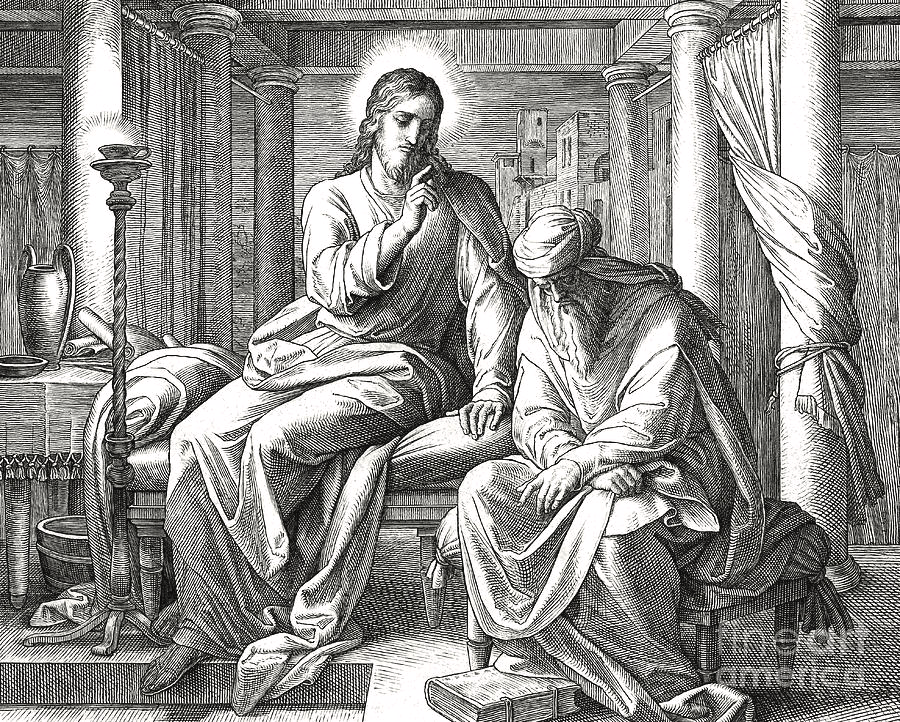
Born Again

Our reading is John 3:1-15. The story is nothing more than a private discussion between Jesus and Nicodemus. Everyone knows Jesus, no additional information is needed. Some know Nicodemus. According to the second half of verse one, he was a member of the Jewish ruling council. That means he had climbed to the top of his profession. It is safe to say Nicodemus spent his days answering the questions of others. This story is unique because he is the one with the questions.

According to verse two, Nicodemus went to Jesus at night. Much has been made about that fact. Some say he went at night to hide his identity. How would it look for a trusted member of the clergy to go to Jesus, a man with no credentials? Others say Nicodemus went at night so the two would have time to talk. The business of the day was done. Regardless, Nicodemus went to Jesus because he was impressed by the Master. No ordinary man could have performed such miracles; he must come from God. Jesus hears through these kind words and knows the real topic – salvation! Jesus says in verse three, no one can enter the kingdom of God unless they are born again. Two thousand years later, the world is still wrestling with those words, so we should not be surprised that Nicodemus wrestled with them that night. He thinks Jesus is speaking of physical birth, reentering your mother’s womb. Jesus is speaking of spiritual birth. The two are as different as night and day. From the moment you were physically born, you struggled to survive. The goal of life is survival, so the most important person in your universe is you. Spiritual rebirth is different. From the moment you are reborn, the most important person is God. Spiritually immature people live for themselves; spiritually mature people live for God. Which is more important to you? Are you the center of your universe, or is God the center of your universe? To help you discover the center of your universe, let me ask you three questions. This is question number one.

First, how do you spend your time? One of the great stories in the Bible is the story of Mary and Martha, Luke 10:38-42. Mary and Martha were sisters of Lazarus, the one who Jesus had resurrected. Jesus stopped at their home in Bethany on his way to Jerusalem. Bethany was only two miles from Jerusalem. When Jesus arrived, Mary sat at Jesus’s feet, absorbing every word. Martha, on the other hand, was consumed by the traditional female duties. It is a story about priorities. In time, Martha resents doing all the work and goes to Jesus to enlist some help. Martha filled her time doing good things; Mary filled her time with the best thing in life, Jesus. How do you fill your time?

Are you spending your time in a way that is pleasing to God? Are you going to fill your life with good things: work, family, friends and entertainment? Are you going to fill your life with the best thing: Jesus? This is a more pointed question – how much time do you spend with God? Are you the center of your universe? Is God in the center of your universe? This is question number two.

Second, how do you spend your money? Studies tell us that one of the reasons people don’t attend church is money. To be more exact, people do not want to go to church and to be asked to give money. The problem is Jesus spoke more about money than any other topic. That is quite a statement. That means Jesus spoke more about money than he did love, forgiveness, grace, or salvation. In my time in the ministry, I was never afraid to talk about money, it is just so practical. If Jesus spoke about money, then I had the license to do the same. Monthly, in my sermons, money came up in one form or another. Annually, I covered the same points during the stewardship drive. First, money is important. If you don’t believe me, then try to live without it. Second, money is limited. It was reported recently that Amazon’s Jeff Bezos (born 1964) is worth approximately $250 billion. Even his fortune has limits. You have limits too. Third, because money is important and limited, how we spend our money is revealing. We only spend our money on things that are important to us. How great of a priority of God to you?

Are you spending your money in a way that is pleasing to God? The church was never meant to be destitute. It was meant to be fiscally responsible to meet the challenges our world is facing. This is a question to ponder: if everyone gave as much money as you do to your church, would the ministry of your church contract or expand? Are you living with yourself in the center of your universe? Are you living with God in the center of your universe? This is question number three.

Third, how do you use your talent? Some consider Leonardo da Vinci (1452-1519) the most talented person in the history of the world. His list of accomplishments is impressive. He excelled as an artist, scientist, and inventor. Some consider Isaac Newton (1647-1727) the most talented person in the history of the world. He made groundbreaking contributions to physics, calculus, and optics. He changed the way we look at the universe. Some consider Elon Musk (born 1971) the most talented person in the history of the world. He has made significant contributions to several industries, including electric vehicles, space exploration, and artificial intelligence. There have been many talented people in history.

Is God pleased with the way you are using your natural talents? You are not the most talented person in the history of the world, but that does not mean you lack talent. Everyone has some kind of talent. I have never met a talentless person. The question is, how are you going to use your talent? Are you just going to use your talents for personal gain? Are you using your talents to bring glory to God? Are you living making yourself the center of your universe? Are you living with God in the center of your universe?

When I was in high school, it seemed like the entire evangelical Christian world was asking the question, are you born again? I saw it as a death question. The real question was, are you prepared to die? Are you going to spend eternity in heaven or hell? Today, I consider that question, are you born again, a life question. Are you going to live in a way making your yourself the center of your universe, or are you going to live in a way to make God the center of your universe? Are you spending your time in a way that is pleasing to God? Are you spending your money in a way that is pleasing to God? Are you sharing your natural talents in a way that is pleasing to God? It has been said, “Being born again means embracing a life of purpose, love, and service.” Are you born again?

Following Jesus

According to Psychology Today, the average person makes more the 35,000 decisions in a single day. This includes conscious and subconscious choices, with many decisions based on prior knowledge and experience. Most decisions are rather simple – where to sit, what to eat for the next meal, what lane you should drive in. These decisions are easily made and have very little consequences. Other decisions are more serious with long-lasting effects. Your decision to follow Jesus is one of them. For once you decide to follow Jesus, everything in your life should change. If you don’t believe me, then look at the life of C. S. Lewis (1898-1963).

He was a novelist, poet, lecturer and Christian apologist. Absolutely brilliant, he held academic posts at both Oxford University and Cambridge University. His Christian faith can be seen in all his classic literary works: The Screwtape Letters, The Chronicles of Narnia, The Space Trilogy, Mere Christianity, Miracles, and The Problem with Pain. However, there was a period in his life when he believed nothing at all. In his memoir, Surprised by Joy, Lewis told how he was baptized into the Church of Ireland, but the sacrament had no influence on him. He walked away from the faith and didn’t return until he was 32. He thanked his friends, including J. R. Tolkien (1892-1973), for his spiritual wakening. His life would never be the same again. Your decision to follow Jesus changed you too. That takes us to our reading, John 1:35-42.

The story is a little complex. It is early in Jesus’s earthly ministry. It is so early Jesus doesn’t have a single disciple. However, John the Baptist does have disciples. When Jesus passes John the Baptist and his disciples, John identifies Jesus as the Lamb of God, referring to Jesus’s future sacrificial death. With that endorsement, two of John’s disciples began to follow Jesus. The Bible identifies one of the disciples as Andrew, tradition identifies the other disciple as John, the author of the fourth Gospel. Seconds later, Jesus noticed they were following him and asks them, “Why?” It is an excellent question because no one likes being stalked. They answered Jesus’s question with another question, “Where are you staying?” Jesus answers that question with an invitation, “Come and you will see.” They accept the invitation and stay with Jesus until about 4:00 in the afternoon. At that time, the two leave Jesus and tell others about him. Andrew told his brother Peter, who decide to follow Jesus too. In this story, three people decide to follow Jesus; their decision to follow Jesus changed them. The question is, are you following Jesus? To explore your answer, let me ask you three more questions.

First, do you follow Jesus exclusively? In the story, Andrew and John begin as disciples of John the Baptist. Don’t forget, John the Baptist was their rabbi or teacher, Andrew and John were his disciples or students. In other words, he gave them spiritual insight and direction. When John the Baptist identifies Jesus as the long-awaited Messiah, they listen to him because they trust him. This story is incredible because Andrew and John left John the Baptist to follow Jesus. They were going to follow Jesus exclusively. Are you following Jesus exclusively? In a politically correct world, this will make some people uncomfortable.

I was raised in a steel town in northeast Ohio. I have no childhood memories of knowing non-Christians. Everyone I knew followed some form of Christianity. I knew people who represented the various branches of the mainline Protestant church. I knew people who practiced the various forms of Orthodoxy. I knew people who were Roman Catholic or Byzantine Catholic. Everyone was a Christian. There was no spiritual tension because everyone believed in Jesus. Then, I became an adult and moved to more urban areas. Saying you follow Jesus exclusively suddenly took on a new meaning. It meant something. However, we are not called to judge others, we are called to love others. That divine truth disarmed many situations. Honestly, I am thankful I am not the judge. You can follow Jesus exclusively and love anyone. The question is, do you follow Jesus exclusively?

Second, do you follow Jesus unconditionally? One of the great stories in the Bible can be found in the Book of Job. Everyone knows the story because everyone has played the part of Job. In the beginning he has everything – wealth, health and family. Satan believes Job’s loves for God is conditional, so he begins to take things away from Job. His wealth is taken away. His health is taken away. His loved ones are taken away. His friends witness his ordeal and encourage him to curse God and die. Job refuses, because his love for God is unconditional. 

Many follow Jesus conditionally. It is easy to follow Jesus when life is good. It is easy to follow Jesus when you have a well-paying, enjoyable job. It is easy to follow Jesus when your health is good and your loved one’s health is good. It is easy to follow Jesus when all your relationships are sound. It is not so easy to follow Jesus when you are unemployed, sick and alone. It is not so easy to follow Jesus when a loved one is struggling. It is not so easy to follow Jesus when your friends tell you to stop following Jesus. After all, we believe in an all-powerful God who resurrected Jesus from the dead. Have you ever wondered why our all-powerful God doesn’t help you? Do you follow Jesus unconditionally?

Third, do you follow Jesus passionately? In other words, do you have a desire to be like Jesus? Are you more like Jesus now than the day you decided to follow him? Following Jesus should transform you in three ways. First, following Jesus will change your perspective. Are you looking at life through different lens, one that emphasizes God’s love, grace, and an eternal perspective. Second, following Jesus will change your priorities. You will be more concerned with others. Our world is filled with hurting people. Third, following Jesus will change your purpose. Personal gain or worldly success will be replaced by God’s plan for the world. If you are going to follow Jesus passionately, then you better be prepared to change. Too many use Jesus and the Bible to promote their personal causes and beliefs. Do you follow Jesus passionately?

In the scripture lesson for today, three people, Andrew, Peter, and John, decide to follow Jesus. They follow Jesus for the rest of their lives. In the end, only John dies of old age. Yet, he experienced the isolation of Patmos Island, where he had a series of visions. Those visions became the book of Revelation. Tradition tells us that Peter died in Rome, where he was crucified upside down for evangelizing. He was crucified upside down at his own request, because he didn’t feel worthy to die like Jesus. Tradition also tells us that Andrew was crucified on an x-shaped instead of a t-shaped cross in Achaea, Greece because he too didn’t feel worthy to die like Jesus. It is safe to say they followed Jesus exclusively, unconditionally, and passionately. The question is – do you follow Jesus, or is it how you follow Jesus? Billy Graham (1818-2018) once said, “When we come to Christ, we’re no longer the most important person in the world to us; Christ is. Instead of living only for ourselves, we have a higher goal: to live for Jesus.”

Ash Wednesday

We are instructed from the Gospel of Luke. The author of this book is never mentioned by name, but we know certain things about him. He was a Gentile, who was well educated in Greek culture, and a physician by trade. He penned this Gospel approximately the year A.D. 70. The outline of Luke is geographical. The first section revolves around Jesus’s time in Galilee. The second section revolves around Jesus’s time in Judea. The third section revolves around Jesus’s time in Jerusalem. In our reading, Luke 9:18-26, Jesus is in Galilee.

In our reading, Jesus was a celebrity. Everyone was talking about him, and everyone wanted something from him. Everyone was guessing his identity. However, Jesus was not interested in everyone else’s opinion. Jesus was only interested in what the disciples thought about him. So, he asked them the question that changed everything: who do you say I am? The usually chatty disciples grew strangely silent. It is not that they don’t have an opinion, it was that they didn’t want to be wrong. It is Peter who answered first and correctly. He said, in verse 20, “God’s Messiah.” Jesus instructs the disciples to keep his identity a secret. The reason is simple – their generation misunderstood the word, Messiah. They longed for a military Messiah to liberate them from foreign rule. Instead, Jesus was a spiritual Messiah who came to liberate them from sin itself. Jesus says it clearly, but the disciples don’t listen. As the spiritual Messiah, Jesus will suffer, be rejected and die. However, that is not the end of the story. In the end, Jesus will be resurrected.

The power of the empty tomb is such a glorious thing. Jesus invites others to share in his glory. However, if you are going to follow Jesus, then you must be completely committed to him. People traditionally give up things for Lent to show the world they are completely committed to Jesus. If you are reading this blog, I am assuming you have decided to follow Jesus too. Let me ask you this question:

What are you going to give up for Lent? Did you know 24% of all Americans observe the season of Lent. Many give up something for Lent. Maybe you are giving up one of these things? The list changes from generation to generation. Are you giving up:

  1. Chocolate or sweets
  2. Alcohol
  3. Smoking
  4. Fast Food
  5. Swearing
  6. Social Media
  7. Shopping
  8. Sports
  9. Caffeine
  10. Meat

I hope you know the truth – Lent is not a season of self-deprivation; it is a season of spiritual renewal.To be honest, I don’t normallygive up anything for Lent, but I don’t think it is a bad thing. Instead I always try to be a better person.

Unlike Christmas and Easter, Lent has not crossed over into the secular world. The reason is obvious. Christmas and Easter emphasize receiving something. Lent emphasizes giving up something. There is nothing wrong with a little self-discipline. However, there are some things you should never give up. It is those things that grab our attention during this sacred season. The things we should never give up are the spiritual disciplines. You should never give up:

  1. Prayer   When was the last time you prayed? 55% of Americans pray daily. That number escalates to 88% when a loved one is facing hardship.
  • Fasting   When was the last time you fasted? Do you understand the concept of fasting? Fasting creates time with God.
  • Worship Is worshipping a priority in your life, or is it something you do when your calendar is clear?
  • Meditation  This is hard to do because time is limited. When was the last time you had time to just think about God and his mysterious ways?
  • The Bible   When was the last time you read the Bible for your own edification? With over five billion copies sold, the Bible is the all-time best seller. Sadly, only 11% of Americans read the Bible daily.

These are five of the spiritual disciplines. I am going to look at each one over the coming weeks. I hope you read each one, because each one of these disciplines is vital to your spiritual health. Remember, Lent is a season of spiritual renewal.

Lent comes from the Anglo-Saxonword lencten,which means “spring.” Excluding Sundays, because every Sunday is a little Easter, Lent is a forty-day period. It correlates with Jesus who fasted forty days before being tempted by Satan. Lent begins this year on March 5, and it ends on Holy Saturday, April 19. What are you going to give up for Lent? Maybe this is a better question: What are you not going to give up for Lent? It has been said, Lent is not something we do for God, Lent is something we do with God.

Our Three Loves

Our reading is 1 Peter 2:4-12. Tradition tells us it was written by the apostle Peter. Clearly, he understood the significance of the resurrection of Jesus, the cornerstone of the Christian faith. 1 Peter was a circular letter. He is not writing to any particular congregation or individual, he wrote it to all believers. That is not an easy task. What do you say that is relevant to everyone? Drawing on his pastor’s heart, Peter encourages them to live out the faith. That sounds simple, but it is a hard thing to do.

In the first century they were worried about Christian persecution. The threat was obvious. In our generation it is more subtle. The threat is no longer external, it is internal. Our world has become masters at compromising everything, including the faith. The world is encouraging us to compromise the faith away. May we never forget, we should live as aliens in this world, always fixing our eyes on heaven. Never underestimate the power of a Christian life. It is a powerful witness. According to our reading for today, to maximize our witness, we must have three great loves.

First, we need to love ourselves. Norman Vincent Peale (1898-1993) was an American clergyman who served in the Reformed Church in America. In 1952, his book The Power of Positive Thinking was released. It was a massive success selling more than five million copies worldwide. Peale became a celebrity. He told this story.

Once while visiting Hong Kong, he came across a tattoo shop. Hanging in the window were the various tattoos one could purchase. There were many, but one tattoo stuck out. It was just three words: BORN TO LOSE. He entered the shop in astonishment and pointed to those words. He asked the Chinese tattoo artist, “Does anyone really have that terrible phrase, BORN TO LOSE, tattooed on their body?” The shop owner replied, “Yes, sometimes.” Peale said, “I just can’t believe that anyone in his right mind would do that.” The shop owner simply tapped his forehead and said in broken English, “Before tattoo on body, tattoo on mind.” How many people do you know who feel like a loser? Could it be you feel like a loser?

Peter reminds us we must love ourselves. I am not talking about narcissism. I am talking about having a humble healthy self-esteem. How do you feel about yourself? Look at the words Peter uses to describe his readers, they are the same words that God has preserved for us to today. They are not harsh words; they are affirming words. Verses nine and ten say, “But you are a chosen people, a royal priesthood, a holy nation, a people belonging to God, that you may declare the praises of him who called you out of darkness into his wonderful light. Once you were not a people, but now you are the people of God; once you had not received mercy, but now you have received mercy.” Those are God’s words to you. Do you believe them? God knows you are valuable. Do you see yourself as valuable? Holocaust survivor Viktor Frankl (1905-1997) once said, “Everything can be taken from a man but one thing, his attitude.” What do you think about yourself? Are you a winner or a loser? The world is great at making us feel like losers. To maximize your witness, you most love yourself!

Second, we must love others. Peter Arnett (born 1934) was a CNN television commentator and reporter. He tells of a time he was in Israel, in a small town on the West Bank, when a bomb exploded. Bloodied people were everywhere. A man came running up to Peter holding a little girl in his arms. He pleaded with Peter to take her to a hospital. As a member of the press, he would be able to get through the security cordon that had been thrown around the explosion scene. Peter, the man and the girl jumped into his car and rushed to the hospital. The whole time the man was pleading with him to hurry, to go faster, heartbroken at the thought that the little girl might die. Sadly, the little girl died on the operating table. When the doctor came out to give them the news the man collapsed in tears. Peter Arnett was lost for words. “I don’t know what to say. I can’t imagine what you must be going through. I’ve never lost a child.” 

It was then that the man said, “Oh, mister, that girl was not my daughter. I’m an Israeli settler. She was a Palestinian. But there comes a time when each of us must realize that every child, regardless of that child’s background, is a daughter or a son. There must come a time when we realize that we are all family.”

Archbishop William Temple (1881-1944) once said, “The church is the only institution that exists primarily for the benefit of those who are not members.” It is the story of the Christian faith. Jesus came and died to help others. There is no room in the Christian faith for selfishness. The world is looking for help. What are you doing to help others? To maximize your witness is to love others.

Third, we must love Jesus. Gregory the Nazianzus (329-390) penned these words for the ages years ago.

He began His ministry by being hungry, yet He is the Bread of Life.
Jesus ended His earthly ministry by being thirsty, yet He is the Living Water.
Jesus was weary, yet He is our rest. Jesus paid tribute, yet He is the King.
Jesus was accused of having a demon, yet He cast out demons.
Jesus wept, yet He wipes away our tears.
Jesus was sold for thirty pieces of silver, yet He redeemed the world.
Jesus was brought as a lamb to the slaughter, yet He is the Good Shepherd.
Jesus died, yet by His death He destroyed the power of death.

It is an incredible story. At just the right time the God of the universe came into the world and took a human form. He lived the perfect life and deserved happiness, but that is not what happened. He was executed on a Roman cross like a common criminal, between two criminals. His death was gruesome. Yet, in that horrible moment the world began to understand the depth of God’s love for us. He died so we could live. He died so we could have the opportunity to spend eternity in heaven. How can you not love Jesus? To maximize our witness we must love ourselves, love others, and love Jesus. Never underestimate the Christian life. It is a powerful witness. Peter, himself, challenges us in verse twelve to live such a life. He says, “Live such good lives among the pagans that, though they accuse you of doing wrong, they will see your good deeds and glorify God on the day he visits us.”

Remembering William Borden

In 1904, William Borden (1887-1913), heir to the Borden Dairy Estate, graduated from a Chicago high school, already a millionaire. His parents’ graduation gift to him was a trip around the world. That trip changed his life. Traveling through Asia, the Middle East, and Europe gave Borden a burden for the world’s hurting people. Writing home, he said, “I’m going to give my life to prepare for the mission field.” When he made this decision, he wrote in the back of his Bible two words: NO RESERVES.

Borden arrived at Yale University in 1905. During his first semester, Borden started to pray group and Bible study with a friend. A short time later, a third student joined them. By the end of his first year, 150 freshmen were meeting for weekly prayer and Bible study. By the time he was a senior, 1,000 out of the 1,300 students were meeting for weekly prayer and Bible study. Borden was pleased because his goal was to win every soul at Yale University for Jesus. That wasn’t enough for Borden. Off Yale’s campus, he went to the darkest parts of New Haven, Connecticut to help those individuals’ society had forgotten. After graduating from Yale, Borden turned down many well-paying jobs and began studying for the mission’s field at Princeton University. At that time, he wrote two more words in his Bible: NO RETREATS.

After leaving Princeton, he dreamed of evangelizing the Muslims in China. He sailed toward China but stopped in Egypt to study Arabic. It was there the unexpected happened. He was diagnosed with spinal meningitis and died at the age of 24. Life can be so cruel. During his illness he wrote two more words in the back of his Bible, NO REGRETS. Those six words written in the back of William Borden’s Bible act as the perfect outline for this blog. That takes us to our scripture reading.

We are in the tenth chapter of John. This is not a pleasant time for Jesus. He is surrounded by conflict by conflict. He tells us something our generation still believes. Actions speak louder than words. His miracles and his teaching state the obvious. Jesus is the Messiah. However, it is not just true of himself. It is also true of his disciples. Actions do speak louder than words. It is one thing to say you are disciple of Jesus Christ, it is something else to act like a disciple of Jesus Christ. If you didn’t speak a single word about Jesus, would the people in your life know you are a disciple? To answer that question, let us look at William Borden’s six words and examine your own life.

No Reserves

The first two words William Borden wrote in his Bible were the words: NO RESERVES. In other words, he was totally committed to serving God. Mark Twain once said, “Traveling broadens a man.” Today, he would have said, “Traveling broadens a person. If you want to experience true poverty, travel outside of the United States. It is shocking at the level and the amount of poverty that exists in the world. When William Borden experienced true poverty, he had to respond. He knew he had to respond with his life. There would be no reserves. He was totally committed. Are you totally committed?

Recently my wife and I started attending our local Lutheran Church. It is odd sitting in a pew after leading worship for forty years. I am doing my best not to evaluate the service, the sermon, or the church. I am simply there to worship and feed my soul. On our first Sunday, a gentleman stood up in the front pew and announced he was looking volunteers to serve on a stewardship task force. Then, he went on to talk about the church’s budget. It was my first Sunday, so I didn’t have the heart to tell him that stewardship is not just about money. Christian stewardship is about maintaining and using wisely the gifts that God as bestowed. Annually, I asked my church this question: if everyone volunteered as much time, shared their God given abilities, and gave as much money as you, would the ministry of your church contrast or expand? It is my experience that 80% of everything in the life of the church comes from 20% of the people. It is an issue of true commitment. Are you totally committed? The first two words in William Borden’s Bible were NO RESERVES! How many reserves do you hold for yourself?

No Retreats

The second two words William Borden wrote in his Bible were the words:  NO RETREATS. He was always finding a new ways to serve God. The world is filled with needs. Some of those needs are physical. For example, many lack food, water, and shelter. Some of those needs are spiritual. Jesus is our only hope of salvation. Those words are offensive to our politically correct world, but that does not change the truth. If we don’t have Jesus, then we have nothing at all. What are you doing to combat the needs in our world. Are you still advancing or has your momentum ground to a haunt?

This is a hard time for the United Methodist Church. The denomination is dividing, and many congregations are opting out. The topic is sexuality, but there are many reasons to leave. Some churches are leaving because they are closing. Once crowded churches are down to a select few. The only generation that remains tells stories of events that happened years ago. The problem is not a lack of devotion or commitment. The problem is not Jesus. The problem is their lack of flexibility. Society changed, but they refused to change. They offer traditional worship to a society who continues to grow more informal. The truth be told, they have decided to close, instead of changing to speak to our new society. At some point all the energy stopped moving outward and started going inward. All the energy is needed just to exist. It has been said, the mainline Protestant church is on the verge of becoming the Amish of the twenty-first century. The second two words in William Borden’s Bible were NO RETREATS. When was the last time you attacked?

No Regrets

This week I found a list of ten things you will never regret. Maybe you can relate to one of these?

          1. Showing kindness to an aged person.

          2. Destroying a letter written in anger.

          3. Offering an apology that will save a friendship.

          4. Stopping a scandal that was ruining a reputation.

          5. Helping a boy or girl find themselves.

          6. Taking time to show consideration.

          7. Refraining from gossip.

          8. Refusing to do a thing which is wrong.

          9. Living according to your convictions.

          10. Accepting the judgment of God.

William Borden had his whole life in front of him. He was only twenty-four years hold when he died. To us, it really doesn’t seem fair. However, William Borden trusted God. The only one he was trying to please was God. The last two words he wrote in his Bible were the words NO REGRETS. How far do you trust God?

I have said it a million times. The only things that really matters are those issues that will matter in one hundred years. What is going to matter in one hundred years? The only thing that really matters in one hundred years is your relationship with Jesus! Are you living for Jesus or are you living for someone or something else? In the back of William Borden’s Bible were written these words: NO RESERVES, NO RETREATS, NO REGRETS. Those words summarized his ministry.

Can I ask you a really difficult question? What words would you write in the back of your Bible? What words summarize your service to God? Would you write down LOCK THE DOORS! Would you write down TURN OFF THE LIGHTS! Would you write down WE HAVE NEVER DONE IT THAT WAY BEFORE! Would you write down SAVE MONEY! Would you write down one word, NO! Could it be you have no words? What words summarize your service to God? Perhaps a better question. How serious are you about serving God?