Don’t Judge Me!

Chuck Swindoll (born 1934) is an Evangelical Christian pastor, author and educator. You may know him from his radio program, Insight for Living, which airs on 2,000 different radio stations around the world. He tells of being at a pastor’s conference in Spokane, Washington. On the first day, a man approached him and told him how excited he was to hear him preach. That evening as the service began, Swindoll noticed the man sitting near the front. But only a few minutes into the message, the man was sound asleep. Swindoll thought to himself that perhaps he was tired after a long day’s journey and couldn’t help himself. But the same thing happened the next few nights, and Dr. Swindoll found his exasperation with the man growing. On the last night, the man’s wife came up and apologized for her husband’s inattention to the messages. She then explained. He had recently been diagnosed as having terminal cancer and the medication he was taking to ease the pain made him extremely sleepy. But it had been one of his life-long ambitions to hear Dr. Swindoll speak before he died, and now he had fulfilled that goal. Swindoll was humbled by her words and ashamed by his own thoughts. When was the last time you wrongly judged someone? That question takes us to our scripture lesson.

Our scripture reading is Acts 18:12-17. The Apostle Paul is in the city of Corinth. According to our first verse, it was when Gallio was proconsul of Achaia. That means it is about the year 51 AD. At that time Gallio was respected in that corner of the world for two reasons. First, Gallio was respected because he was well connected. His brother, Seneca, was the tutor of Nero, the Roman Emperor. Second, Gallio was respected because had shown himself to be a fair and calm man. It is that quality that saved Paul.  

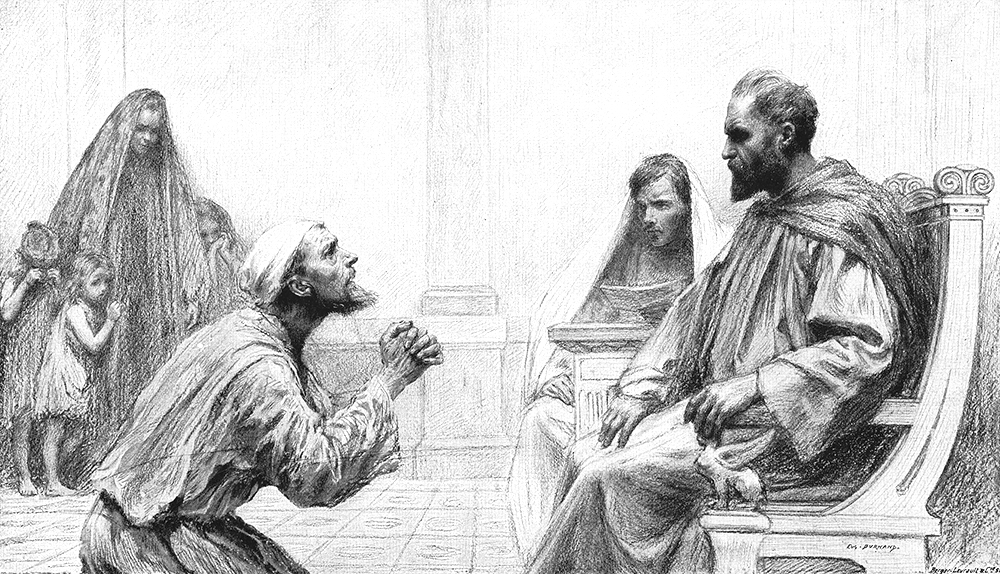
Once again, Paul had worn out his welcome. The Jews had grown tired of his lecturing in the synagogue and dragged him into court. Gallio was the judge. They felt like they had a solid case against Paul. He was worshipping God in a new way. They may have been the first to recognize that Christianity stood alone. It was not an offshoot of Judaism, making it an illegal religion in the eyes of Rome. As Paul was about to defend himself, Gallio threw the whole case out. He ruled that it is not a matter of the state, rather it was an internal matter among the Jews. Everyone is expelled from the courtroom. Then the ugly scene grows uglier. The Jews are more than embarrassed. They turn on the ruler of the synagogue, Sosthenes, and beat him. It sounds shocking to us, but it must have been just another day for Gallio. He didn’t seem to care. In the end, the group that wanted to make Paul look bad, made themselves look bad. That is what always happens when you judge others. In the end they make themselves look bad. When was the last time you judged someone harshly? When was the last time you made yourself look bad?

Webster defines judgement as: the act or process of forming an opinion after careful thought. We don’t need the word defined, because we have been judged and we have all judged others. There is no other way to say it – judging hurts everyone. Judging hurts the person who is judged. Judging hurts the one who judges. Judging creates a negative environment. Judging damages relationships and organizations. It is painfully true. When judging occurs within the life of the church the church itself gets damaged. We should know better. Jesus told us not to judge. Do you remember the story? 

It is found in the eighth chapter of John. The story is the adulterous woman. Jesus is at the Mount of Olives teaching about the Kingdom of God. Without warning, the teachers of the law and the Pharisees appear dragging an adulterous woman with them. It takes two people to commit adultery, a man and a woman. However, in this story the woman stands alone. The Old Testament law was clear. The woman must be stoned to death. Jesus looked at the woman and had pity on her. He doesn’t respond at first, he writes something in the sand. After a period of silence, Jesus looks at the judging crowd and says, “Ye that is without sin cast the first stone.” Everyone in the crowd dropped their stone because everyone in the crowd had sinned. The crowd disperses, and Jesus tells the woman to sin no more. There is only one point to this story – judging is wrong, yet everyone judges. Judging is a sin, yet everyone judges. The problem is not Jesus. The Master spoke clearly, “DON’T JUDGE!” The problem is us, we simply refuse to apply this teaching to our lives. When was the last time you judged someone harshly?

Years ago, my family was vacationing at Fort Myers Beach, Florida. Most of our time was spent around the pool or at the beach. We didn’t have a car. It really didn’t matter, because we could walk to the beach or a store for supplies. When we walked to the store we took the shortest route. It was through an empty parking lot next to a closed plaza. There was only one store in the plaza left, a liquor store. We walked by that liquor store several times. It was always busy. One of the times we walked by the liquor store my daughter, Sarah, said to me, “I love people in liquor stores!” She was an adult, and I was limited in what I could say. I asked, “Why?” She answered, “Most people in liquor stores have so many problems, they don’t have time to judge you. In church, everyone feels like they have their lives in order, so they have lots of time to judge you. Church people judge you; liquor store people leave you alone.” I didn’t respond because I thought she might be right. She worked on a church staff for nearly six years and did a great job. She left that job for several reasons. One of the reasons was she grew tired of being judged by church people. Do you find some truth in her statement: “In church, everyone feels like they have their lives in order, so they have lots of time to judge you?” When you judge others, you damage the church, the bride of Christ.  

When you judge others, you reveal your greatest flaws. Psychologists tell us we judge other people to fill in various voids in our lives. A website called PositivelyPresent.com wrote about these voids in a May 2009 article called Stop Judging. How many of these voids do you have in your life? 

We judge because we are afraid! Our prejudices fall into this category. That means, you judge the person or group that intimidates you. The more you judge a person or a group, the more that person or group intimidates you. Jesus does not want us to be intimidated by anyone. Never forget it – you are a child of God! When you judge, you are telling the world you are afraid! 

We judge because we are lonely! One of our greatest human fears is loneliness. We rarely judge in isolation. We find others who hold the same opinions and form a bond with them. This is odd to say, but judging fills a social void. When you judge, you are telling the world you are lonely! 

We judge because we are hungry for change! I have never met a person who had a perfect life. Everybody wants to change something. We judge the person who has what we want. For example, someone predicts a failed marriage because they want to be married, or they are bored in their own marriage. When we judge, we tell the world we are seeking a change!  

We judge because we are insecure! This is the bottom line on judging. We really don’t care for ourselves, so we put others down. The goal is to make others less attractive than ourselves. The goal is to get the attention off yourself, so others won’t see your imperfections. The more you judge others, the less you like yourself. When you judge, you are telling the world you are insecure! 

Can I ask you our question one more time? When was the last time you judged someone harshly? When you did, you were telling the world you were afraid, lonely, hungry for a change and insecure.  

In 1884, Charles Elliot (1801-1875) was president of Harvard University. One day on his agenda was a couple who wanted to establish a memorial in the name of their son. When the grieving couple came, they were very unimpressive. Elliot wished they would just leave. They were wasting his valuable time. Trying to speed through the appointment, he asked the couple what he could do. They spoke of some kind of memorial, but their words fell on deaf ears. In a patronizing tone, Eliot brushed aside the idea as being too expensive for this modest couple and they departed. The next year, Elliot learned that this plain pair had gone elsewhere and established a $26 million memorial named Leland Stanford Junior University. Today, we call their memorial Stanford University. Charles Elliot judged this couple wrongly and he missed out on a great opportunity. Can I ask you a question? What great opportunities have you lost because you judged wrongly? 

When was the last time you judged someone harshly? You know better! In the true church, judging others will not be tolerated. It is a sin. In the true church everyone should be accepted the way they are. Albanian born Catholic nun Mother Teresa (1910-1997) said, “If you judge people, you have no time to love them.” 

Time Well Spent

Allan Bevere is a United Methodist minister. He tells the story of attending a continuing education event in Atlanta. One day, his workshop ran late, and he missed dinner. He was forced to eat at a nearby Burger King. As he walked in a homeless man stopped him and asked him for money. Allan didn’t give him money, but he offered to buy him a meal. The homeless man accepted, and the two men got in line. When they were given their plastic trays, the homeless man said, “Thanks” and turned to eat by himself.

Allan decided to eat with him and followed him to a table. He admitted later it may not have been the wisest choice. The homeless man smelled. Allan said it was hard to eat at first, but then they started to talk. The homeless man’s name was Jason, and he was from southern Florida. He lived with his mother and sister. He hadn’t seen his biological father in years. When his mother found a new boyfriend, he moved in with them. In time, the boyfriend began abusing him and his sister, so they ran. His sister moved in with her boyfriend. Jason bought a bus ticket to Atlanta to make his fortune. The fortune never came, and now Jason was living in the streets. The more Jason talked the more Allan felt sorry for Jason and offered to buy him a bus ticket back to Florida. Jason declined the offer. He said, “No one wants me in Florida.” Allan didn’t know how to respond.

When the meal was over, the two parted. Allan went back to his clean hotel room. Jason went back to the streets. However, before they parted, Jason said something Allan will never forget. He said, “Thank you for your time.” He didn’t thank him for the food. He thanked him for his time. That story reminds us time is valuable. How do you spend your time? That takes us to our scripture.

We find ourselves in the first eleven verses of the eighteenth chapter of Acts. The very first verse tells us Paul was in the city of Corinth. Located just off the Corinthian isthmus, Corinth was the crossroads for both travelers and traders. It was a massive, diverse city. Goods flowed through the city from as far west as Spain to as far east as Egypt. Like Athens, the Corinthians placed a high premium on philosophy and wisdom. Corinth was the home of twelve temples, yet Corinth was infamous for her immorality. Her prostitutes were known around the world. Many would not have even tried to convert them, but this is the Apostle Paul. He knew, the converts he won for Christ in Corinth could easily influence the world. Jesus could be their chief export! Verse eleven tells us Paul stayed in Corinth for a year and a half.  

It is that line that grabbed my attention this week. Paul stayed in Corinth for a year and a half. That is a long time, if you are Paul. Most of his stays were very short. In Philippi, he stayed a few weeks at best. In Thessalonica, he stayed approximately a week. In Berea, he stayed a day. He did not stay long in Athens. He did not stay in Corinth for a year and a half because he got tired of traveling. He stayed in Corinth a year and a half because the challenge in front of him was so great. The time aspect in this story is significant because time itself is significant, especially to us mortals.

Psalm 90:2, says, Before the mountains were born or you brought forth the whole world, from everlasting to everlasting you are God.” That means God transcends time. In other words, God is not limited by time, but that is not our story. We are limited by time, so we are preoccupied with time. It is one of God’s gifts to us. Every year, God gives us 365 days to live. Every day, God gives us 24 hours to live, 1,440 seconds. If you live to be one hundred years old, then God is giving you 36,525 days to live, including twenty-five leap years. There is no other way to say it – our time is limited. It is my experience that we view time differently as we grow older. The young feel like wasting time is fine, because they have so much left. That is not the case as you grow older. I try not to waste a single day. Benjamin Franklin (1705-1790) once said, “Lost time is never found again.” Do you feel like you are spending your time wisely? How we spend our time reveals our priorities. With those questions in mind, let me ask you these questions:

How much time do you spend handling your responsibilities?  Your responsibilities include work, paying bills, cleaning the house and mowing the yard. Each one of those things is important and each one of those things takes time. Our responsibilities take up a great deal of time. How much time do you spend handling your responsibilities?  

How much time do you spend maintaining your relationships?  We are social animals and maintaining the relationships in our lives takes time. How much time do you spend doing things you don’t want to do because it makes someone in your life happy? That is why grandparents go to baseball games and dance recitals. That is why we attend our spouse’s high school reunions or Christmas parties. How much quality time do you give to your loved ones? How much time do you spend maintaining your relationships?

How much time do you spend on yourself?  In my last few years in the ministry, we were introduced to the term self-care. We were encouraged to take a regular day off. We were encouraged to take all our vacation days. Leaves were offered to those who felt like they were burning out. At first, I dismissed self-care, but no more. Maybe if I had practiced more self-care, I would have lasted longer in the ministry? Self-care is not selfishness. Self-care is important because it helps us escape and rest. How much time do you spend on yourself?

How much time do you spend cultivating your relationship with God?  The founder of Methodism, John Wesley (1703-1791) asked the question, “How is it with your soul?” It is an excellent question because our lives are incomplete without God. That is why the spiritual disciplines are important. The spiritual disciplines are worship, Bible study, fasting, simplicity, solitude, and service. Each one of those things takes time. How much time do you spend cultivating your relationship with God? How we spend our time reveals our priorities. Do you feel like you are spending your time wisely? I am sixty-seven years old, and I ask myself that question regularly.

Several weeks ago, I officiated at a wedding at my former church. I was proud to be part of the wedding. The bride’s name was Katee. She is a beautiful young woman, who I have known most of her life. Her parents joined my church when she was five years old. The church was a big part of her life. She attended Sunday school regularly as a child and was confirmed at twelve years old. As a teenager, she participated in the annual mission trips and the high school Sunday school class. I celebrated with her when she graduated from high school and was happy when she graduated from college. At one point, she was a police officer in my hometown, and is now serving in another community. I viewed her wedding as a celebration of a life well lived.

My wife Kathryn and I went to the wedding reception. The venue was beautiful. We sat at a table with extended family, and we observed the festivities. At one point, Katee and her groom, Tyler, went from table to table to welcome their guests. As I watched them, I thought not just about Katee, I thought about all the people I served at my last church. In my twenty-eight years there, we had been through so much together. I thought about all those Christmas Eve services together. I thought about all those Holy Week activities. I thought about all those Easter mornings. I thought about all the sermons I preached. I thought about all the children I confirmed. I thought about all the children who went to church camp and went on mission trips. I wondered how many babies I baptized and how many people I buried. I wondered how many couples I joined in marriage. How many meetings did I attend and how many crisis moments had I endured. But most of all I thought about the people I had served. They were not perfect people, but they were good people.

As I thought about all those things, I will admit very few things were done perfectly, but everything was done with a genuine spirit of Christian love. Everything was done in the name of Jesus. As I look back, I am proud of my body of work, and I believe my time in the ministry was time well spent. I hope when you look back on your life, you feel the same. Proverbs 16:3 says, “The heart of a man plans his way, but the Lord establishes his steps.”

America’s Four Gods

In the early 1960’s there was a radio show called Conversation. The panel was made up of famous personalities of the day. Each one was an expert in a different field. They were to debate the question of the day and come up with one single answer.

The question on one episode was: what are you most afraid of?  After much heated debate, the panel answered: nuclear annihilation. Everyone agreed, but one panelist remained silent. His name was Bennett Cerf (1898-1971). He was a Christian writer who was known for both his quick intellect and his humor. He sat quietly and never tried to persuade the others. Later, the master of ceremonies inquired about his silence. Cerf said, “My answer to the question, what are you most afraid of, seemed silly next to the rest.” He finished by saying, “What I am most afraid of is not being loved.” I think it was a good answer. Can you imagine not being loved? That is one of things that makes the Christian faith so attractive. God loves us and is with us! That takes us to our scripture reading.

We are in the seventeenth chapter of Acts, verses seventeen through thirty-one. Paul is alone in the city of Athens. He is waiting for Silas and Timothy to arrive. As he waits, he explores the city and finds a large number of idols. The idols troubled him, and he shared his concerns with the others. He goes to the synagogue and complains to the local Jews and God-fearing Greeks. In time, he would be invited to the Areopagus, now called Mars Hill, where he addresses two philosophical groups, the Epicureans and the Stoics. The Epicureans promoted happiness through a sensual system of thought. The Stoics believed that happiness came from self-sufficiency and independence. It was a make-or-break moment in Paul’s evangelistic efforts in Athens.

Paul would have to be in top form because the ancient Greek’s understanding of God was different from Paul’s. The ancient Greeks were not pantheists, who believe nature, itself, was God.  They were polytheist, who believed there were multiple gods. Their gods were involved in all aspects of life – work, theater, justice, politics, marriage and battle. Those gods were in a hierarchy with Zeus, the king of the gods, having a level of control over the others, although he was not all mighty. Paul believed in the one triune God. One God with three personalities. There is God the father who is the creator. There is God the son who was the savior, offering redemption to all. There is God the Holy Spirit who is the life giver. What is your understanding of God? It is a good question. Your understanding of God is extremely important.

Despite the decline of the mainline Protestant church, America remains the most religious country in the world. In fact, 95% of Americans believe in God. The greatest divisions in America are not between atheists and believers, or even between people of various faiths. What divides America is how we perceive God and the role he plays in our lives.

In 2010, sociologists Paul Froese and Christopher Bager released a book called America’s Four Gods. They hold Americans, regardless of religious background, view God in four different ways. Let me give you a brief description of the four gods. I will admit I do not have a clear understanding of the first three.

          The Distant God created the world and established natural law. Once completed, God removed himself from the world and only observes it from a distance. National law is never broken, so miracles never occur. History is filled with many who held this view. Many of America’s founding fathers held this view of God. George Washington (1732-1799), John Adams (1735-1826), and Thomas Jefferson (1743-1826) held this view of God. They considered themselves Christian Deists. A deist is one who believes in a single god who created the world but does not act to influence the events of the world. It is a rationalist form of theology. Do you know of anyone who believes in a distant God?

          The Critical God acknowledges our sins but does not punish the sinner. This group is generally frustrated with God. Our news reports are filled with bad news and evil characters. Innocent people get hurt and suffer, yet God does nothing to eliminate or relieve their suffering. They are always asking the question, “Why doesn’t God do something?” Through the years I have met many who view God in this way. Do you know of anyone who believes in a critical God?

          The Authoritative God is involved in the world as judge. This group believes the evil and the good get what they deserve in this world. This view reminds me of karma, which is an ancient Indian concept that refers to an action, work, or deed, and its effects or consequences. We rejoice when good things happen to good people, and we rejoice when bad things happen to bad people. However, we struggle when bad things happen to good people, and when good things happen to bad people. Do you know of anyone who believes in an authoritative God? There is one more view of God.

Recently, I visited a man in a local hospital. His name is Bill and his time in this world is short. He is in hospice care. He was not a stranger; I had seen him many times sitting in worship with his girlfriend. However, I must admit we never talked. I went to visit him at her request. When I got to his room I was taken back by his physical state, the disease was winning. He was pale and thin, but his mind was still quick. I would not have recognized him if he had not spoken. On that day his mind was clear, and his voice was strong. I pulled up a chair next to his bed and he told me his story.

Bill was raised in Youngstown, Ohio. He lived several miles away from his childhood home on the south side. He had a long-term relationship with his Roman Catholic congregation. He attended school at St. Pat’s as a child and was a regular Saturday night worshipper as an adult. It was clear, he was proud of his church, the beauty of the sanctuary, the warmth of the people, the compassion of the priest. He admitted, he only came to my church to be with his girlfriend, but he liked hearing about Jesus. He added, “You can’t hear too much about Jesus.” Once our talk was completed, I prayed with him and he ended our visit with these words: Russ, I have received much more from the faith than I have given. Jesus has always been with me, and he won’t abandoned me now.

          Bill believes in a Beneficial God, and so do I. The Beneficial God loves and helps us despite our failings. That is the God of the Christian faith. That is the God that our world needs because life is hard. Psalm 116:5 says, The Lord is gracious and righteous; our God is full of compassion.” What is your understanding of God?

Lost in New York

Many years ago, before man walked on the moon, before a civil war threatened to divide America, before Columbus discovered a New World, there was a man who spoke for God. His name meant “Comforter,” but we call him Nahum. His exact location is unknown, but we do know he spoke to the people of Judah prior to the year 612 BC. The ones receiving these words were the people of Nineveh. Yes, it was the same Nineveh God sent Jonah to one hundred years earlier, the capital of the Assyrian Empire, known for her cruelty, idolatry, and wickedness. The Assyrian Empire covered parts of present-day Iran, Iraq, and Turkey. This time, they were guilty of backsliding. They had repented for Jonah, but they had returned to their old ways. God has had enough and now they must pay for their sins. Those are not just empty words. History tells us the great city of Nineveh was destroyed by a devastating fire in the year 612 BC. Nahum’s brief book, only three chapters long, reminds us sin must be taken seriously. It is as true today as it was in Nahum’s time. 

According to Webster, sin is an immoral act against divine law. We should take sin seriously because our sins damage our relationship with God. While we are not known for our cruelty, idolatry, and wickedness, we are all guilty of sinning. It is no secret. We know we are sinners and God knows we are sinners The Apostle Paul knew we would be sinners. He wrote in Roman 3:23, “All have sinned and have fallen short of the glory of God.” Everyone is guilty of sinning. That means we are more like the Ninevites than we care to admit.  

James W. Moore (1938-2019) was the pastor of the 7,500 member St. Luke United Methodist Church in Houston, Texas from 1984-2006.  He received his Master of Divinity degree from the Methodist Theological School in Delaware, Ohio. Through the years he wrote many books, which are nothing more than his printed sermons. I own several of those books. One of those books is entitled Yes, Lord, I Have Sinned, But I Have Several Excellent Excuses. In that book, he tells us our sins originate in four sources. Three of those ways are found in two parables in the fifteen chapter of Luke. 

Sometimes, we sin by being led astray. That is what happened in the parable of the lost coin. In that parable a coin is lost. That coin equaled a day’s wages. That means it is worth finding. The coin did not grow legs and walk away. The coin was lost because someone misplaced it. That is what happens with people. Some sin because of the influence another has on them. Parents know it is true. That is why we evaluate our children’s friends. That is why we want our children to participate in wholesome activities. Parents fear their young will be influenced by others and get into trouble. God fears we will be led astray by others too. Can I ask you a question? Who are the most influential people in your life? Sometimes we sin by being led astray.  

Sometimes, we sin by running away. That is what happened in the story of the prodigal son. He could not wait for his father to die, so he went to his father for his share of the inheritance. He took his cash and ran. For a short time, he lived life in the fast lane. Then, he discovered what everyone knows – life is expensive. In a short time, he is struggling to survive. Then, as the Bible says, he came to his senses and returned to his father asking for a job. You can call it selfishness. Those are the sins we commit when we think the world revolves around us. Those are the sins we commit because we think we are God’s gift to the world. Can I ask you a question? Do the people in your life consider you selfish? Sometimes, we sin by running away because we are selfish. 

Sometimes, we sin because of resentment. The parable of the prodigal son reveals two origins of sin. The first is selfishness. The second is resentment. It is found in the older son who stayed home. While his little brother was out living the wild life, the older son stayed at home. He got up early daily and went to work. You can call him responsible, but he felt foolish. He dreamed of the wild things he was missing. At first, he must have admired his brother, but in the end, he resented his little brother. It is no fun working when others are having fun. Many believe this is the greatest sin in the life of the church today. It is no fun doing church work when so many have forgotten the church. Can I ask you a question? Who do you resent? Sometimes, we sin because of resentment. 

Sometimes we sin by wandering off. That was the story of the Ninevites. One hundred years earlier, God’s reluctant prophet, Jonah, arrived and told them they must repent. The people heard his word and responded. They started acting like God wanted them to act. They became more loving. They became less judgmental. They became more accepting. They promised they would never return to their cruel, idolatrous, and wicked ways. However, as the emotion wore off, they began to backslide. Before long they were known once again for their cruelty, idolatry, and wickedness. The Ninevites are not much different from us. We know what God wants us to do but we refuse to do it. Can I ask you these questions? How far have you wandered away from God? Are you the person God intended at the very beginning?Has the excitement of that mountaintop experience started to fade away and you find yourself falling into your old routine? Sometimes, we sin because we wander off. I hope that is not your story. Nahum reminds us there is a price to pay for sinning. However, this is the good news for today.  

Nahum lived in Old Testament times, and we live in New Testament times. The great city of Nineveh was destroyed by a fire; that was their punishment for sinning; they got what they deserved. That was the Old Testament way. We deserve to be punished for our sins, but it will never happen, because we live in New Testament times. Every Sunday school child knows Jesus died on the cross for our sins. His death was not pretty because our sins are not pretty. Yet, his death handled the sin problem. How you respond to Jesus’s death is extremely important. Is it just a passing thought or is it a life changing experience? It has been said, “God’s grace is not an excuse to sin, but rather a reason to love and serve him more fully.”

The address was 202 Midwood Street. That was my grandparents’ address in Brooklyn, New York, and the address of the home where my mother was raised. We visited it annually. As a child, I remember it as a massive place. It included an outer sitting room with a player piano, an inner living room with a modest television set, dining room and a tiny kitchen. Upstairs, there were three bedrooms and a full bath with a skylight. It seemed massive to me as a child. Recently, I researched that massive home. It was constructed in 1901 and is 1,800 square feet. The market value of that 1,800 square foot home in Brooklyn today is $2 million. It is hard to compare property values in Brooklyn, New York with northeastern Ohio. Externally, the house was not original. My mother called it a “Brown Stone.” The entire neighborhood was filled with them and each one was identical. Each one was constructed from a tan stone, a flat roof, a bay window, and a flight of stairs leading up to the front door. The only thing that changed about each dwelling was the address. My grandparents lived at 202 Midwood Street. I will never forget that address because of an event that happened to me one day on one of my family’s visits to Brooklyn. 

I was not very old. I must have been six or seven. My grandparents wanted to entertain me, so they borrowed a bicycle from a neighbor for me to ride during the visit.  The problem was there are very few places a child can ride a bicycle in the middle of Brooklyn. My only option was to ride up and down Midwood Street. I am confident my parents told me to be careful and I am confident they told me my grandparent’s address, 202 Midwood Street, because all the houses looked the same. The problem was I did not listen to them. I was more interested in trying out the bicycle. When I jumped on the bike and began to peddle, within a few seconds I was lost in the adventure of the ride. I picked up speed fast and I imagined being in all kinds of exciting places. I was having a great time! When I snapped back to reality, I discovered the truth – I was lost in New York. All the homes were identical, and I did not know which one belonged to my grandparents. I could not remember my grandparents’ address, 202 Midwood Street. Emotionally, I went from the highest mountain to the lowest valley. Fear began to flood through me. I thought I would never see my family again. How would I survive on the streets of New York alone? There was only one option, I began to cry. I know that is hard to believe because I am so manly today. I promised myself that I would never ride a bicycle again and I prayed for God to help me. 

God heard my prayer. My savior came to rescue me. In that emotional moment I heard comforting words – it was my mother, who had been watching me from the window the whole time. I do not remember her exact words, but I do remember the relief I felt. My mother took me by the hand, wiped my tears, and led me home. I took one last look at that horrible bicycle and walked inside. I was safe and sound. I am confident I was extra good the rest of that trip. Can I ask you another question? When was the last time you were lost? 

It is not just a story about a small boy lost in a big city. It is the story of the Christian faith, itself. We are lost in sin. Everyone does it and it comes in many forms, each one damaging our relationship with God. We deserve what the people of Nineveh got, punishment. But our punishment never comes because our Savior came 2,000 years ago. His name is Jesus. Grace is a wonderful thing. How do you respond to God’s grace? It has been said, “God’s grace is not an excuse to sin, but rather a reason to love and serve him more fully.”

Testing Your Spiritual Maturity

We find ourselves in the seventeenth chapter of Acts, verses ten through fifteen. The story is a continuation of last week’s reading, Acts 17:1-9. Paul and Silas are on their second missionary journey. The ugly mob from Thessalonica is looking for them. For this reason, they fled at night and headed to Berea. That means they traveled fifty miles to another province. They must have been hoping for a better experience. The problem was, they didn’t learn much from their past mistakes. As soon as they arrive, they do the same exact thing in Berea that they did in Thessalonica. They headed to the synagogue and told everyone about Jesus. However, this time the plan worked. The Bereans were eager to hear about Jesus. They examined the scriptures and found Paul’s words to be true. Verse twelve tells us that many were saved and in that group were both Jews and Greeks. Isn’t it too bad the story doesn’t end there? The problem is our reading continues.

When the Thessalonians heard about what was happening in Berea, they decided to go. In the end, they caused all kinds of problems. They agitated the crowd and caused Paul to flee again. This time, he fled to Athens. Silas caught up with him later. Can I be honest with you?

I have read this story countless times and each time I saw something more clearly. There are many similarities between this week’s story and last week’s story. Both the Thessalonians and the Bereans heard the same message in the same place, the synagogue. Both the Thessalonians and the Bereans heard Jesus was the long-awaited Messiah. Both the Thessalonians and the Bereans heard how Jesus was crucified at the hands of sinful men. Both the Thessalonians and the Bereans heard how Jesus was raised from the dead. Both the Thessalonians and the Bereans heard how Jesus ascended into heaven. Both the Thessalonians and the Bereans heard Jesus was their only hope of salvation. Both communities heard the same exact things, but both communities reacted to Paul’s message in completely different ways. The Thessalonians reacted to Paul’s message in a negative way; they formed an ugly mob. The Bereans accepted Paul’s message and helped the ministry. So why did the Thessalonians and the Bereans react so differently?  

The only thing that separates the two communities is their level of spiritual maturity. Verse eleven says the Bereans were of more noble character. Luke never described the Thessalonians using those terms. The Bereans were spiritually mature. The Thessalonians were spiritually immature. Why is that important to us? The reason is simple. The spiritually mature Bereans helped the ministry. They protected Paul and helped him get to Athens. The spiritually immature Thessalonians frustrated the ministry by agitating the group. Are you more like the citizens of Berea? Or are you more like the citizens of Thessalonica? This is the real question: How spiritually mature are you?

In this blog, I want to help you discover your spiritual maturity by giving you a little test. It is not original, it came from the internet highway. I found it on Crosswalk.com.  There are a variety of tests to measure your spiritual maturity, but I chose this one because it is practical. This test does not take long. There are only seven questions. It is important that you answer the questions for yourself, not thinking of anyone else in your life. It is important to remember, tests are not given to tear you down, tests are given to build you up. This is the first question.

Are you self-centered? Spiritual immature Christians are self-centered. Their happiness is the primary goal. They want to know what they are going to get out of church, and they evaluate their church experience based on their expectations. They seem to have forgotten that church is not about their comfort, needs or wants. Church is about God. Spiritually immature people are self-centered. Are you self-centered? 

Are you noisy? Spiritual immature Christians are noisy. In other words, they cry a lot when things don’t go their way. They cry when the energy of the church doesn’t benefit them. They cry when money is being spent on other generations. They cry when money isn’t spent on their ministry or interests. They cry when other groups, not theirs, get praised. They cry at the mention of any mission project of which they won’t benefit. If you have ever heard someone, say, “Why do we help other people – we have problems right here?” Then, you are listening to a spiritually immature person. The church is the only organization that exists for the benefit of its non-members. Spiritually immature people are noisy. Are you noisy?

Are you messy? Spiritual immature Christians are messy. Infants never clean up after themselves. Your church should be a busy place, there should be all kinds of activities. There is nothing sadder than an empty church. The problem is activities within the church cause tension. In my time in the ministry, I am shocked at the mess people leave. Every church tells people to leave the room the way they found it. It doesn’t happen. Part of the problem is laziness. Part of the problem is selfishness. Part of the problem is spiritual immaturity. It would be nice if you left the room in a condition to help the next group. The spiritually immature never clean up after themselves. Are you messy?

Are you impatient? Spiritual immature Christians are impatient. Our society is built on speed. Do you need an example? Fast food is big business in America for one reason, it is fast. That is good enough. It may not even be good food, but it is fast. There came a point when fast food wasn’t fast enough, so someone created the first drive-through window to make it faster. There is nothing wrong with fast, but there is one problem  — God does things in God’s time. Have you ever wished God would move faster? That is why so many struggle with the church. Everything seems to move at a snail’s pace. Group dynamics tells us we can only move as fast as the slowest member. The church has a surplus of slow people! That frustrates many. The spiritually immature are impatient. Are you impatient? 

Are you defined by what you can’t do? Spiritually immature Christians are defined by what they can’t do. Spiritual infants can’t cooperate.Spiritual infants can’t get along. Spiritual infants can’t apologize and mean it. Spiritual infants can’t trust others. Spiritual infants can’t support other groups. Spiritual infants can’t even talk to others outside of their group. However, they can criticize just about everything and everyone. The spiritually immature are defined by what they can’t do. Are you defined by what you can’t do?

Are you explosive? Spiritual immature Christians are explosive. In other words, they are always mad. Do you have someone in your church who is always mad? Several years ago, I received a piece of hate mail. The woman wrote to me to explain why she was leaving my church. It was well outlined and written. Someone accused her of stealing a pie at a church dinner. I’m sure it was a misunderstanding, but to the best of my knowledge she is now unchurched. In other words, she is sitting home alone, teaching my former church a lesson. This is the truth, it was nice when she left because she was always mad about something. The spiritually immature are explosive. Do you know of anyone who is always mad at your church? Are you explosive? Here is the last question:  

Are you irresponsible? Spiritual immature Christians are irresponsible. They are great at expecting a lot out of others but expect nothing from themselves. There is a rule called the 80/20 rule. It says that 80% of the church work is done by 20% of the people. It crosses over into finances, 80% of the money given is by 20% of the people. That leads us to an interesting question: if everyone did as much as you; if everyone gave as much as you, would the ministry of your church expand or contract? The spiritual immature are irresponsible. Are you irresponsible?

So how did you do on your test?

The spiritually immature look a great deal like human infants. They are self-centered, noisy, messy, impatient, unhappy, mad, and irresponsible. When I retired, I was glad the spiritually immature when not part of my life anymore because they are exhausting. Are you a spiritually mature person, like the Bereans, who helped the ministry? Are you a spiritually immature person, like the Thessalonians, who frustrated the ministry?  

My grandparents lived in Brooklyn, New York. When I was young, they came to visit us twice a year, during the summer and during the holidays. When I was young, they traveled by bus. We would pick them up at the Greyhound bus station in my hometown. After my grandfather died, my grandmother flew into the area at the regional airport. It really didn’t matter how she arrived, the scene was always the same. The reunion was always genuine. I would run up to her and give her a hug. Grandma would say, “Russell, let me look at you!” She would pull me back, square my shoulders and pat me on my backside. Then, she would say, “You have gotten so big. You are maturing and becoming a man.” My dad, who despised my grandmother and hated her visits, would always respond sarcastically, “What is the big deal? If the boy wasn’t growing, then there would be a problem.” He was right, yet he was so wrong. Can I ask you a question? 

Are you growing? I don’t mean, are you taller. I don’t mean, are you heavier. I mean, are you maturing? Are you growing in the faith? If your answer is “no” or “I’m not sure”, then there is a problem. Today is a good day to test your spiritual maturity and start working on the person God intended you to be from the very beginning. American philosopher Dallas Willard (1935-2013) once said, “The disciple of Christ desires above all else to be like him.”

How Amish Are You?

My mother was raised in Brooklyn, New York. She moved to Ohio when she got married. Through the years, we had many visitors from the Empire State. She wanted them to experience all the sites of Northeastern Ohio, so one by one, she took them to Burton, in Geauga County, to see the Amish. When I was young, I accompanied my mother on those trips. I found the Amish to be curious. I remember asking my mother why they live that way. My mother simply said, “Russell, they are good people, but the Amish hate change.” That little community of Amish is not alone. Ohio has approximately 84,000 Amish.

Did you know there are approximately 384,000 Amish in North America? The Amish are found in 32 different states. Pennsylvania has the largest Amish population, 90,000. Ohio is second. Indiana is third at approximately 64,000. There are approximately 6,100 Amish living in Canada. There are only 30 Amish in New Mexico. In my life, I have seen the Amish countless times. Never forget, they are a traditionalist Christian fellowship with Swiss Anabaptist roots. They are known for simple living, plain dress and a reluctance to adopt many conveniences of modern technology. My mother was right – the Amish hate change! Can I ask you a question? How Amish are you? How do you feel about change? That question takes us to our scripture lesson.

We are in the first nine verses of the seventeenth chapter of Acts. Paul and Silas are on their second missionary journey, in the city of Thessalonica. The scripture tells us they spent a minimum of three weeks there. At that time, Thessalonica had a population of approximately 200,000 residents and was the capital of the province of Macedonia. Part of that population was a colony of Jews who had established a synagogue. It was Paul’s custom to go to the synagogue to teach and tell people about Jesus. That is exactly what he did.

On Saturday, the Sabbath, they go to the synagogue to tell those who have gathered about Jesus. To be more exact, Paul tells them about the Good News of Jesus Christ on three consecutive Sabbaths. The good news is some believe Paul, they accept Jesus, and their souls were saved. In their numbers were some Jews and some God-fearing Greeks. The bad news is Paul’s success made some of the other Jews jealous and the scene turned ugly. They go to the marketplace and round up a mob, who go to the home of Jason to look for Paul and Silas, but they are gone. Frustrated, the mob turns on Jason and drags him in front of the city officials. They identify him as the source of the civil unrest. In the end, Paul and Silas slip out of town quietly.

That ancient synagogue did what we must never do – they became inflexible. At some point, their traditional ways became the most important thing. God had done something new, but they were more interested in the old. God had done a great thing through the ministry of Jesus Christ, but they didn’t care. The only thing they cared about was their traditional ways. They were more concerned about their “likes” and “dislikes” than what others needed. Just like the Amish, this ancient Jewish congregation hated change. Those who resisted change won the battle, but they lost the war. Their body was divided over change.  Can I ask you a question? How Amish are you? How do you feel about change? This is the painful truth; the American Mainline Protestant church has become notorious for her inflexibility.

Years ago, I was involved in a pulpit exchange. It was the third Sunday in January, so the weather was cold and icy and the crowd was thin. When I arrived, I approached four men with the average age of one hundred. Without offering their names, they began to apologize for the poor attendance. They told me about their church’s glorious past. Their choir was the best in the county. The bowling team never threw a gutter ball. The pastor worked 120 hours a week and never asked for a raise. The nursery was filled with crying babies and the crowd was uncountable, standing room only!

When you are the guest preacher, you can ask questions that you can’t ask as the permanent pastor. I asked, “Where did everybody go?” The four of them shook their heads and shrugged their shoulders. They said, “The problem is the younger generation, they are just not committed like us. They just don’t appreciate the old ways. They just don’t appreciate the old songs.” One guy lit up when he looked at his bulletin and announced, “Good! We are singing Lilies of the Valley today!” I said, “Why don’t you start singing some songs younger generations may like?” One gentleman responded, “We are never going to sing that junk. Younger folks just need to grow up.” They were speaking in perfect English, but they might as well have grown beards and spoke Pennsylvania Dutch. They were Amish – they hated change! How Amish are you? Our inflexibility will be our demise.

The mainline Protestant church is dying at an alarming rate. The numbers are not pretty. According to the FASICLD (Francis A. Schaeffer Institute of Church Leadership Development), 4,000 churches close their doors annually. That averages out to be approximately 77 churches a week. Consider this fact with me, between 1990 and 2000, our national population grew 11%. During the same period, the membership of the mainline Protestant church dropped 9.5%. Did you know the number of Christians in America is smaller than the number of Christians in India and China? The reason the mainline Protestant church is shrinking is the inflexibility of our membership. It is the same theme found in our scripture lesson. The times had changed, but the people resisted the change. They hated change. You can call them “first century Amish.”

Why do people hate change? There is no single answer. According to the Harvard Review there are ten reasons why people hate change:

  1. Loss of control
  2. Excess uncertainty
  3. Surprises
  4. Everything seems different
  5. Loss of face
  6. Insecurity
  7. More work
  8. Ripple effect
  9. Past resentments
  10. Fear of failure

Can I add an eleventh reason? Most don’t like change at church because of selfishness. They are more concerned about their “likes” and “dislikes” than what is good for other people. They are more concerned about their “likes” and dislikes” than other generations. The mob was created because they didn’t like what was happening. They should have been happy because others were coming to Jesus, but no, they were Amish, they hated change. How Amish are you?

Years ago, I had some interior painting done in my home. The painter showed up at 8:00 on a Monday morning. He did not make the best first impression. I don’t know how else to describe him. He was stuck in the early 1970s. His stringy, graying hair hung down to his shoulders. His beard was ungroomed. His t-shirt was from some past concert. When I opened the door, he simply introduced himself as “the painter.” I said, “Your parents didn’t name you ‘the painter.’ What is your name?” He smiled a toothless smile and answered, “Just call me Squeaks.” I shook Squeak’s hand and said, “Nice to meet you, Squeaks!” In the next few minutes, he carried his equipment in, and he plugged in his boom box. The first song I heard was ACDC’s “Highway to Hell,” then came “Back in Black,” and “Running with the Devil.”

It took Squeaks about two days to finish the job, and he did a good job. Over those hours, I talked to him as I came and went. It didn’t take long for us to become comfortable. At one point, he looked at me and asked, “What do you do for a living?” I responded, “I am a preacher!” He said, “Wow! You save souls for a living? Does that pay well?” He laughed, but I didn’t respond. Then, Squeaks asked, “What kind of preacher are you?” I said, “I am a United Methodist.” He fired back, “Is that anything like the Amish?” I said, “No!” He shocked me when he said, “My girlfriend used to be Amish.” I thought to myself, “he has a girlfriend?” What I said was, “Really? She is a lucky young woman to have you.” Leading with some ugly language he said, “I am the lucky one. She is real sweet and pretty. She appreciates everything I do for her. Her name is Lydia.” I couldn’t leave it alone, so I asked him, “Where did you meet Lydia?” The answer was, at a Ted Nugent (born 1948) concert. I asked him, “What is an Amish girl doing at a Ted Nugent concert?” Squeaks said, “Oh, she isn’t Amish anymore, she walked away.” Squeaks told me because she walked away, her family and the entire Amish community shunned her. He said, “Lydia has tried to reach out to them, but they treat her like she is dead.” I didn’t know what to say, but Squeaks kept talking. Using more colorful ugly language he said, “They are the losers. They are missing out on so much. She is a wonderful, loving person.” Squeaks was right! Squeaks was wiser than he looked. Can I ask you a question?

How Amish are you? How much do you hate change? How many wonderful, loving people aren’t part of our lives because it is our way or the highway? Like it or not, many within the life of the church are like the Amish. They hate change, but the world has changed, God is always doing something new. Russian writer Leo Tolstoy (1828-1910) once said, “Everyone thinks of changing the world, no one thinks of changing himself.”

Life in Flagstaff, Maine

In Somerset County, Maine, is the community of Flagstaff. It was named after a flagstaff built by Benedict Arnold (1741-1801) in 1775. Today, Flagstaff is a ghost town. Her citizens left during the 1950’s when the Dead River was dammed, creating Flagstaff Lake. Historians tell us in the months prior to the flooding, all improvements, repairs and improvements in the whole town stopped. Why paint a house that was going to be flooded? Why repair something that was going to be wiped out? So, week by week, the whole town became more and more bedraggled, more gone to seed, more woebegone. Methodist preacher and teacher Halford Luccock (1885-1960) once said, “Where there is no faith in the future, there is no power in the present.” That quote describes Flagstaff, Maine. Many believe it describes the world in which we live.

Like the residents of Flagstaff, Maine, many believe our world has no future. Just think about it for a moment. Our world is facing some tremendous problems. Population growth, illiteracy, and food and water shortages are common in many places. The United States is facing some tremendous problems. The news media is filled with stories about illegal immigration, drugs and affordable healthcare. The American family is facing some tremendous problems. 50% of American marriages end in divorce and 25% of American children are being raised in a home without a father being present. The greatest shortage facing our world, country and homes is hope. That is why knowing Jesus is so important. With him there is always hope. That takes us to our scripture reading.

We are in the sixteenth chapter of Acts, verses nineteen through thirty-one. Do you remember the story? Paul healed the fortune-telling slave girl from an evil spirit. Everyone should have been happy, but that just didn’t happen. Everyone was upset. Those who wanted to see into the future were upset because their window into the future was gone. The owners of the slave girl were upset because they had lost an income stream. In the end, everyone turned against Paul and Silas. After being stripped and flogged, they are imprisoned. I can’t describe to you the misery of their surroundings. Whatever words I use to describe it falls short of their reality. They are completely dependent on God. However, with God all things are possible.

About midnight, Paul and Silas are singing and praying. God must have heard them, because a great earthquake rocked the entire prison. According to the text, the prison doors opened, and all the chains and fetters fell off the prisoners. The jailor was responsible for the incarcerated, and he assumed everyone ran away. He considered committing suicide. It was a good thing he reconsidered, because all the prisoners remained, including Paul and Silas. In the morning, he looked at them and asked, “Sirs, what must I do to be saved?” They answered, “Believe in Jesus.” It is a great story with two sides. There is an eternal spiritual side and a temporary practical side.

The spiritual eternal side cannot be ignored. There are fourteen earthquakes mentioned in the New Testament, including the earthquake mentioned at Jesus’s resurrection. Earthquakes in the Bible always illustrate God’s power. The jailor had just experienced God’s power and was humbled by the experience. All his earthly pride was wiped away and he felt insignificant. In this humbled state he asks the question, “What must I do to be saved?” I have never met a person who didn’t want to live for eternity. Despite all our shortcomings, we believe that heaven is waiting for us and our loved ones. It would be a horrible thing to lose a loved one and question their salvation.

Years ago, I officiated at a funeral of a nineteen-year-old. His life ended before it got started. The story was tragic. The only thing he had done in life was get into trouble. He made one poor decision after another. On the night he died, he made one last poor decision. It was 3:00 in the morning and he was drunk. He was walking down the middle of a busy road, when he was hit by a drunk driver. Everyone who came to his funeral was young. It was their first taste of death. One by one they passed by his closed casket. A young woman wanted to speak at his service. The family granted her request, and she ended her emotional words by saying, “I hope he found a way to get into heaven.” I have never forgotten her hopeless words.

Have you ever wondered about the salvation of one of your loved ones? There are no secret entrances to get into heaven. There is no side door. There is no back door. The only way to get into heaven is by believing in Jesus. He is our only hope of salvation. His blood washes us white as snow. That is the eternal, spiritual side to the story. Yet, there is another side to this story. 

This is a temporary practical side to the story. God is always present and with God there is always hope. In the story, the incarcerated had no hope, until God intervened on their behalf. That theme isn’t just found in this story. It is found throughout the New Testament. It is the theme of our faith. People of faith understand it clearly. God can turn victims into victors. However, people who lack faith remain victims, like the residents of Flagstaff, Maine. Do the people in your life consider you a hopeful, optimistic person? Do the people in your life consider you a person of faith? Never forget, with God there is always hope. This is the story of the most hopeless time in my life.

When I was in seminary, there was one series of classes that I feared more than the rest – New Testament Greek. I was required to take three classes in New Testament Greek to graduate: Greek I, Greek II and a class in Greek grammar. I found Greek I to be challenging. I found Greek II to be impossible. Part of my problem was my life at that time; it was complex.

As the final exam approached, I knew it wasn’t going to be pretty. It would be the first class I ever failed. The standards were high for that class. There was only one test and you had to get an 80%. That simply wasn’t going to happen and my future hinged on that test. If I didn’t get an 80%, I wouldn’t get my degree, which meant I wouldn’t be ordained. It was one of the most stressful moments in my life. With no other options, I asked the professor for more time to study. He agreed and said I could take it at 8:00 on a Friday morning, because his grades were due at noon. I took that extra time to go back to the beginning of the class and retaught myself Greek. At first it was easy, but then it grew hard. The situation seemed hopeless. I remember the night before I took the test sitting in the library completely alone. Everyone else had gone home because the semester was over. Depressed, I sat there. In my heart, I knew it, I had no hope of passing. I remember at 8:00 in the evening I started to panic. I felt like my future was over before it began. Trying to control my emotions, I knelt by my study carrel and began to pray. My prayer was simple. “Please, God help me. I can’t do this alone. I need you. If you have called me into the ministry, then help me.” For another ninety minutes nothing changed. There is no other way to say it. I was living in Flagstaff, Maine, hopeless. I waited for the announcement that the library was closing. It was at that moment that God acted on my behalf. Like God rolled back the great stone on Easter morning, God rolled back the great stone to my brain. Suddenly, everything clicked. Greek is one of those things you either get or you don’t. For the first time, I got it! Overcome with emotions, I prayed a word of thanksgiving.

The next morning, I was there early to take the test so I wouldn’t have time to forget what I had studied. Once completed, I waited for the professor to grade it. I needed an 80% to pass the class. I would like to report I got a 100%, but I won’t lie to you. I got an 81% and it was the most magnificent 81% in the history of the church! I knew the truth. I didn’t get the 81% because I worked hard, I got an 81% because God was with me. Without God, I would have failed. Without God, there is no hope. However, with God, there is always hope. Can I ask you a question? 

How much time do you spend in Flagstaff, Maine? How much time do you spend in a sea of hopelessness, wallowing in self-pity? I cannot tell you all your prayers will be answered with a yes, but I can tell you in the end God wins. With God, all things are possible. God knows what is best. Martin Luther King Jr. (1929-1968) once said, “We must accept finite disappointment, but never lose infinite hope.” 

Is Bigger Better?

Hudson Taylor (1832-1905) is remembered for his many years of mission work in China. One night, he was scheduled to speak at a church in Birmingham, England. After months of planning, the day finally came, but the weather was horrible. Some tried to discourage Taylor from speaking. Even the organizers of the event discouraged him. But Taylor, himself, insisted. Less than a dozen people showed up, but the meeting was marked with unusual spiritual power. Half of those present either became missionaries or their children entered the mission field, and the rest were faithful supporters of the China Inland Mission for years to come. Can I ask you a question? Was that meeting a success or was it a failure? Through the eyes of this world, it was a disaster; less than twelve people came. Yet, through the eyes of God it was a great success – lives were changed in the name of Jesus. Let me state the obvious, bigger isn’t always better.

We find ourselves today in the fourth chapter of Mark, verses twenty-six and thirty-four. Jesus is in Galilee. He was extremely popular there, so a great crowd was following him. They heard a series of parables about the Kingdom of God. The chapter begins with the parable of the sower. Next comes the parable of the light and the bushel basket, the growing seed, and our parable, the mustard seed. Jesus says the Kingdom of God is like a mustard seed. It is known by all, because it is so short and easy to understand.

Proverbially speaking the mustard seed was the smallest of all the seeds. (The truth be told, other seeds in that corner of the world are smaller. For example, the seed of a cypress tree is smaller.) However, don’t be fooled by the size of the seed. It is deceiving. It starts out being small and insignificant, but it ends up being quite impressive. A full-grown mustard plant is more of a bush than a tree. It stands twelve feet tall. It is large enough for birds to take shelter. The point Jesus is trying to make is not hard to discover. The Kingdom of God may begin very small, but it will grow. In time, the Kingdom of God will become quite impressive.

Jesus wasn’t setting up the crowd for disappointment. The Kingdom of God did grow. Today, Christianity is the largest religion in the world. Our world has a population of approximately eight billion people. Approximately one-third of our world’s population is Christian. On the global scene Christianity is still growing. Did you know the Christian faith grows by 80,000 people per day? That didn’t just happen in an instant. It took time. Consider this with me:

  • In 100 AD the world population was 181 million. For every 360 people, there was one Christian.
  • In 1000 AD, the world population was 270 million. For every 269 people, there was one Christian.
  • In 1500 AD, the world population was 425 million people. For every 84 people, there was one Christian.
  • In 1900 AD, the world population was 1.6 billion people. For every 40 people, there was one Christian.
  • In 1950 AD, the world population was 2.5 billion people. For every 30 people, there was one Christian.

Jesus didn’t lie to the crowd, he told them the truth. He told them the Kingdom of God would start out very small, but in time it would be very big. We like those big numbers, because in America we believe bigger is better. That line of thought has even filtered into the life of the church.

Lakewood Church in Houston, Texas is the largest church in America. They have 45,000 in worship every weekend. They have six services on an average weekend, four in English and two in Spanish. Joel Osteen (born 1963) is the lead pastor. I don’t know how you feel about Joel Osteen. I do not know how I feel about Joel Osteen. However, you must admit, in a bigger is better society, Joel Osteen is a great success.

Can I make a confession? I am a product of this society. I, too, believed bigger is better. For most of my working career, I chased the crowd. For decades, I studied church growth principles. I could have held my own church growth workshop. Weekly on Sunday afternoons, I added up my church’s attendance. If it was a good attendance day, then I was in a good mood the rest of the week. If it was a low attendance day, then I would be in a bad mood the rest of the week. When my colleagues ask me about my church, I give them a number. I researched other churches’ numbers. I believed bigger is better. There is nothing wrong with numbers, until they became a preoccupation. At some time, I had a revelation – the numbers were robbing me of any feeling of satisfaction. The numbers only promoted my failures. I began to evaluate my worth as a person based on the numbers. Joel Osteen averages 45,000. I averaged about 250. There really is no comparison. I am not criticizing Joel Osteen or any other mega church. Every community seems to have one. I am saying numbers aren’t everything. It all changed for me in an instant and I discovered it in one of my own sermons. I discovered it was more important to be faithful then it was successful. It was a humbling moment.

It was the Sunday before the resurrection of Jesus. You know the story. A great crowd had gathered in Jerusalem for the annual Passover observance. On the lips of everyone in the crowd was the name Jesus. His miracles had made him famous. Some believed he was the long-awaited Messiah. When Jesus arrived, everyone wanted to see him. Some were in the crowd cheering for Jesus because he was trending. Some were in the crowd cheering for Jesus because they wanted him to perform a miracle. Perhaps they needed a healing, or a loved one needed a healing. Some were in the crowd for political reasons. They were tired of foreign domination and hoped Jesus would use his power for political liberation. A minority in the crowd loved Jesus and just wanted to be near him. Through the eyes of the world, it couldn’t get any better. Jesus was a success because he had drawn a great crowd. But you know what happened. One by one the people walked away. On Thursday evening, the great crowd had been whittled down to twelve. By Friday, the crowd had been reduced to a select few. It didn’t seem to matter to Jesus, he wasn’t interested in the crowd anyway, he was more interested in the committed. Jesus was more interested in eternal faithfulness than he was in worldly success. Some things don’t change. To Jesus, bigger isn’t necessarily better. The only thing that really mattered to Jesus is faithfulness. This is the question you must answer: How faithful are you?

One of the great preachers of the twentieth century was Fred Craddock (1928-2015). He taught homiletics at the Candler School of Theology at Emery University. No one influenced my preaching more than Fred Craddock. Years ago, I read a story about a time Fred Craddock addressed a group of ministers at a conference. These are his own words:

To give my life for Christ appears glorious. To pour myself out for others. . . to pay the ultimate price of martyrdom — I’ll do it. I’m ready, Lord, to go out in a blaze of glory. We think giving our all to the Lord is like taking a $l,000 bill and laying it on the table—”Here’s my life, Lord, I’m giving it all.” But the reality for most of us is that he sends us to the bank and has us cash in the $l,000 for quarters. We go through life putting out 25 cents here and 50 cents there. We listen to the neighbor kid’s troubles instead of saying, ‘Get lost.’ Go to a committee meeting and cover the same issues again. We give a cup of water to a shaky old man in a smelly nursing home. Usually, giving our life to Christ isn’t glorious. It’s done in all those little acts of love, 25 cents at a time. It would be easy to go out in a flash of glory; it’s harder to live the Christian life little by little over the long haul.

It isn’t just true of preachers; it is true for everyone. We long to do something great for God, but what we normally do are the little things and hope God uses them. We aren’t just doing little things – we are planting mustard seeds. How many mustard seeds have you planted in your life? Charles Spurgeon (1834-1892) is one of the great names in the history of the western church. He was the minister of the New Park Street Chapel of London for 38 years, where he saved countless souls and influenced a generation. His accomplishments in life are impressive, but his own conversion was quite simple. He accepted Christ as a teenage boy at a little Methodist chapel in the middle of a snowstorm. Very few were there that night. Even the preacher was absent. A layman led the service for the tiny crowd. He spoke on just one verse Isaiah 45:22, “Look unto me and be saved, all ends of the earth.” Those words resonated in Spurgeon. He accepted Christ, and the world will never be the same again. When I read that story, I couldn’t help but to ask this question: I wonder if that sincere layman knew the impact he had on the world? I wonder what kind of impact we have had on the world. I wonder what kind of impact you have made on this world. How many mustard seeds have you planted?

Understanding Infant Baptism

In 2017, my wife Kathryn and I traveled to Ukraine. In the shadows of Russia, Ukraine has always had a strained relationship with what was once called the “Evil Empire.” Our host on that trip was an American missionary named Patrick. He was planning a baptismal service and was encouraging everyone who had never been baptized to participate. I don’t know how else to say it, spiritually, the Ukrainian people seemed confused. They had been part of the Soviet Union, so there has been a communist hangover. Some Ukrainians believe in nothing; during communist rule they were taught atheism. They are working hard to survive, so they have no energy left to think about eternity. Some Ukrainians profess to be Orthodox, but they have not practiced their faith in decades. Some Ukrainians have joined cults. When religious freedom came to that land, cults arrived like Mormonism which began teaching their false theology. The Protestants, like Methodism, are lumped together with the cults. Patrick’s baptism service was important because he was simply trying to lead the people back to their Christian core. He was not promoting his denomination, the United Methodist Church, he was simply promoting Jesus! In the life of the church, nothing matters but Jesus! Any form of baptism means nothing without Jesus. Baptism has been part of our world for a long time.

Baptism was not created by the early church, but it was redefined by the early church. Baptism began with God’s Chosen People. Never forget, the Jews are both a race and a faith. Some were born into the faith. Gentiles, non-Jews, were baptized into the Jewish faith. The symbolism was clear. The individual was held under water to symbolize a washing. It was like taking your Saturday night bath. They were washing away the sins of their old life and starting over again fresh and new. It has been called the sinner’s baptism, and this was the baptism that John the Baptist offered. Many left the city and went into the wilderness to be baptized by John. Everyone was encouraged to be baptized because everyone had sinned. Then, Jesus came, and everything changed. 

Jesus never sinned. I do not know why Jesus wanted to be baptized, but his baptism signaled the beginning of his earthly ministry. Like smashing a champagne bottle on a hull of a new ocean liner, Jesus went to work. The early church wanted to be like Jesus, so they baptized new converts. In the beginning, it took place on Easter morning. Men baptized men, and women baptized women. Everyone was in their birthday suits. The symbolism changed – when you were held under the water you were dying with Christ. When you were pulled out of the water you were being resurrected with Christ. We call this form of baptism “immersion” or believer’s baptism. Some churches, especially Baptist churches, continue to practice immersion.

Everyone would have been immersed if it wasn’t for the Dark Ages. For it was during that horrible period baptism changed. You can say it is based on poor theology. Mothers and fathers have always loved their children. Parents have always wanted to see their children go to heaven. The problem was, during the Dark Ages the infant mortality rate was sky high. Parents were afraid their children wouldn’t make it into heaven without baptism, so they ran their newborns to the church to be baptized, just in case the unthinkable happened. It is for this reason most of the western church practices infant baptism. The story of Lydia in Acts 16:11-16 illustrates how one believer can affect the lives of others.

In infant baptism two things happen. First, we wash away the original sin of Adam. Within each newborn is a flaw that leads them to sin. I have never met a perfect person. I have never met a single person who claims to be perfect.  Second, we recognize the importance of environment. Children are not born into isolation, they are born into communities. Part of that community is family, part of that community is the church. The goal of infant baptism is salvation. We are promising to influence the child toward Jesus, our only hope of salvation. We want the child to gently wade into the faith. Infant baptism is my norm, so I want to examine it in this blog. I will do that by looking at the ritual used in the United Methodist Book of Worship and by looking at three words.

The first word is faith. John the Baptist believed in Jesus from the very beginning. It is for this reason he was uncomfortable baptizing Jesus. When Jesus was baptized, something wonderful happened. God Himself suddenly appears. God says in Matthew 3:17, “This is my Son, whom I love; with him I am well pleased.”  In other words, God is endorsing Jesus as the Messiah. For the Jews, it meant the waiting was over. The Messiah had finally arrived. To us, it means more – it means that Jesus was the most unique life who ever lived. He was the very incarnation of God, the perfect sacrifice for the sins of the world. He is our only hope of salvation. Baptism reminds us that Christianity is the one true faith! Baptism is a witness. We are telling the world that Jesus is our only hope of salvation. Mohammed and Buddha were fine people, but they were not the son of God. They are both dead, but Jesus is alive. If you are reading this blog, then I am assuming you believe Christianity is the one true faith.

The second word is family. One of Paul’s traveling companions was Timothy. Who was Timothy? Timothy was several things. For one thing, Timothy was a product of a Christian home. Timothy’s grandmother was Lois, and his mother was Eunice (2 Timothy 1:5). Timothy was not a first-generation believer. He was at least a third-generation believer. I do not know how much Paul knew about family dynamics, but I do know this: Paul knew the greatest influence on your life is your family. The greatest influence on the child being baptized is his or her family.  

That is why in the ritual we ask the parents of the child these questions:  

Beloved, do you in presenting this child for holy Baptism confess your faith in our Lord and Savior Jesus Christ? 

Do you therefore accept your duty and privilege to live before this child a life that becomes the Gospel; to exercise all Godly care that he be brought up in the Christian faith, that he be taught the Holy Scriptures, and that he may learn to give the reverent attendance upon the private and public worship of God?  

Will you endeavor to keep the child under the ministry and guidance of the church? 

The parents always say, “We do” or “We will.” However, on the day the parents answer, “No!” the baptism is over. Infant baptism means nothing if the faith means nothing to the parents. Let me ask you this question: how important is the Christian faith to you? If you want your child to take the faith seriously, then you must take the faith seriously.

The third word is fellowship. There comes a point in the baptism ritual that the attention leaves the baby and the parents. It is now the church’s turn to make the promise. I have recited these words many times.

With God’s help we will so order our lives after the example of Christ, that this child, surrounded by steadfast love, may be established in the faith, and confirmed and strengthened in the way that leads to life eternal.  

Don’t just read the words, look at their meaning. The church is promising to create a Christian environment to influence the child toward growth in faith and personal salvation. That is why Vacation Bible School is important. That is why Sunday school is so important. That is why Junior Church is so important. That is why confirmation is important. That is why the annual youth mission trip is so important. God has entrusted these young souls to us, so we must be at our best. How could you enjoy the riches of heaven if one of these precious souls was missing?

In a few weeks, I am scheduled to baptize a baby named Natalie. It will be a great day. Baptisms are great for three reasons. First, baptisms are great because they bring people to the church. It is no fun preaching to a half empty room. The more the merrier. Second, baptisms are great because they remind us of the goodness in younger generations. Sometimes we fail to see the goodness in other generations. Church is the last place where all generations mix. Third and finally, baptisms are great because we get to see a baby. How often do you get to see a baby? During infant baptism the spotlight will rest on Natalie. It will be a nice moment, but baptisms don’t just last a moment. The real work begins once the water dries. Chinese Church leader Watchman Nee (1903-1972) once said, “Baptism is an outward expression of an inward faith.”

Why Timothy?

Our scripture reading is Acts 16:1-5. Much has already happened. It will have to suffice to say that Paul had taken center stage. His first missionary journey is complete, and he is about to embark on his second. However, before he leaves, he enlists some help. His list of potential helpers was short. As a matter of fact, only one name is mentioned, Timothy. According to our text, Timothy was the product of a mixed marriage. His mother was a Jewess believer, and his father was a Greek, or Gentile, non-believer. His references spoke of him in glowing terms. Having just stated these facts, one question remains: why Timothy? What was it about Timothy that made him stand out? What made him an excellent candidate? Those are the questions I want to try to answer. They are the same qualities that God is looking for today. Could it be you have some of those qualities? Let me begin with the obvious.

Timothy was not selected by Paul for any physical reasons. This was not like the NFL draft where the physically gifted are selected first. We do not know how much Timothy weighed. We do not know how fast Timothy could run. We do not know how high Timothy could jump. We do not know if Timothy was extremely quick or tall. We do not know if Timothy was short or overweight. Luke does not include any of this information for one reason — it simply doesn’t matter. Church history is filled with people of every physical description. Timothy was not selected by Paul for any physical reason. Your physical state does not eliminate you or include you for Christian service. That is a good thing. Did you know, according to the United States government, approximately 41.9% of Americans are considered obese?

Timothy was not selected by Paul because he was the right age. I know age is one of the factors in this story. We can assume Timothy was young, he must be young. Both of his parents and his grandmother are still alive. In First Timothy 4:12 Paul tells us that Timothy was young. However, age does not seem to be the driving force behind Paul’s choice. If he was a United Methodist, it would be a factor. Did you know the medium age in America today is 38.5 years old? Did you know the average age of a United Methodist is 57 years old? Did you know the United Methodist Church has intentionally decided to shrink that gap by promoting more youthful laity and clergy? I believe every generation has something to offer. After all, God loves and uses every generation. Timothy was not selected by Paul because he was the right age. Your age is no excuse for not serving God.

Timothy was not selected by Paul for any economic reasons. There is no mention of money in this story. However, I do know that money is important. If you don’t believe me, then try to live without it. Try to maintain your church ministries and building without money. It would have been easier if Timothy had some extra cash. He could have paid for everyone’s lunch. He could have paid for some traveling expenses. He could have paid for some advertising. If Timothy had some money, then they could have eliminated all the fundraising. The problem is, money isn’t mentioned in the story, so money wasn’t a major factor. Timothy was not selected for any economic reasons. So why was Timothy selected? Timothy was selected for one reason, FAITH!

Second Corinthians 5:6-9 says:

Therefore, we are always confident and know that as long as we are at home in the body we are away from the Lord. For we live by faith, not by sight. We are confident, I say, and would prefer to be away from the body and at home with the Lord. So we make it our goal to please him, whether we are at home in the body or away from it. 

In other words, Timothy was a man of faith. Faith isn’t a magic wand to get what you want. Faith is a deep trust in God, who knows what is best. Does your faith teeter on getting what you want? Is your faith rooted in trusting God? The two are a million miles apart. Martin Luther (1483-1546) once said, “God our Father has made all things depend on faith, so that whoever has faith will have everything, and whoever does not have faith will have nothing.”

When I was in high school, I had a friend by the name of Nancy. There was no romance, just friendship. We were in high school youth group together. The love of her life as a teenager was her horse. She was bright and attractive. As an only child, she was the apple of her parent’s eyes. To say the least, she was an extrovert. She made every experience fun. I spent hours with her acting silly and laughing. Years later, I attended her wedding and had too much fun at the reception. A year later, she told me she was going to have a baby. Her future seemed so bright. Then a horrible thing happened. Both she and her baby died during the birth. Her husband struggled for answers and her parents mourned. My parents told me her parents left the church because they didn’t believe in God anymore. Their faith was gone. I don’t want to be critical, but they didn’t get the memo. There is nothing easy about life or faith. Faith is not a magic wand to get what you want. Faith is trusting God to know what is best.

In 2016, my wife Kathryn and I visited Vicksburg, Mississippi. We love history, and in particular, Civil War history. Today, Vicksburg is a struggling community on the Mississippi, but in the 1860’s it was a booming metropolis. Do you remember your American history? As long as the Confederates controlled Vicksburg, they controlled the entire Mississippi River. It was vital that the Union take Vicksburg. Ohio born U.S. Grant (1822-1845) made that happen because of a forty-seven-day siege. Once Vicksburg fell, the Confederacy was cut in half and the Mississippi was opened to commerce again. That battle happened in 1863. However, the Union occupied Vicksburg for years to come.  

One of the great names attached to that battle was Ohio born William T. Sherman (1820-1891). In time, he would make it to Atlanta, and then complete his famous march to Savannah, the famous “March to the Sea”. You can say, in Vicksburg he practiced for his future success. Trying to isolate the state of Mississippi from the war, he traveled 180 miles from Vicksburg to Meridian, Mississippi. He destroyed railroad lines and private property along the way. Sherman was confident that he would succeed, but one thing did surprise him — he never expected freed slaves to follow him and his army along the way. That would happen time and time again, until the end of the war. They followed Sherman for one reason: they didn’t just believe in Sherman, they had faith in Sherman. They really didn’t know what the future held. There were no promises of free money, education, or a piece of land. The only thing those former slaves knew was life had to be better following him. Blindly, they followed Sherman because they believed he knew what was best for them. That is true faith. Timothy was selected because he had faith.

Are you a person of faith? I am not talking about magic wand faith. I am talking about the kind of faith that trusts God no matter how hard life gets. Christian author and clergyman Max Lucado (born 1955) once said, “Faith is not the belief that God will do what we want. It is the belief that God will do what is right.” Timothy was selected because he was a man of faith. What is the condition of your faith? Would you have been chosen?